Written by the SoccerGuidely Editorial Team | Last updated: November 2026 | Checked against the IFAB Laws of the Game 2026/27
Quick Answer: Offside is the same rule in MLS, the Premier League, the Champions League and the World Cup. All of them play under Law 11 of the IFAB Laws of the Game. What changes is the technology. Some leagues check offside with VAR and hand-drawn lines, while others use semi-automated offside technology that tracks every player with roof cameras.
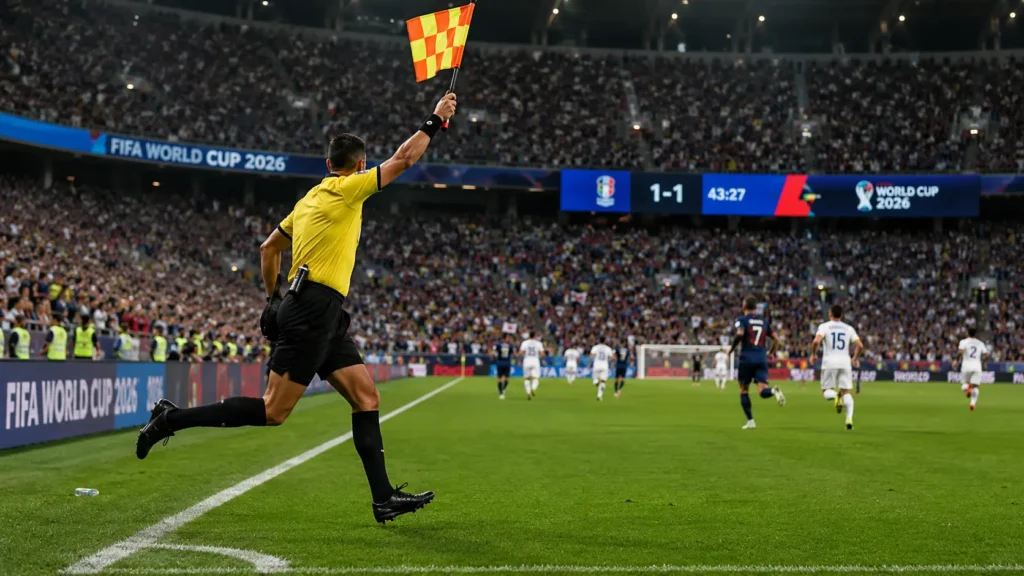
It’s the 43rd minute of USA vs. Australia at the 2026 World Cup. Alex Freeman heads the ball in. The flag goes straight up. Then the video check comes back: onside, goal.
Same offside rule as your local MLS game. Very different tools. That’s the whole story of offside in the Champions League, the World Cup and MLS, and it’s simpler than it looks.
Key Takeaways
- MLS, the Premier League, the Champions League and the World Cup all use the same Law 11.
- What changes is the technology: VAR with hand-drawn lines, or semi-automated offside technology.
- At the 2026 World Cup, FIFA used 16 optical tracking cameras in each of the 16 stadiums.
- Technology judges position; whether a player interfered with play is still a human call.
Who this guide is for: this guide is for American fans who watch more than one competition, from MLS on Saturday to the Champions League on Tuesday, and want to know if the offside rule in the Champions League differs from MLS or the World Cup. How we made it: we checked the rule against IFAB Law 11 and Law 5, and the technology details against FIFA and ESPN reports.
Is the offside rule different in different competitions?
No. Competitions do not write their own offside rule. The International Football Association Board (IFAB) writes the Laws of the Game, and Law 11 covers offside. MLS, the NWSL, the Premier League, UEFA and FIFA all follow it.
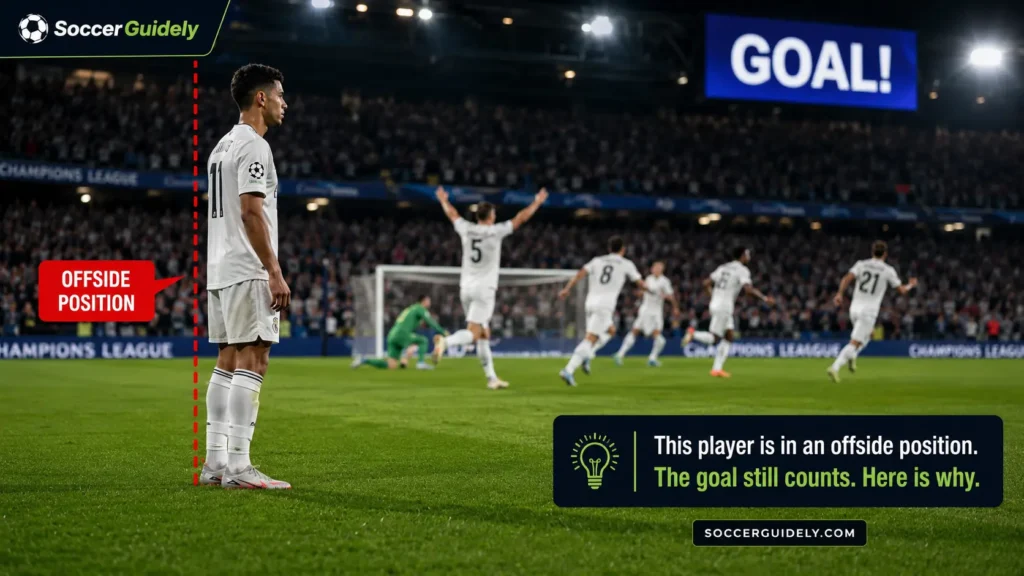
Under Law 11, a player is in an offside position if any part of the head, body or feet is in the opponents’ half and nearer to the opponents’ goal line than both the ball and the second-last opponent. The hands and arms of all players are not considered. Being in that position is not an offense by itself. The player is only penalized if they become involved in active play when a teammate plays or touches the ball.
It is not an offence to be in an offside position.
IFAB Laws of the Game, Law 11
New to the rule? Start with our full guide, What Is Offside in Soccer?, then come back here.
So what is different between MLS, the Champions League and the World Cup?
Three things can change from one competition to another: whether VAR is used, whether semi-automated offside technology is used, and how quickly a decision is shown to fans. The law stays the same.
| Competition | Offside rule | How offside is checked |
|---|---|---|
| MLS | IFAB Law 11 | Video assistant referee (VAR) reviews goals, including possible offside |
| Premier League | IFAB Law 11 | VAR plus semi-automated offside technology, introduced in April 2025 |
| UEFA Champions League | IFAB Law 11 | VAR plus semi-automated offside technology, used since the 2022/23 season |
| FIFA World Cup | IFAB Law 11 | VAR plus semi-automated offside technology, first used at Qatar 2022 |
| Youth and amateur soccer | IFAB Law 11 (with local youth modifications) | Usually only the referee and assistant referees, no video |
Since the 2026/27 edition of the Laws, IFAB’s Law 5 says competitions may use technology, including semi-automated offside technology, to help the referee make or change offside decisions. In other words, the technology is now written into the Laws as an option. Each competition decides whether to use it.
How does semi-automated offside technology work?
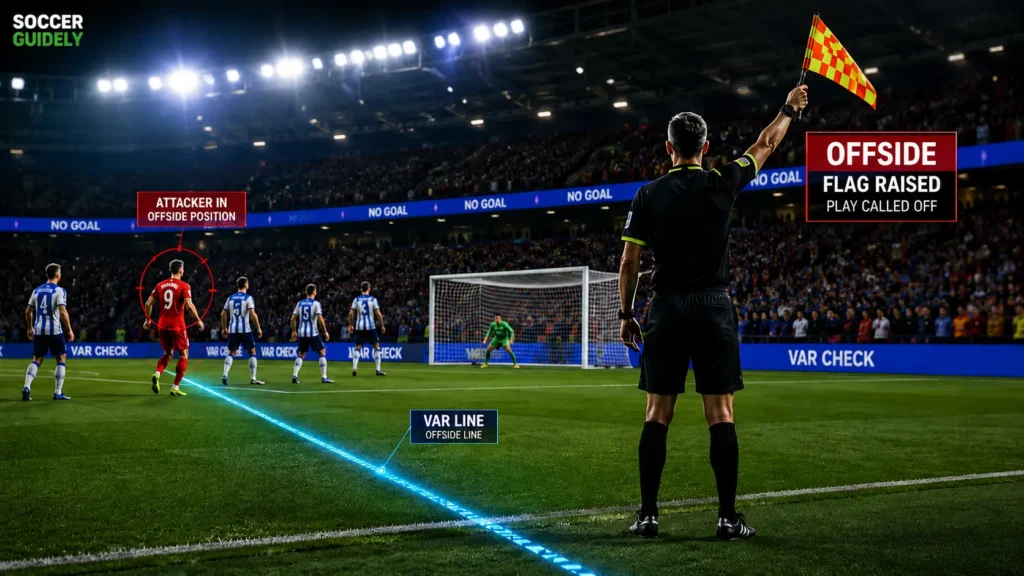
Semi-automated offside technology uses special cameras installed under the stadium roof. They track the ball and many points on every player’s body, many times per second. When a goal is scored and an attacker may have been offside, the system calculates the offside line at the moment the ball was played and alerts the video officials.
At the 2022 World Cup, FIFA said its system tracked 29 data points on each player 50 times per second, and the match ball carried a sensor to pinpoint the exact moment it was kicked. UEFA uses a camera-based system in the Champions League.
There is one important limit. The technology can tell officials where a player was. It cannot decide whether that player was actually involved in play. Whether an attacker was interfering with an opponent, for example, is still a human judgment made by the referee and the VAR. Our guide to active vs passive offside explains that part of the rule.
Why do some offside checks take so long?
Where only VAR is used, a video official has to find the exact frame when the ball was played, then place lines on the second-last defender and the attacker. Choosing the right frame and the right body part takes time, especially when players are level.
Semi-automated systems speed up the line-drawing part, so offside decisions in the Champions League or at the World Cup are often confirmed faster. If a decision also needs a judgment about involvement in play, the check can still take longer. You can learn more in our guides to VAR offside decisions and how VAR works.
What should American fans watch for in the Champions League this season?
The 2026/27 Champions League is in its league phase. Under the current format, 36 clubs each play eight league-phase matches. The top eight go straight to the round of 16, and the clubs placed ninth to 24th play a knockout play-off round. UEFA lists Matchday 5 for 24 and 25 November 2026.
- When a goal is checked, watch for the 3D graphic. It shows the attacker and the second-last defender at the moment the ball was played.
- Remember that the line is drawn from the body parts that can legally score. Arms do not count.
- If the graphic shows the attacker level, the goal stands. Level is onside.
- A long check usually means the officials are judging involvement in play, not just position.
For the competition itself, see our UEFA Champions League guide.
Does offside work the same way in MLS and women’s soccer?
Yes. MLS and the NWSL follow the same Law 11. A forward in Seattle, Manchester or Madrid is judged against the same second-last defender standard. Read our guide to MLS for how the league works, and offside in women’s soccer for the women’s game.
What happened with offside at the 2026 World Cup?
According to FIFA, the 2026 World Cup was the first to use its advanced semi-automated offside system. Clear offsides were sent straight to the officials on the field, so the assistant referee could flag right away instead of waiting on the video room. FIFA also said every player was 3D-scanned, and each of the 16 stadiums had 16 optical tracking cameras producing more than 150 million tracking data points per match.
The USMNT got a front-row seat. Against Australia on June 19, Freeman’s header was flagged offside on the field. Replays showed he was onside when Sergiño Dest shot, and the goal stood in a 2-0 win, as ESPN referee analyst Andy Davies explained. Two weeks later, the U.S. had two goals called back for offside against Bosnia and Herzegovina, including a Folarin Balogun finish where only the goalkeeper was between him and the goal, Yahoo Sports reported.
And people were watching. FIFA says a record 6,810,966 fans attended the 104 matches. The final, Spain’s 1-0 extra-time win over Argentina, averaged 62.8 million U.S. TV viewers across Fox and Telemundo/Peacock. NBC Sports noted that’s more than any 2025 NFL game except the Super Bowl.
How do the offside systems compare?
| System | Cameras | What it tracks | Where |
|---|---|---|---|
| FIFA semi-automated offside | 16 optical tracking cameras per stadium (2026) | Every player 3D-scanned; 150M+ data points per match | FIFA World Cup |
| UEFA semi-automated offside | 10 to 12 roof cameras | 29 data points per player at 50 frames per second | Champions League since 2022/23 |
| Premier League (Genius Sports) | About 30 iPhone cameras per stadium | 10,000 surface points per player at 100 frames per second | Premier League since April 2025 |
| VAR only | Broadcast cameras | Lines placed by hand by the video official | Many other leagues |
Camera numbers for UEFA and the Premier League come from ESPN’s April 2025 breakdown. Think of the 3D line like the yellow first-down line on an NFL broadcast, except this one is used to make the call, not just show it.
What most American fans don’t realize is that the margin isn’t identical everywhere. ESPN reported that the Premier League kept a tolerance of about 5 centimeters, giving the attacker the benefit of the doubt, while other competitions using the technology did not. Same Law 11, slightly different safety margin in practice.
What are the biggest myths about offside in big competitions?
Myth one: the Champions League or the World Cup has its own offside rule. Nope. IFAB writes Law 11, and everyone from MLS to FIFA follows it.
Myth two: the computer makes the call. Under Law 5, technology may help the referee, but the referee still decides. FIFA was clear that its 2026 system only judges position, not whether a player interfered with play. Myth three: a fast decision means nobody checked. Every goal is still reviewed. The tech just makes the line-drawing part quicker, and VAR still handles the judgment calls.
Try It: What to Watch on the Next Offside Check
Use this checklist the next time a goal is reviewed.
- Look at the 3D graphic and find the second-last defender first.
- Check only the attacker’s body parts that can score: head, body and feet, not arms.
- Remember that level is onside.
- If the check takes a long time, officials are usually judging involvement, not just position.
Frequently Asked Questions About Offside in Major Competitions
No. The Champions League uses IFAB Law 11, the same offside rule used in MLS, the Premier League and the World Cup. It adds semi-automated offside technology to help officials check close calls.
MLS uses the video assistant referee (VAR) to review goals, including possible offside. Check MLS’s official announcements for its current use of semi-automated offside technology.
UEFA introduced semi-automated offside technology in the Champions League in the 2022/23 season.
No. Technology can show where players were when the ball was played. Whether an attacker was involved in active play is still decided by the referee and the video officials.
The wording of Law 11 did not change for 2026/27. Law 5 now states that competitions may use technology, including semi-automated offside technology, to help with offside decisions.
Want plain-English rule guides like this when they drop? Join SoccerGuidely. It’s free, and we only send soccer.
Sources
- IFAB Laws of the Game: Law 11 Offside
- IFAB: Law changes 2026/27 (Law 5 technology)
- UEFA: 2026/27 Champions League format and dates
- UEFA: 2026/27 Champions League league phase fixtures
- ESPN: Champions League welcomes semi-automated offside
- ESPN: Semi-automated offside arrives in the Premier League
- TNT Sports: How semi-automated offside works
- FIFA: Semi-automated offside and innovation at the FIFA World Cup 2026 (June 3, 2026)
- FIFA: Spain crowned FIFA World Cup 2026 champions (July 20, 2026)
- ESPN: VAR review of Alex Freeman’s goal vs Australia (June 19, 2026)
- Yahoo Sports: How offside worked at World Cup 2026 (July 3, 2026)
- NBC Sports: More than 62 million U.S. viewers watched the 2026 World Cup final
- ESPN: Premier League semi-automated offside explained (April 12, 2025)