Written by the SoccerGuidely Editorial Team | Last updated: November 2026 | Checked against the IFAB Laws of the Game 2026/27
Quick Answer: The offside rule is the same for every player, but each position feels it differently. Strikers and wingers time their runs to start level with the second-last defender. Midfielders get caught arriving late. Defenders set the offside line and can step up to trap attackers. Goalkeepers count as opponents, which moves the line when they leave their goal.
Watch a striker just before a through ball. A half-step forward, a glance at the back line, a curl across the defender. It looks a lot like a wide receiver reading a cornerback. That little dance is all about how to avoid being offside, and every position on the field plays it a bit differently.
Key Takeaways
- Law 11 of the IFAB Laws of the Game is the same for every position. What changes is how often each role runs into it.
- Strikers and wingers stay onside by starting level with the second-last defender and timing their run to the moment of the pass.
- Defenders set the offside line, and the goalkeeper counts as one of the two opponents.
- Real example: at the 2026 World Cup, Folarin Balogun had a USMNT goal ruled out because only the goalkeeper was between him and the goal when the pass was played.
Who this guide is for: SoccerGuidely wrote this offside by position guide for American soccer fans, youth and adult players, and coaches who want to know how the offside rule affects strikers, wingers, midfielders, defenders and goalkeepers. Use it before a game, at practice, or any time an offside call on TV leaves you confused.
Does the offside rule change by position?
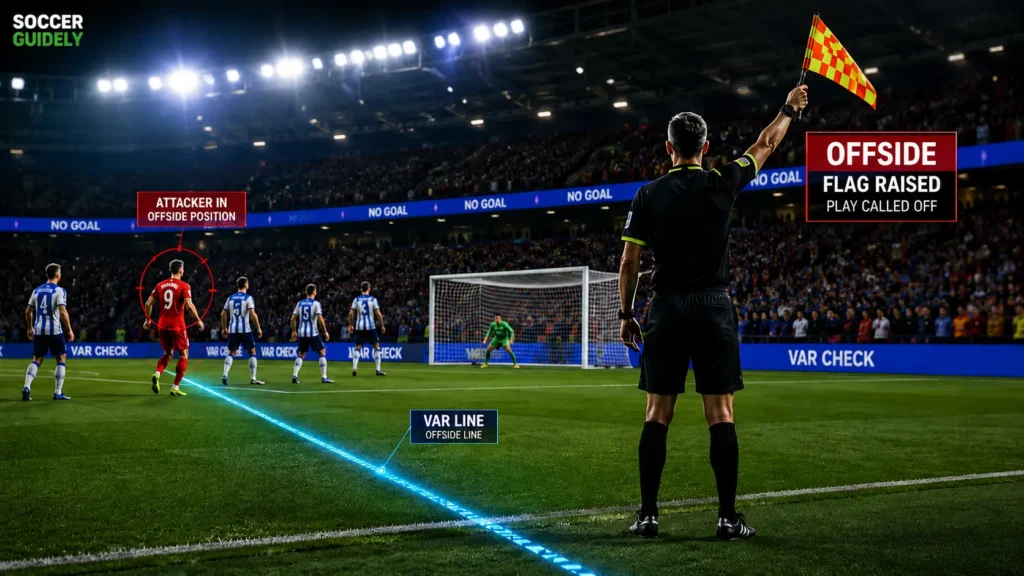
No. Law 11 applies to every outfield player and the goalkeeper in the same way. Any player in the opponents’ half who is nearer to the goal line than both the ball and the second-last opponent is in an offside position. What changes is how often each position faces the decision.
How do strikers stay onside?
The striker lives on the offside line. Their best goals often come from a run that starts level with the last defender and finishes behind them. Coaches commonly teach a few habits:
- Start level or slightly behind. Begin the run from a position level with, or just behind, the second-last defender. Level is onside.
- Time the run to the pass. The line is judged when the ball is played, so the burst should begin as the passer is about to release the ball, not before.
- Curve the run. Running across the line before turning forward helps a striker stay level until the pass arrives.
- Watch the defenders, not just the ball. Defensive lines often step up together. A striker who sees the step can drop back in time.
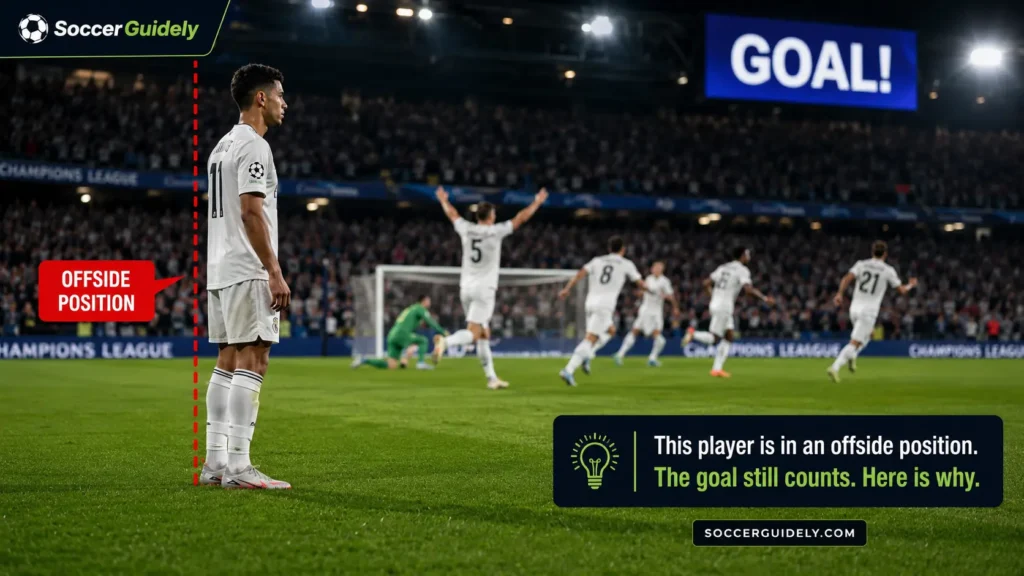
- If you are offside, do not touch it. Being in an offside position is not an offense. If you stay out of the play, a teammate can still score.
Attacker Defender Goalkeeper Dashed yellow line: second-last defender
How does offside affect wingers?
A winger starts wide, often near the touchline, so they can see the defensive line from the side. That helps them judge it. Wingers are often caught when they cut inside behind the full-back early, before the pass is played. Good wingers hold their position wide and only attack the space once the passer is ready.
When do midfielders get caught offside?
Midfielders are caught less often, but it does happen. The most common case is a late run into the box: a midfielder joins the attack, the defense steps up, and the midfielder is left beyond the line when the cross or through ball arrives. Attacking midfielders who make runs beyond the striker face the same timing challenge as forwards.
How do defenders use offside?
Center-backs and full-backs decide where the offside line is, because the line is set by the second-last defender. A well-organized back line can step up together to leave attackers in offside positions. This is the offside trap. It is risky: if one defender steps up late, they keep everyone onside.
Defenders cannot cheat the line by leaving the field. A defender who steps off the field without permission is still treated as standing on the goal line or touchline for offside.
Does the goalkeeper count for offside?
Yes. The rule refers to the second-last opponent, not the second-last outfield defender. Usually the goalkeeper is the last opponent, so the second-last is a defender. But if the goalkeeper comes far off their line, two outfield defenders may be the last two opponents. Then the offside line is set by whichever of them is nearer to the halfway line.
| Position | How offside affects it | Key habit |
|---|---|---|
| Striker | Faces the line on almost every attack | Start level, time the run to the pass |
| Winger | Caught cutting inside too early | Hold width, attack space late |
| Midfielder | Caught on late runs into the box | Watch the line as the defense steps up |
| Defender | Sets the offside line | Step up together, never alone |
| Goalkeeper | Counts as an opponent for the line | Know that coming off the line moves it |
What did the 2026 World Cup teach strikers about offside?
Timing beats speed. In the USMNT’s 2-0 win over Bosnia and Herzegovina, Folarin Balogun had a goal ruled out because, when Weston McKennie passed, the only Bosnian player between him and the goal was the goalkeeper, Yahoo Sports reported. Half a step later and it’s a highlight. That’s the striker’s whole job in one sentence.
Defenders had a new problem too. According to FIFA, the 2026 system sent clear offsides straight to the officials on the field, and every player was 3D-scanned for the replays. In the Premier League, ESPN reports the cameras track 10,000 surface points on every player, toes and knees included, 100 times a second. A back line that steps up together gets rewarded fast. One that steps up late gets exposed just as fast.
Here’s something many coaches teach that fans rarely notice: watch the passer, not just the ball. The run should start as the passer is about to strike, so the attacker is still level when the ball leaves the foot.
What are the common offside myths by position?
Myth: defenders can’t be offside. They can. Any player in the opponents’ half can, including a center-back who stays forward after a corner. Myth: the goalkeeper is always one of the “two defenders.” Not always. The rule counts opponents, so if the keeper charges out, two outfield players can be the last two.
Myth: a fast striker should just go early. Speed doesn’t help if the run starts too soon, because the line is judged at the pass. Our guide to the offside trap shows how defenders punish exactly that.
Try It: A 10-Minute Offside Drill for Any Position
Here’s a simple practice template coaches and players can use. You only need four cones and three players.
- Set two cones across the field to mark the offside line (the second-last defender).
- One player passes from midfield, one attacker makes the run, and one defender holds the line or steps up.
- The attacker must start level with the line and only accelerate as the passer is about to strike the ball.
- Call “onside” or “offside” out loud at the exact moment of the pass, then swap roles so everyone plays striker, winger and defender.
How We Built This Guide
The SoccerGuidely Editorial Team checked every rule in this guide against the official IFAB Law 11 text, reviewed referee analysis of real 2026 World Cup offside calls from ESPN and Yahoo Sports, and drew the striker diagram above ourselves so you can use it to teach a team. If a rule changes, we update this page and the date at the top.
Frequently Asked Questions About Offside by Position
Usually strikers, because they spend the most time on the defensive line and make the most runs in behind.
Start level with or slightly behind the second-last defender, time the run to the moment the pass is played, and watch the defenders as well as the ball.
Yes. Any player in the opponents’ half can be offside, including a defender who has joined an attack.
The rule uses the second-last opponent, which can be the goalkeeper or any outfield player.
Only if the midfielder is beyond both the ball and the second-last opponent when the ball is played, and then becomes involved in play.
Want plain-English rule guides like this when they drop? Join SoccerGuidely. It’s free, and we only send soccer.