Written by the SoccerGuidely Editorial Team | Last updated: November 2026 | Checked against the IFAB Laws of the Game 2026/27
Quick Answer: In the NFL, offside is a pre-snap foul: a player is in or beyond the neutral zone at the snap, and it costs 5 yards. In soccer, offside is about an attacker being beyond the ball and the second-last defender when a teammate passes, and then getting involved in play. The punishment is an indirect free kick, not yardage.
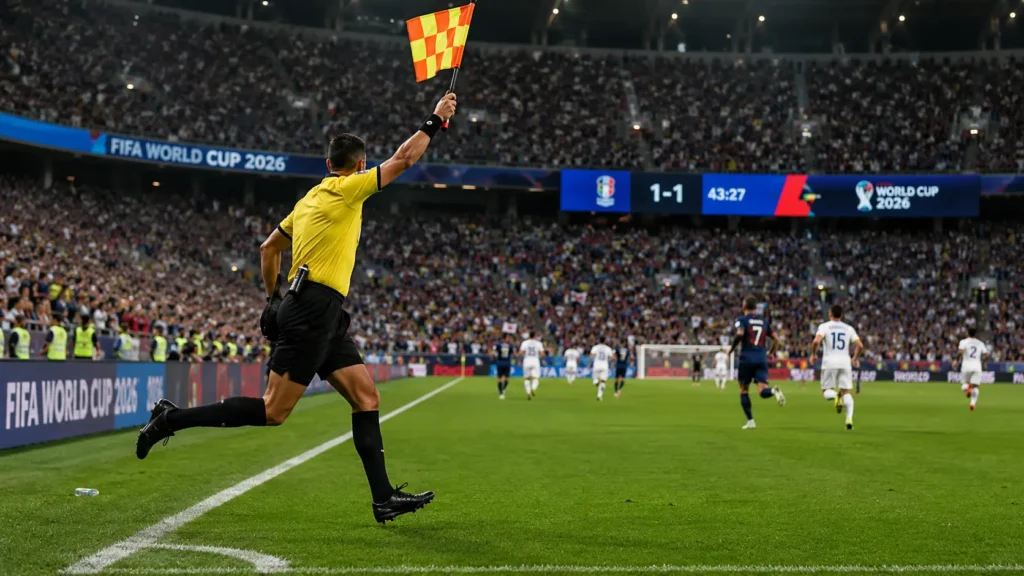
You know offside. Sunday afternoon, third-and-3, the defensive end jumps early. Yellow flag, five yards, done. Then you put on a soccer match, a striker scores a gorgeous goal, and a flag waves it off for “offside.” Same word. Totally different rule. Here’s soccer offside vs NFL offside, side by side.
Key Takeaways
- NFL offside is a pre-snap alignment foul that costs 5 yards.
- Soccer offside is judged when a teammate plays the ball, and the penalty is an indirect free kick.
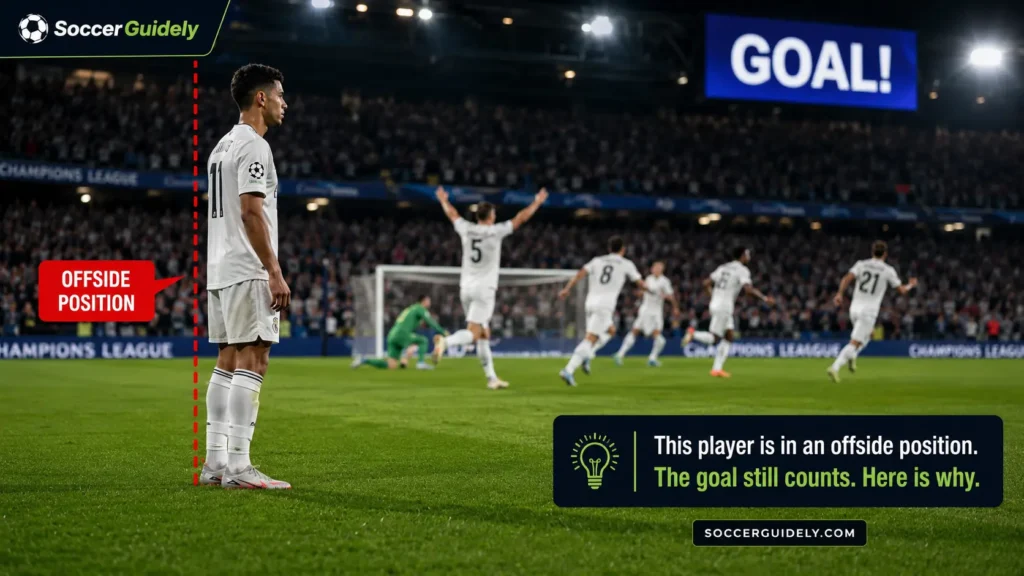
- In soccer, just being in an offside position is not a foul; the player has to get involved.
- The closest American comparison to soccer offside is hockey’s offside, not the NFL’s.
Who this guide is for: this soccer offside vs NFL offside guide is for football fans, fantasy players and anyone who grew up on Sunday NFL games and is now watching MLS, the Champions League or the national team. How we made it: we compared the official IFAB Law 11 text with the NFL’s own rules and checked our examples against real 2026 World Cup calls.
What is offside in the NFL?
In American football, offside is about alignment before the play starts. When the ball is snapped, players must be on their own side of the neutral zone, the space the length of the ball between the two lines of scrimmage. A player who is in or beyond the neutral zone at the snap is offside. It is most often called on the defense, and it costs 5 yards. Related calls such as encroachment and neutral zone infraction cover contact or movement into the neutral zone before the snap.
What is offside in soccer?
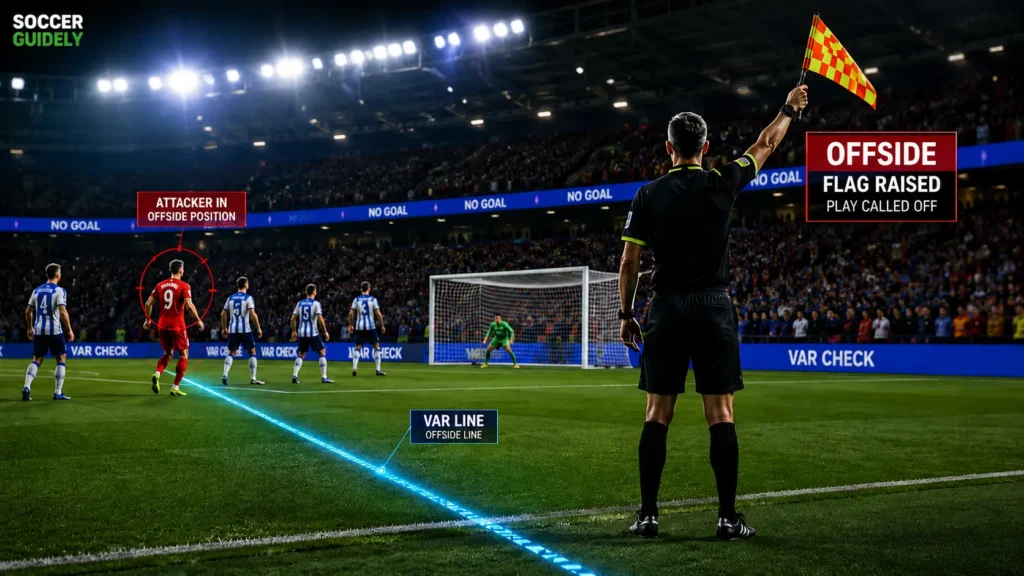
Soccer has no snap and no line of scrimmage. Play is continuous. Offside stops attackers from waiting next to the opponent’s goal for a long ball. A player is in an offside position if any part of the head, body or feet is in the opponents’ half and nearer to the goal line than both the ball and the second-last opponent. They are only penalized if they become involved in play when a teammate passes or touches the ball.
It is not an offence to be in an offside position.
IFAB Laws of the Game, Law 11
Soccer offside vs NFL offside, side by side
| NFL offside | Soccer offside | |
|---|---|---|
| When it is judged | At the snap | At the moment a teammate plays the ball |
| Who it usually affects | Defenders, before the play starts | Attackers, during open play |
| Reference point | The line of scrimmage / neutral zone | The ball and the second-last defender |
| Is position alone a foul? | Yes, if in or beyond the neutral zone at the snap | No, the player must become involved in play |
| Penalty | 5 yards | Indirect free kick to the other team |
| Purpose | A fair, simultaneous start to each play | Stop attackers waiting behind the defense |
Is there anything similar to soccer offside in American sports?
The closest comparison is hockey. In the NHL, attackers cannot enter the offensive zone ahead of the puck. Like soccer, the idea is to stop players camping in front of the goal. Soccer’s version is more complex because the line moves with the defenders rather than being painted on the field.
A football comparison that helps: think of soccer’s offside line as an invisible line of scrimmage that moves every second, set by the second-to-last defender. An attacker must be level with it, or behind it, when the pass is thrown.
Why does soccer call it offside?
Both sports grew from the same 19th-century English football games, and the word is usually traced to the old idea of a player being “off his side” of the ball. Over time the two sports developed in different directions, and the word now describes two different rules. Our guide to the history of the offside rule traces soccer’s version back to 1863.
Why does this matter more for American fans after World Cup 2026?
Because a lot of new fans showed up. According to NBC Sports, the 2026 World Cup final averaged 62.8 million U.S. viewers across Fox and Telemundo/Peacock, more than every 2025 NFL game except the Super Bowl. FIFA says a record 6,810,966 fans attended the tournament’s 104 matches. Plenty of those viewers were football fans hearing “offside” and picturing a lineman jumping early.
NPR even noted that some traditionalists felt the tournament’s hydration breaks made games feel like four quarters, the way an NFL or NBA game does. Offside didn’t change, though. It was the same Law 11 used in every league.
What do football fans get wrong about soccer offside?
The first mistake is thinking offside is about where you line up. Soccer has no snap, so position only matters at the moment a teammate passes. The second is thinking it’s a defensive penalty. In soccer it’s almost always called on attackers.
The third is the word itself. The Laws of the Game say “offside,” singular. “Offsides” is a football habit, and soccer people will notice. Not a big deal, but now you know.
What most American fans don’t realize is that soccer’s line is never set. In the NFL, the line of scrimmage is fixed before every play. In soccer, the second-last defender drags the line up and down the field every second, and the assistant referee has to run with it. That’s why it feels harder to call, because it is.
Try It: A Quick Quiz for Football Fans
Three questions to lock in the difference. Answers are in brackets.
- A defender is in the neutral zone at the snap. Which sport calls offside? (The NFL, 5 yards.)
- A soccer attacker is past the second-last defender when a pass is played but never touches the ball or affects anyone. Offside? (No.)
- What does the other team get for a soccer offside? (An indirect free kick, not yardage.)
Frequently Asked Questions About Soccer vs NFL Offside
No. NFL offside is a pre-snap alignment foul worth 5 yards. Soccer offside is about an attacker’s position when a teammate passes the ball, and it is punished with an indirect free kick.
Because its purpose is to stop attackers waiting behind the defense for a long pass. NFL offside is about players lining up correctly before the snap.
It is closer to hockey than to the NFL. Both stop attackers from getting ahead of the play, but soccer’s line moves with the defenders.
The official term in the Laws of the Game is “offside.” Many Americans say “offsides,” which comes from football, but “offside” is the correct soccer term.
The other team gets an indirect free kick from the place where the offside offense happened.
Want plain-English rule guides like this when they drop? Join SoccerGuidely. It’s free, and we only send soccer.
Sources
- IFAB Laws of the Game: Law 11 Offside
- NFL Football Operations: rules
- Pro Football Network: offsides vs encroachment
- NBC Sports: More than 62 million U.S. viewers watched the 2026 World Cup final
- FIFA: Spain crowned FIFA World Cup 2026 champions (July 20, 2026)
- NPR: Spain defeats Argentina in the 2026 World Cup final (July 19, 2026)