Written by the SoccerGuidely Editorial Team | Last updated: November 2026 | Checked against the IFAB Laws of the Game 2026/27
Quick Answer: Here’s the kid version: “When your teammate passes the ball forward, you need two players from the other team, usually the goalie and one defender, level with you or closer to their goal.” In U.S. youth soccer that follows U.S. Soccer’s Player Development Initiatives, 4v4 games have no offside, and it starts at U9 with a build-out line.
Your seven-year-old scores, sprints over, and the ref waves it off. “Wait, why didn’t it count?” Every soccer parent hits this moment. Here’s how to explain the offside rule for kids in one sentence, and when U.S. youth leagues actually start using it.
Key Takeaways
- One-sentence version for kids: you can’t hang around behind the other team’s last defender waiting for the ball.
- Under U.S. Soccer’s Player Development Initiatives, the youngest 4v4 games have no offside.
- Offside starts at U9 in 7v7, with a build-out line: no offside between the halfway line and the build-out line.
- Always check your own league, because rules can vary by state association.
Who this guide is for: this offside rule for kids guide is for soccer parents, volunteer coaches and young players in U.S. youth leagues. Use it before your child’s first season with offside, or any time a goal gets waved off at a game. How we made it: we checked the youth rules against U.S. Soccer’s Player Development Initiatives material and the IFAB Law 11 text, and wrote every explanation the way we would explain it to a seven-year-old.
How do you explain offside to a kid in one sentence?
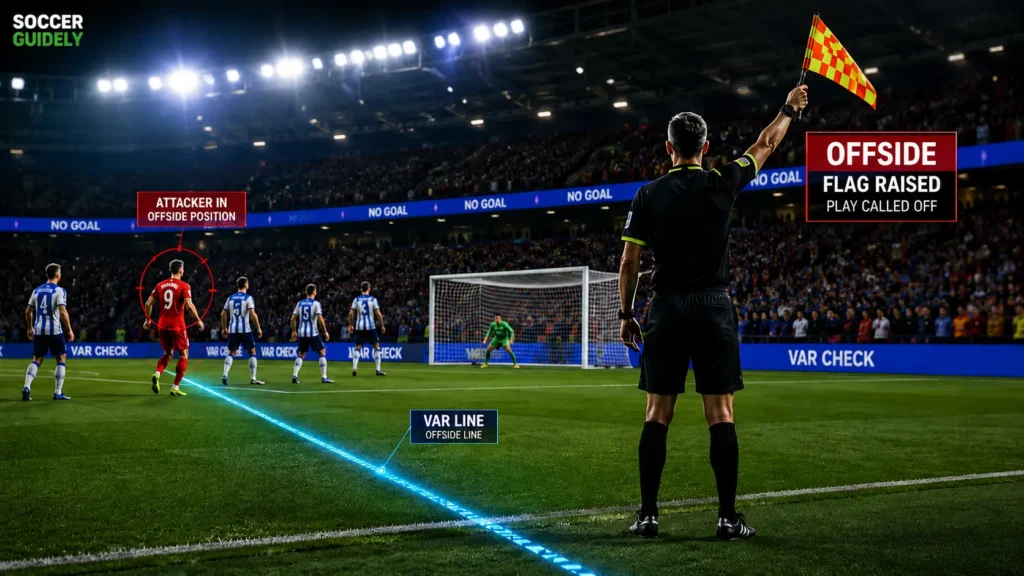
Try this: “You can’t hang around behind the other team’s last defender waiting for the ball.” Then add the detail when they are ready: it only matters at the moment a teammate passes the ball forward, and it only counts in the other team’s half.
What is a kid-friendly comparison for offside?
- The tag “safe spot.” Imagine a game of tag where one player waits right next to the safe spot. It is not fair. Offside stops a player from camping next to the other team’s goal.
- The line of cones. Tell your child to imagine a line of cones across the field at the last defender’s feet. When the pass is kicked, they must be on their side of the cones, or exactly on the line.
- The freeze test. When the pass is kicked, everyone “freezes.” If you are past the line in the freeze picture, you are offside.
When do kids start playing with offside in the U.S.?
Many American youth leagues follow U.S. Soccer’s Player Development Initiatives (PDI), which set small-sided game formats by age. Under these standards, offside is introduced gradually:
| Age group (typical) | Game format | Offside |
|---|---|---|
| U6 to U8 | 4v4 | No offside |
| U9 to U10 | 7v7 with a build-out line | Offside applies only between the build-out line and the goal line |
| U11 to U12 | 9v9 | Offside applies |
| U13 and older | 11v11 | Full offside rule |
Formats and rules can vary by state association and league, so check with your club. The table reflects U.S. Soccer’s PDI standards as published to state associations.
What is the build-out line?
In 7v7 games for U9 and U10, the field has a build-out line, usually halfway between the halfway line and the penalty area at each end. It encourages teams to play the ball out from the back. It also changes offside: a player cannot be penalized for offside between the halfway line and the build-out line, but can be penalized between the build-out line and the goal line.
Attacker Defender Goalkeeper Dashed yellow line: second-last defender
What are the most common offside mistakes kids make?
- Waiting by the goal. The classic. Teach players to stay level with the last defender until the pass is kicked.
- Running too early. They start the run before the passer kicks the ball.
- Thinking it is offside in their own half. It never is.
- Thinking a throw-in can be offside. There is no offside directly from a throw-in, goal kick or corner kick.
How can coaches and parents practice offside?
- Set out a line of cones across the field to mark the “last defender.”
- One player passes, one runs. Call “onside!” or “offside!” the moment the pass is kicked.
- Swap roles so every child is the passer, the runner and the defender.
- Finish with a small game where you, as the coach, call offside out loud and explain each one.
For more beginner help, see our guide to soccer for kids and the beginner soccer guides.
Why are so many kids asking about offside after the 2026 World Cup?
Because they watched. The 2026 World Cup final averaged 62.8 million U.S. TV viewers, NBC Sports reported, and FIFA says a record 6,810,966 fans attended matches across the U.S., Canada and Mexico. If your kid saw the USMNT have two goals called back for offside against Bosnia and Herzegovina, that’s a perfect moment to explain it.
And there are a lot of young players. According to US Youth Soccer, it registers about 2.68 million players a year across 54 state associations. US Youth Soccer, US Club Soccer and AYSO also announced a return to seasonal-year age groups in 2026, so check which age group your child is in before you worry about offside.
What do parents get wrong about offside?
The biggest one is yelling “offside!” at a U8 game. At 4v4 there isn’t any. Another is thinking the goalie doesn’t count. For offside, the goalie is one of the two opponents.
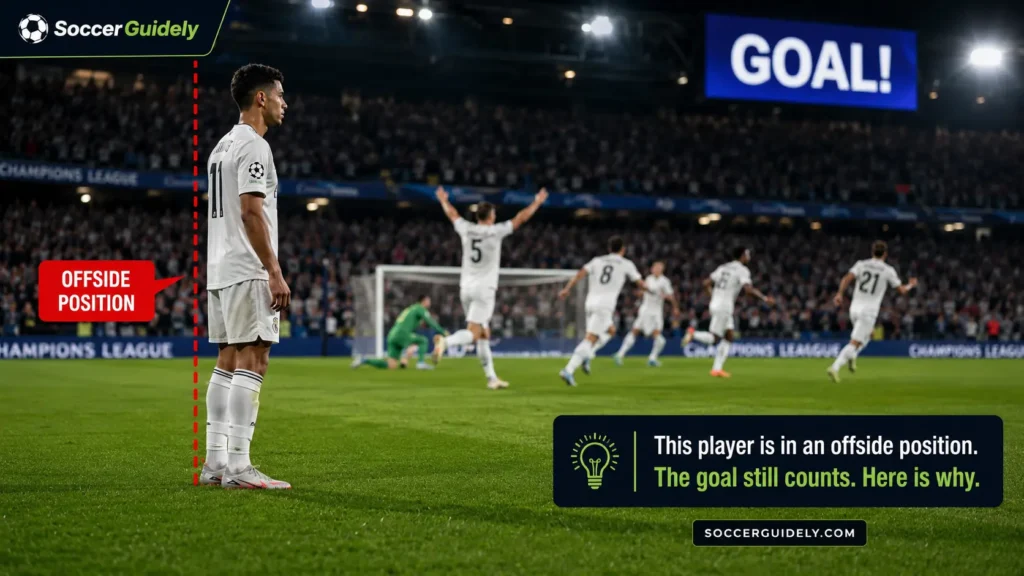
And plenty of parents think a kid standing in an offside spot is automatically in trouble. They’re not. It’s only an offense if they get involved when the ball is passed. For kids who love football, try this: offside is a bit like lining up past the line of scrimmage, except in soccer the line moves with the defenders.
Try It: A Quick Check for Parents
Test yourself before the next game. Answers are in brackets.
- Your U8 child scores while standing behind the last defender in a 4v4 game. Offside? (No. There’s no offside at 4v4.)
- Your U10 player is past the last defender but between the halfway line and the build-out line when the pass is made. Offside? (No. In 7v7, offside only applies between the build-out line and the goal line.)
- Your child receives a throw-in behind the defense. Offside? (No. There’s no offside directly from a throw-in.)
Frequently Asked Questions About the Offside Rule for Kids
Under U.S. Soccer’s Player Development Initiatives, offside begins at U9 in 7v7 games, with a build-out line. Younger 4v4 games have no offside. Check your league, as rules can vary.
Say: you can’t wait behind the other team’s last defender for the ball. When your teammate kicks the pass, you need to be level with, or behind, that defender.
A line used in 7v7 games for U9 and U10. Players cannot be offside between the halfway line and the build-out line, only between the build-out line and the goal line.
No. Nobody can be offside in their own half of the field.
No. There is no offside offense directly from a throw-in, a goal kick or a corner kick.
Want plain-English rule guides like this when they drop? Join SoccerGuidely. It’s free, and we only send soccer.
Sources
- IFAB Laws of the Game: Law 11 Offside
- U.S. Soccer Player Development Initiatives FAQ (via FYSA)
- NBC Sports: More than 62 million U.S. viewers watched the 2026 World Cup final
- FIFA: Spain crowned FIFA World Cup 2026 champions (July 20, 2026)
- Yahoo Sports: How offside worked at World Cup 2026 (July 3, 2026)
- US Youth Soccer: 2.68 million registered players (July 2025 release)
- US Youth Soccer: return to seasonal-year age groups in 2026