Written by the SoccerGuidely Editorial Team | Last updated: November 2026 | Checked against the IFAB Laws of the Game 2026/27
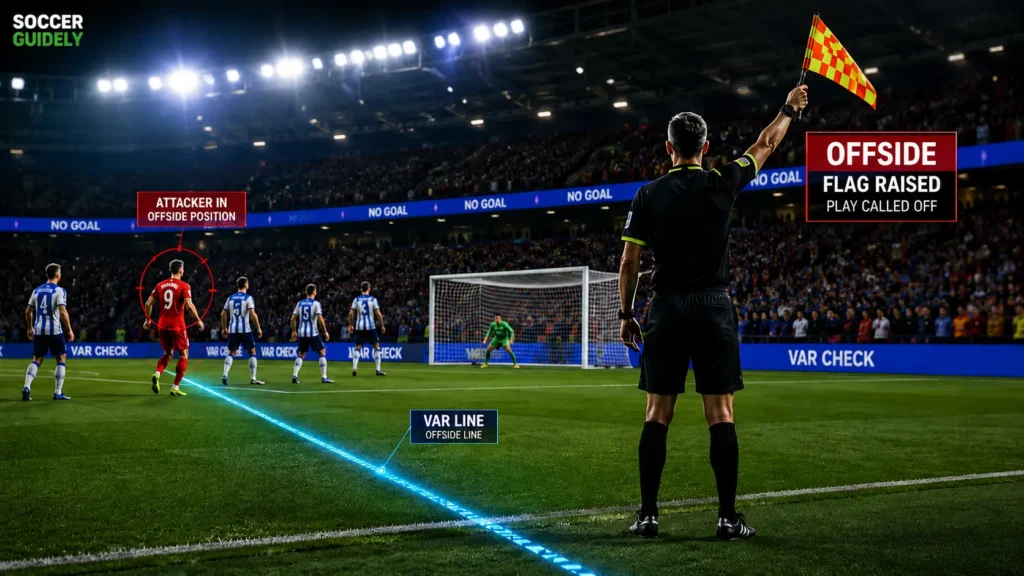
Quick Answer: Offside is easier to see than to read. In every offside rule diagram below, red attacks toward the goal on the right, and the dashed yellow line marks the second-last defender when the ball is played. A red attacker past that line and past the ball is in an offside position, but is only penalized if involved in play.
Offside calls happen in a split second, and the TV replay usually shows one frozen frame with a line across it. That frozen frame is exactly what these eight diagrams recreate. Each one has a plain-English verdict and the part of Law 11 that decides it, so the next time the line pops up on screen, you’ll know the answer before the referee does.
Key Takeaways
- Every diagram freezes the moment the pass is played, because that is when Law 11 judges offside.
- Level with the second-last defender is onside, and nobody can be offside in their own half or behind the ball.
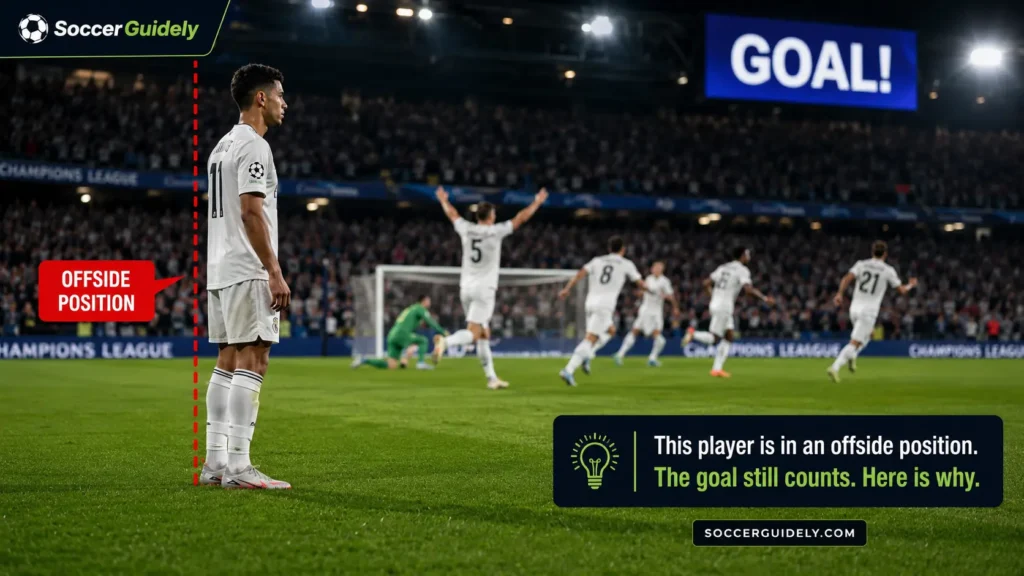
- Being in an offside position is not an offense until the player gets involved, for example by blocking the goalkeeper’s view.
- A rebound off the post or a deflection off a defender does not reset offside.
Who this guide is for: SoccerGuidely made this offside rule diagram guide for American fans, parents, youth coaches and new players who learn faster from pictures than from rulebook text. Use it to settle a call you saw on TV, or to teach a team at practice. How we made it: we drew all eight diagrams ourselves and checked each verdict against the official IFAB Law 11 text.
1. What does a basic offside position look like?
Attacker Defender Goalkeeper Dashed yellow line: second-last defender
2. Is level with the defender onside?
Attacker Defender Goalkeeper Dashed yellow line: second-last defender
3. Can you be offside in your own half?
Attacker Defender Goalkeeper Dashed yellow line: second-last defender
4. Can you be offside if you are behind the ball?
Attacker Defender Goalkeeper Dashed yellow line: second-last defender
5. Does the goalkeeper count as a defender?
Attacker Defender Goalkeeper Dashed yellow line: second-last defender
6. Is a player who does not touch the ball offside?
Attacker Defender Goalkeeper Dashed yellow line: second-last defender
7. Is blocking the goalkeeper’s view offside?
Attacker Defender Goalkeeper Dashed yellow line: second-last defender
8. Is it offside from a rebound off the post?
Attacker Defender Goalkeeper Dashed yellow line: second-last defender
What are the key rules behind all eight diagrams?
| Rule | What it means |
|---|---|
| Offside position | In the opponents’ half and nearer the goal line than the ball and the second-last opponent |
| Arms do not count | Hands and arms of all players are ignored; the arm ends at the bottom of the armpit |
| Level is onside | Level with the second-last opponent, or the last two, is not offside |
| Involvement | Penalized only for interfering with play, interfering with an opponent, or gaining an advantage |
| No offside restarts | Goal kick, throw-in, corner kick |
| Sanction | Indirect free kick where the offense happened |
How do the World Cup’s 3D replays compare to these diagrams?
Same idea, way more cameras. According to FIFA, every 2026 World Cup stadium had 16 optical tracking cameras producing more than 150 million tracking data points per match, and every player was 3D-scanned so the replays looked like the real players. The Premier League’s system, ESPN reports, tracks 10,000 surface points on each player at 100 frames per second.
All of that still boils down to diagram 1: where were the attacker, the ball and the second-last defender at the moment of the pass? Think of it like the yellow first-down line on an NFL broadcast, a simple graphic that makes a hard spot easy to read.
Diagram 7 is the one technology can’t settle alone. FIFA said its 2026 system only judges position. In the USMNT’s win over Australia, ESPN referee analyst Andy Davies said Folarin Balogun didn’t block the goalkeeper’s line of vision or physically disrupt him, so the goal stood.
Which offside myths do these diagrams bust?
Diagram 2 busts “level is offside.” Diagram 3 busts “you can be offside anywhere.” Diagram 6 busts “anyone in an offside spot is offside.” And diagram 8 busts the most stubborn one of all: that the ball touching a post, a keeper or a defender wipes the slate clean. Only a deliberate play by a defender does that.
Try It: Test Yourself on 3 Quick Calls
Cover the captions above and answer these. The diagram number tells you where to check.
- An attacker is level with the second-last defender when the pass is played. Offside or onside? (Onside, see diagram 2.)
- An attacker starts in their own half and runs past every defender before receiving the ball. Offside? (No, see diagram 3.)
- A shot hits the post and bounces to an attacker who was beyond the second-last defender when it was struck. Offside? (Yes, see diagram 8.)
Frequently Asked Questions About Offside Diagrams
Find the second-last defender when the ball is played and draw a line across the field there. An attacker in the opponents’ half who is past that line and past the ball is in an offside position.
Yes. A player level with the second-last opponent, or level with the last two opponents, is onside.
You need two opponents level with you or nearer their goal line. Usually that is the goalkeeper and one defender, but it can be any two opponents.
Not unless they interfere with an opponent, such as blocking the goalkeeper’s view, or gain an advantage.
Yes, you can share a link to this page with your team or parents. Please link back to SoccerGuidely rather than copying the images.
Want plain-English rule guides like this when they drop? Join SoccerGuidely. It’s free, and we only send soccer.