
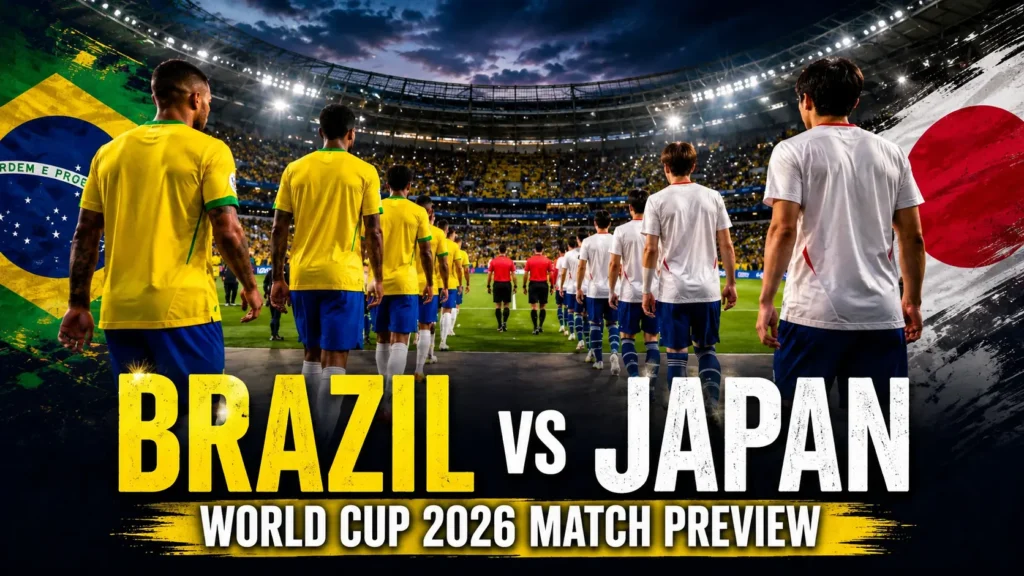
Brazil and Japan meet in the Round of 32 at the FIFA World Cup 2026, a knockout fixture that brings together two teams with sharply different football identities. The match is scheduled for 29 June 2026 at Houston Stadium in Houston, Texas, with kickoff listed for 1:00 PM EDT (17:00 UTC), although final operational confirmation of venue and scheduling details is still pending official tournament release.
Brazil arrive with the weight of expectation that usually follows them into World Cup knockout rounds. Their attacking depth and technical quality have placed them among the tournament favorites, and this stage now shifts attention toward execution under pressure rather than reputation. Japan, meanwhile, have earned their place in the knockout rounds through a disciplined and well-organized group-stage performance that reflected clarity in structure and consistency in approach.
What makes this fixture compelling is not just the contrast in pedigree, but the way both teams interpret control. Brazil lean toward individual creativity within structured possession, while Japan rely on collective movement and precise coordination. In knockout football, those differences often become sharper rather than softer.
Tournament Context
This Round of 32 fixture sits inside the first elimination phase of the expanded FIFA World Cup format, where every match is decisive. There is no margin for recovery here. A single result determines progression, and the losing side exits the tournament immediately.
If the match is level after 90 minutes, it moves into extra time and, if required, a penalty shootout. That structure tends to compress risk-taking, especially in games where both teams feel capable of controlling different phases.
Brazil’s presence in this round reflects their consistent positioning among international heavyweights, while Japan’s qualification continues a broader trend of strong tournament performances shaped by structure, organization, and tactical discipline.
Full confirmation of the knockout bracket alignment and operational scheduling remains subject to official FIFA release at the time of writing.
Team Analysis
Brazil
Brazil’s attacking identity continues to be shaped by fluid movement between midfield and forward lines, supported by technically secure defenders who are comfortable initiating possession. The build-up is rarely rushed. Instead, it is constructed through short passing sequences designed to draw opponents out of shape before accelerating into advanced zones.
There is often a clear emphasis on width. Wide players stretch the pitch, creating space for midfielders to receive between lines. From there, Brazil’s attacking game becomes more unpredictable, with quick combinations and individual duels in tight areas frequently deciding the rhythm of play.
Defensively, Brazil are flexible rather than fixed. They can settle into a compact mid-block, but also apply pressure higher up the pitch when triggers appear in opposition build-up. The challenge is less about defensive structure and more about transition control. When fullbacks push forward, space can open behind them if possession is lost at the wrong moment.
That balance between attacking commitment and defensive spacing often becomes a defining theme in knockout matches, where one transition sequence can change the entire tone of a game.
At the time of writing, no official updates regarding injuries or squad availability have been confirmed.
Japan
Japan’s football identity is built on structure, coordination, and constant collective movement. Their group-stage performances reflected a team that rarely loses shape, even when facing sustained pressure. Rather than relying on individual moments, their approach is grounded in synchronized positioning across all phases of play.
In possession, Japan tend to progress through controlled combinations, often using midfield circulation to move opponents laterally before finding vertical passing lanes. The tempo is measured, but not passive. There is a clear intention to advance the ball with purpose rather than simply retain it.
Out of possession, their organization is one of their strongest traits. The mid-block is compact, distances between lines are carefully managed, and pressing actions are triggered collectively rather than individually. This makes them difficult to break down through central areas, particularly when structure is intact.
Their transition moments stand out. When possession is regained, Japan often move quickly into forward positions with coordinated support runs. It is less about direct long-ball counterattacks and more about structured acceleration into space before the opposition can reset.
Where challenges can emerge is in defending sustained pressure close to their own penalty area. Against teams capable of controlling territory for long spells, maintaining compactness without conceding dangerous zones becomes a demanding task.
No official squad changes or availability updates have been confirmed.
Tactical Matchup
The tactical shape of this match is defined by contrast rather than similarity. Brazil’s structured possession and attacking width will meet Japan’s compact defensive organization and disciplined spacing.
Brazil are likely to spend long phases circulating the ball in midfield zones, looking to shift Japan’s block horizontally before finding entry points between the lines. The key question is whether they can sustain progression without becoming predictable in central buildup patterns.
Japan’s response will not rely on constant pressing. Instead, pressure is likely to be applied in carefully selected moments, particularly when Brazil attempt vertical passes into midfield or when receivers turn under pressure. That selective approach is designed to disrupt rhythm rather than dominate possession.
The midfield becomes the central reference point of the match. Brazil want control through technical circulation and positional rotation. Japan aim to compress space, close passing lanes, and force play into wider areas where defensive numbers can shift more easily.
Wide zones carry their own tension. Brazil’s attacking width can stretch Japan’s shape, but those same areas can become transitional spaces if possession is lost with players committed forward. Japan’s ability to recognize and exploit those moments will influence how open the match becomes.
Set pieces may also carry weight in a fixture where structured attacks are likely to face resistance in open play.
Players to Watch
Brazil’s attacking midfielders will be central to how effectively they break through Japan’s compact structure. Their movement between lines is not just about chance creation, but about pulling defenders out of position to open passing corridors for others.
The central midfield role is equally important. The player operating in deeper progression phases will dictate how quickly Brazil can move from circulation into penetration. If that rhythm slows, Japan’s defensive shape becomes significantly harder to disrupt.
For Japan, the midfield unit is the foundation of everything. A press-resistant midfielder capable of receiving under pressure and releasing the ball quickly becomes essential against Brazil’s structured pressing moments.
Their wide players also carry significant responsibility. Defensively, they must track Brazil’s width. In possession, they provide the first layer of transition support when space opens after turnovers.
Japan’s goalkeeper, often involved in early build-up phases, plays a quieter but important role in maintaining composure when Brazil apply higher pressure.
Key Battles
The match is likely to be shaped by how Brazil’s controlled buildup interacts with Japan’s disciplined mid-block. If Brazil can consistently find players between the lines, Japan will be forced to shift deeper than planned.
In wide areas, Brazil’s attacking structure meets Japan’s defensive mobility. Those zones will determine whether the match remains compact or begins to stretch vertically and horizontally.
Transition moments sit just beneath the surface of both approaches. Brazil’s advanced positioning creates opportunity, but also risk. Japan’s efficiency in those moments is one of their most consistent threats.
Midfield control, however, remains the defining layer. Whoever dictates tempo there will indirectly shape how the rest of the pitch behaves.
Storylines
This is a meeting of contrasting football philosophies at a decisive knockout stage. Brazil’s tradition of attacking creativity faces a Japan side that has steadily built its reputation on structure, discipline, and tactical cohesion.
There is also a broader narrative around evolution. Brazil continue to balance flair with control in modern tournament football, while Japan’s progress reflects a system built on collective intelligence rather than individual reliance.
In a single-elimination format, those identities are tested under pressure rather than theory.
Match Details
- Competition: FIFA World Cup 2026
- Stage: Round of 32 (Knockout Stage)
- Match: Brazil vs Japan
- Date: 29 June 2026
- Kickoff Time: 1:00 PM EDT (17:00 UTC) unconfirmed pending official schedule release
- Venue: Houston Stadium pending official confirmation
- City: Houston, Texas
- Country: United States
Match Outlook
Brazil vs Japan enters the knockout stage as a tactical contrast built around possession structure against collective discipline. Brazil’s ability to control territory and create consistent attacking sequences will be tested by Japan’s compact organization and carefully timed pressing actions.
The match is likely to be defined by small margins rather than large swings. Midfield control, transition efficiency, and defensive spacing under pressure all sit at the center of how the game develops. Neither side can afford extended lapses in structure, particularly in a single-elimination setting where momentum can shift quickly.
What emerges is a contest shaped less by narrative expectation and more by execution across different phases of play.