Written by the SoccerGuidely Editorial Team | Last updated: November 2026 | Checked against the IFAB Laws of the Game 2026/27
Quick Answer: The assistant referee is the sideline official who watches for offside. They stay level with the second-last defender, or with the ball if it is nearer the goal line, and raise the flag when an attacker in an offside position gets involved in play. In VAR games, they often wait on close calls until the attack ends.
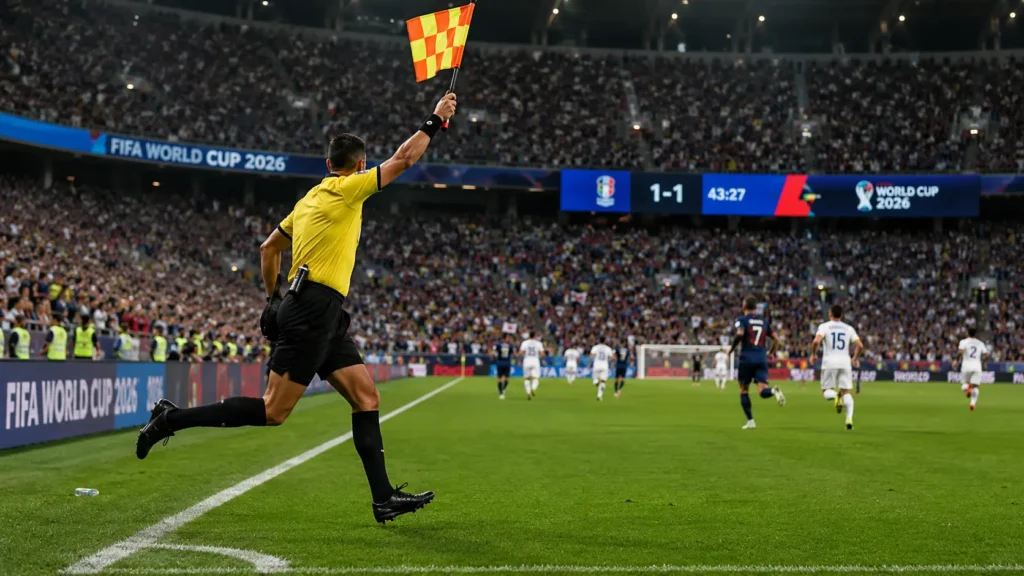
Watch the sideline instead of the ball for one attack. You’ll see the assistant referee sliding up and down the touchline like a cornerback mirroring a receiver, eyes locked on the back line. Most offside calls, from a U12 game to the World Cup final, start with that person and a flag.
Key Takeaways
- The assistant referee signals offside, and the referee makes the final decision under Law 6.
- The assistant stays in line with the second-last defender, or with the ball if it is nearer the goal line.
- In VAR competitions, assistants often delay the flag on close calls so a correct goal isn’t lost.
- At the 2026 World Cup, FIFA sent clear offsides from its tracking system straight to the officials on the field.
Who this guide is for: this assistant referee offside guide is for fans who want to read the sideline, new referees and assistant referees, and coaches who want to know why a flag went up late. How we made it: we checked the signals and positioning against the IFAB Laws and IFAB’s guidelines for match officials, and used ESPN’s referee analysis for the World Cup example.
Who calls offside, the referee or the assistant?
Under Law 6, assistant referees help the referee by indicating when a player in an offside position may be penalized. The referee makes the final decision. In practice, the assistant has the best view of the offside line, so the referee nearly always relies on the flag.
Each assistant covers one half of the field, on one touchline. That way, there is always one assistant looking across the defensive line at each end.
Where does the assistant referee stand?
To judge offside, the assistant needs to see the attacker and the second-last defender in a straight line across the field. That is why the AR moves up and down the touchline to stay level with the second-last defender. When the ball is closer to the goal line than the second-last defender, the AR stays level with the ball instead.
Attacker Defender Goalkeeper Dashed yellow line: second-last defender
What do the assistant referee’s flag signals mean?
IFAB’s guidelines for match officials describe the offside signal in two steps:
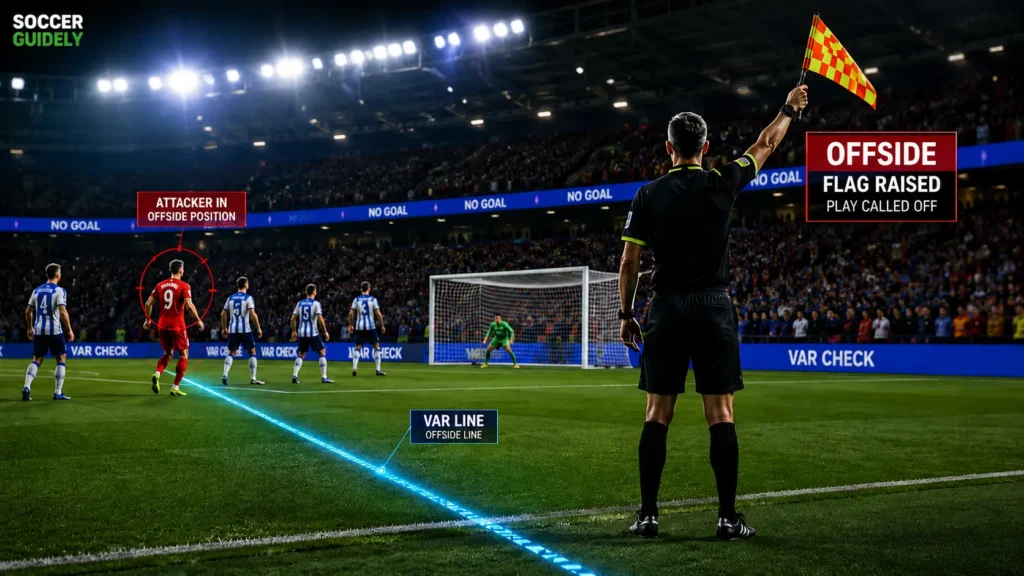
- Raise the flag. The assistant raises the flag, using the right hand, which gives a better line of vision across the field.
- Show where it happened. If the referee stops play, the assistant uses the flag to indicate the area of the field where the offense occurred.
If the referee does not see the flag straight away, the assistant must keep signaling until the referee acknowledges it, or until the ball is clearly in the control of the defending team. Showing the area matters because Law 11 says the indirect free kick is taken where the offense occurred, even if that is in the player’s own half.
The first action of the AR for an offside decision is to raise the flag.
IFAB Guidelines for Match Officials
What is the delayed flag, and why do assistants wait?
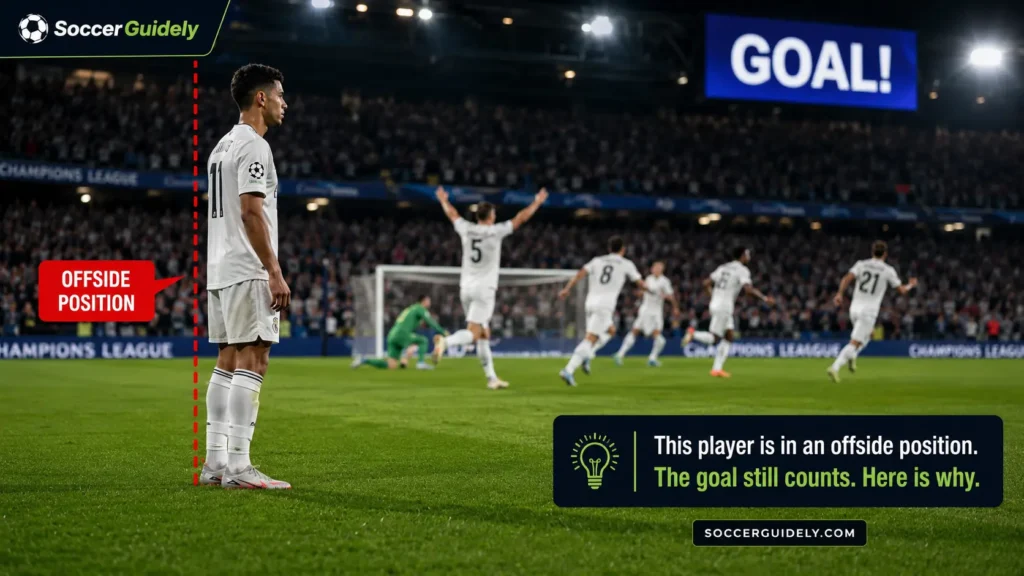
In competitions that use VAR, assistants are instructed not to raise the flag straight away on tight offside calls when an attack is about to produce a goal or a clear chance. They let play continue and raise the flag once the move is over.
The reason is simple. If the assistant flags too early and is wrong, the referee stops play and a legitimate goal can never be scored. VAR cannot bring back an attack that was already stopped. If the assistant waits and the goal is scored, VAR can still check the offside and rule the goal out if needed. The Premier League introduced this delayed-flag guidance for its assistants for the 2020/21 season.
Delayed flags can feel strange for fans: play goes on for several seconds, a goal is scored, and only then does the flag go up. It is deliberate. For clearly offside players, assistants still flag immediately.
What happens when the assistant is not sure?
Referee guidance gives the benefit of the doubt to the attacker. UEFA’s instruction to its assistants is that if they are not totally sure about an offside offense, they should not raise the flag. This is one reason close calls without video review often go the attacker’s way.
Can an assistant referee get offside wrong?
Yes. Offside is one of the hardest calls in sports. The assistant must watch the moment the ball is played by one player while also watching the position of two other players who may be 30 yards away. At top speed, players can move more than a yard in a fraction of a second. That is exactly why video review and semi-automated technology now support assistants in top competitions.
If you want to try the job yourself, our guide to becoming a soccer referee explains how refereeing careers work in the United States.
How did technology change the assistant’s job at the 2026 World Cup?
A lot. According to FIFA, the 2026 World Cup was the first where clear offsides from its semi-automated system were sent directly to the officials on the field. “Instantly, the assistant referees can flag for positional offsides,” said FIFA Director of Innovation Johannes Holzmüller. At Qatar 2022, that information went to the video room first.
FIFA was also clear about the limit. The system only handles position. Whether a player in an offside position interfered with play is still a human call, made by the officials and the VAR.
What does a real World Cup offside call look like?
Take the USMNT’s 2-0 win over Australia on June 19, 2026. Sergiño Dest’s shot was blocked and looped into the air. Alex Freeman got there first and headed it in. The assistant flagged offside.
VAR reviewed it, and the replays showed Freeman was onside when Dest shot, so the goal counted. ESPN referee analyst Andy Davies called it the correct intervention and said he was surprised the flag went up at all. Here’s the thing: because the ball was already in the net, the mistake could be fixed. A whistle that stops a breakaway can’t be undone, which is exactly why assistants delay the flag on close calls.
What most American fans don’t realize is how much this job is about angle, a lot like a baseball umpire on the bases. An assistant who is a yard out of line with the defenders can see an onside player as offside. That’s why IFAB’s guidelines tell assistants to stay in line with the second-last defender.
What are the common myths about the assistant referee?
The most common myth is that the referee in the middle calls offside. Under Law 6, the assistant indicates it and the referee makes the final decision, but the referee almost always goes with the flag. Another myth: a late flag means the assistant missed it. In VAR competitions, the late flag is usually on purpose. And “linesman” isn’t a different job. It’s just the old name.
Try It: Watch the Assistant Referee for One Attack
Next time you watch a match, try this for a few minutes.
- Pick one assistant referee and watch only them for a full attack, not the ball.
- Notice how they stay level with the second-last defender as the line moves.
- When a pass is played, guess onside or offside before the flag goes up, or doesn’t.
- If the flag goes up late after a goal, that’s usually the delayed flag, not a mistake.
Frequently Asked Questions About the Assistant Referee and Offside
The assistant referee signals when a player in an offside position may be penalized, and the referee makes the final decision. In practice the referee usually follows the assistant’s flag because the assistant has the best view.
In VAR competitions, assistants are told to delay the flag on close calls during a promising attack. If a goal is scored, VAR can check it. If they flagged early and were wrong, the goal could never happen.
IFAB’s guidelines say the assistant raises the flag with the right hand because it gives a better line of vision. After the referee stops play, the flag is used to show the area of the field where the offside happened.
In line with the second-last defender, or level with the ball when the ball is closer to the goal line.
Yes. “Linesman” is the old name. The Laws of the Game now call them assistant referees.
Want plain-English rule guides like this when they drop? Join SoccerGuidely. It’s free, and we only send soccer.
Sources
- IFAB Laws of the Game: Law 11 Offside
- IFAB Laws of the Game: Law 6 The Other Match Officials
- IFAB Guidelines: assistant referee signals
- IFAB Guidelines: assistant referee positioning
- Premier League: delayed offside flag guidance
- UEFA: referee and assistant referee conclusions
- FIFA: Semi-automated offside and innovation at the FIFA World Cup 2026 (June 3, 2026)
- ESPN: VAR review of Alex Freeman’s goal vs Australia (June 19, 2026)