Written by the SoccerGuidely Editorial Team | Last updated: November 2026 | Checked against the IFAB Laws of the Game 2026/27
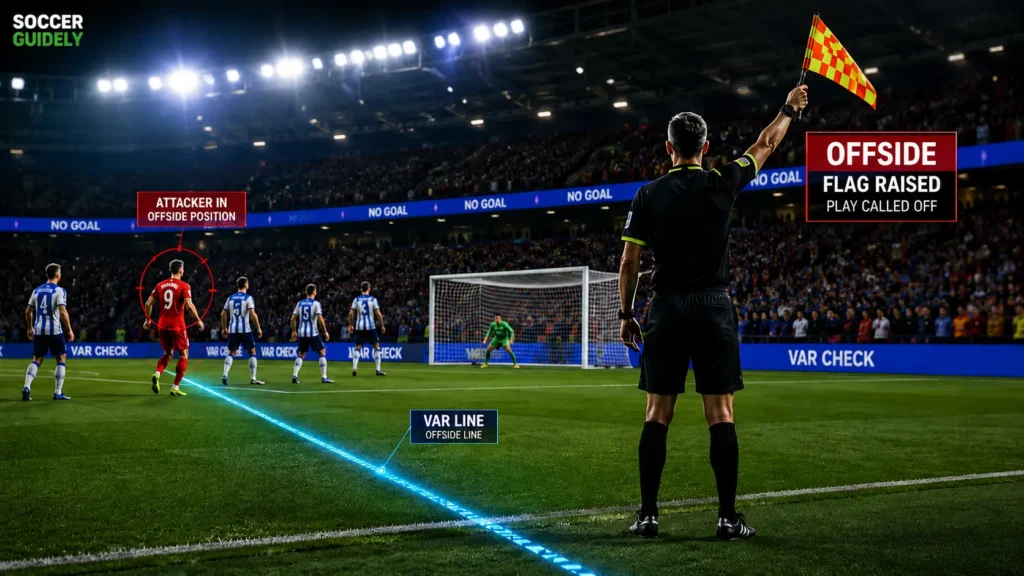
Quick Answer: The current offside rule for 2026/27 matches last season. You’re in an offside position if a body part you can score with is beyond the ball and the second-last opponent in their half when a teammate plays it. The real change is in Law 5, which now lets competitions use semi-automated offside technology. The “daylight” idea is not law.
Every summer someone posts “the offside rule is changing!” and every summer half of it is wrong. This page sorts out the current offside rule for 2026/27: what IFAB actually changed, what stayed the same, and what you saw at the 2026 World Cup. We update it each season, so you don’t have to dig through the rulebook.
Key Takeaways
- Law 11 did not change for 2026/27.
- Law 5 now lets competitions use technology, including semi-automated offside technology, for offside decisions.
- The daylight idea is only a trial, run in the Canadian Premier League in 2026, and is not part of the Laws.
- Level with the second-last opponent is still onside, and arms still don’t count.
Who this guide is for: this current offside rule guide is for fans, coaches, referees and players who want to know exactly which offside rule applies this season in MLS, the Premier League, the Champions League and youth soccer. How we made it: we compared the IFAB 2026/27 Laws and law changes with last season’s text, and we update this page each time IFAB publishes new Laws.
Did the offside rule change for 2026/27?
The text of Law 11 itself was not changed in the 2026/27 edition. Everything in the offside law that applied last season still applies:
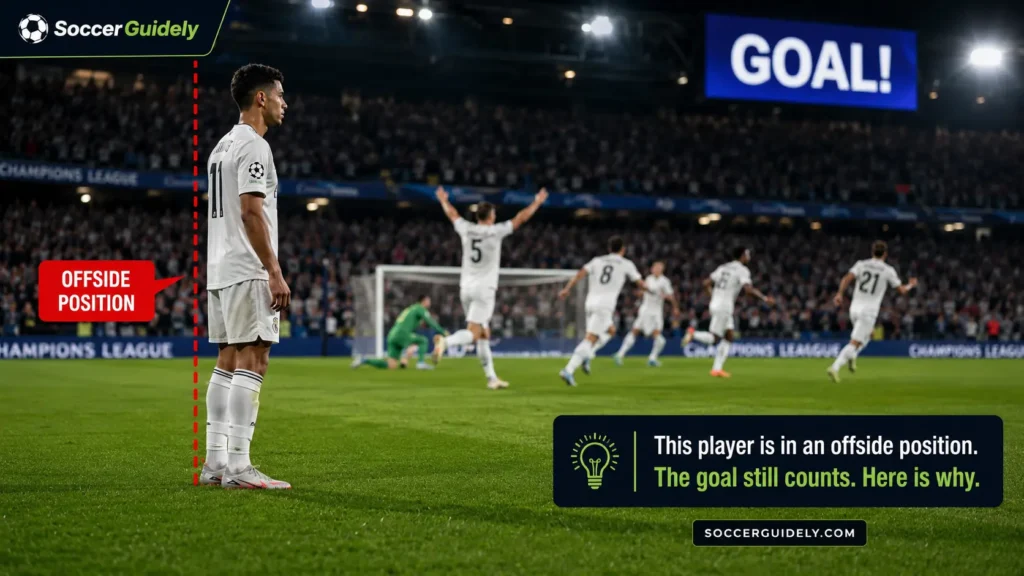
- Being in an offside position is not an offense.
- Any part of the head, body or feet counts. The hands and arms of all players, including goalkeepers, do not count. The upper limit of the arm is the bottom of the armpit.
- A player level with the second-last opponent, or level with the last two opponents, is onside.
- Offside is judged at the moment a teammate plays or touches the ball.
- There is no offside offense directly from a goal kick, a throw-in or a corner kick.
- The sanction is an indirect free kick where the offense happened.
A player is not in an offside position if level with the second-last opponent or last two opponents.
IFAB Laws of the Game, Law 11
What did change? Technology is now written into the Laws
The 2026/27 changes to Law 5 (The Referee) list the areas where competitions may use technology to help the referee make or change decisions. Offside is one of them, including through semi-automated offside technology (SAOT). IFAB explains that bringing this option into Law 5 also prohibits any unofficial use of technology by match officials.
In plain terms: semi-automated offside is now an official, allowed tool. It is not required. A competition can choose to use it, as the Champions League and the World Cup already do. Our guide to VAR offside decisions explains how video review works today.
What about the “daylight” or “Wenger” offside rule?
You may have read about a proposal, often linked to FIFA’s Arsène Wenger, under which an attacker would only be offside if their whole body is beyond the second-last defender. Under the current law, any scoring body part beyond the line is enough.
That proposal is not part of the 2026/27 Laws of the Game. IFAB has said that offside trials will continue, and in March 2026 it approved a daylight trial in the Canadian Premier League for the 2026 season, theScore reported. But a trial is not a change to the law. Until IFAB publishes a new Law 11, the current rule applies in MLS, the Premier League, the Champions League and the World Cup.
| Topic | Status in the 2026/27 Laws |
|---|---|
| Law 11 offside position and offense | Unchanged |
| Semi-automated offside technology | Now listed in Law 5 as a technology competitions may use |
| “Daylight” / whole-body offside | Not in the Laws. Discussed and trialled, not adopted |
| VAR review of offside | Offside is checked as part of goal and penalty decisions |
What does the current rule mean in a real game?
Attacker Defender Goalkeeper Dashed yellow line: second-last defender
Offside is decided by where players are at the exact moment the pass is made, not where they are when they receive the ball. Our guide to offside timing goes deeper into this.
How will this page stay current?
IFAB normally confirms changes at its annual general meeting in the spring, and the new Laws apply from the start of the following season. When the 2027/28 Laws are published, we will update this page with exactly what changed, using IFAB’s own documents as the source.
How was the current offside rule used at the 2026 World Cup?
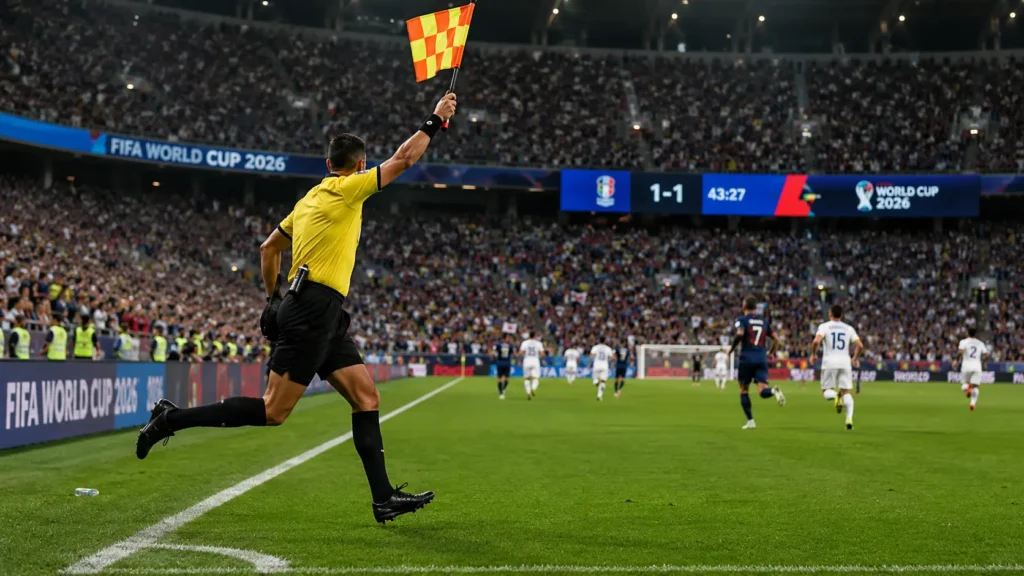
The 2026 World Cup was the first big test of the rule plus the new tech. According to FIFA, clear offsides were sent straight to the officials on the field, every player was 3D-scanned, and each stadium had 16 optical tracking cameras producing more than 150 million data points per match. FIFA said the system only covers positional offside, which fits Law 11: being in an offside position isn’t an offense until the player gets involved.
FIFA says the tournament drew a record 6,810,966 fans across 104 matches and produced 308 goals. Some of the goals that didn’t count tell the story best. The U.S. had two goals called back for offside against Bosnia and Herzegovina, while Alex Freeman’s goal against Australia was flagged on the field and then given after the VAR check.
What most American fans don’t realize is that the 2026/27 update didn’t make offside stricter. It only made the tool official. The line sits exactly where it sat last season. It’s a bit like NFL rule proposals: plenty get debated every off-season, but only the ones that are voted in reach the rulebook.
What do fans still get wrong about the current rule?
First, arms. Hands and arms never count, and the cut-off is the bottom of the armpit. Second, “level is offside.” It isn’t. Level is onside, always has been under the current law.
Third, deflections. A lot of fans think any touch by a defender resets offside. Only a deliberate play does. A deflection, a rebound or a save doesn’t. Our guide to offside edge cases walks through each one.
Try It: Is This Still the Rule in 2026/27?
Quick checks against the current Laws. Answers are in brackets.
- A striker’s arm is past the last defender but the rest of the body is level. (Onside. Arms don’t count.)
- A league uses semi-automated offside technology. Is that allowed? (Yes. Law 5 now lists it as an option.)
- An attacker is offside by a few inches with no daylight between them and the defender. Offside under the current Laws? (Yes. Daylight is only a trial.)
Frequently Asked Questions About the Current Offside Rule
A player is in an offside position if any part of the head, body or feet is in the opponents’ half and beyond both the ball and the second-last opponent. They are only penalized if they become involved in active play when a teammate plays the ball.
Law 11 was not changed in the 2026/27 Laws. Law 5 now states that competitions may use technology, including semi-automated offside technology, for offside decisions.
No. The whole-body or “daylight” proposal is not part of the 2026/27 Laws of the Game.
No. The hands and arms of all players, including goalkeepers, are not considered. The upper boundary of the arm is the bottom of the armpit.
IFAB publishes law changes each year, and they normally apply from 1 July or the start of the next competition season.
Want plain-English rule guides like this when they drop? Join SoccerGuidely. It’s free, and we only send soccer.
Sources
- IFAB Laws of the Game: Law 11 Offside
- IFAB: Law changes 2026/27
- FIFA: Semi-automated offside and innovation at the FIFA World Cup 2026 (June 3, 2026)
- FIFA: Spain crowned FIFA World Cup 2026 champions (July 20, 2026)
- Yahoo Sports: How offside worked at World Cup 2026 (July 3, 2026)
- ESPN: VAR review of Alex Freeman’s goal vs Australia (June 19, 2026)