Written by the SoccerGuidely Editorial Team | Last updated: November 2026 | Checked against the IFAB Laws of the Game 2026/27
Quick Answer: The trickiest offside calls come down to three questions in Law 11. Did a defender deliberately play the ball? That resets offside, but a deflection or a save does not. Was a defender off the field? They still count, as if on the goal line. And did the attacker actually get involved in play? Answer those and you win.
You’re at a watch party. The ball pinballs off a defender, your striker taps it in, and the flag goes up. Half the room screams “it came off their guy!” The other half just shrugs. These are the tricky offside situations that start arguments, and every one has a clear answer in the rulebook.
Key Takeaways
- A deliberate play by a defender resets offside; a deflection, a rebound or a deliberate save does not.
- A defender who leaves the field without permission still counts as standing on the goal line or touchline.
- An attacker can be penalized without touching the ball if they clearly block the goalkeeper’s view.
- Real example: at the 2026 World Cup, ESPN’s referee analyst said Folarin Balogun did not impede Australia’s goalkeeper, so the USMNT goal stood.
Who this guide is for: this guide to tricky offside situations is for fans who already know the basics, referees in training, and coaches and players who want the exact Law 11 answer for the calls that start arguments. How we made it: we used the official IFAB Law 11 text for every case and checked the World Cup example against ESPN’s referee analysis.
Does a deflection off a defender reset offside?
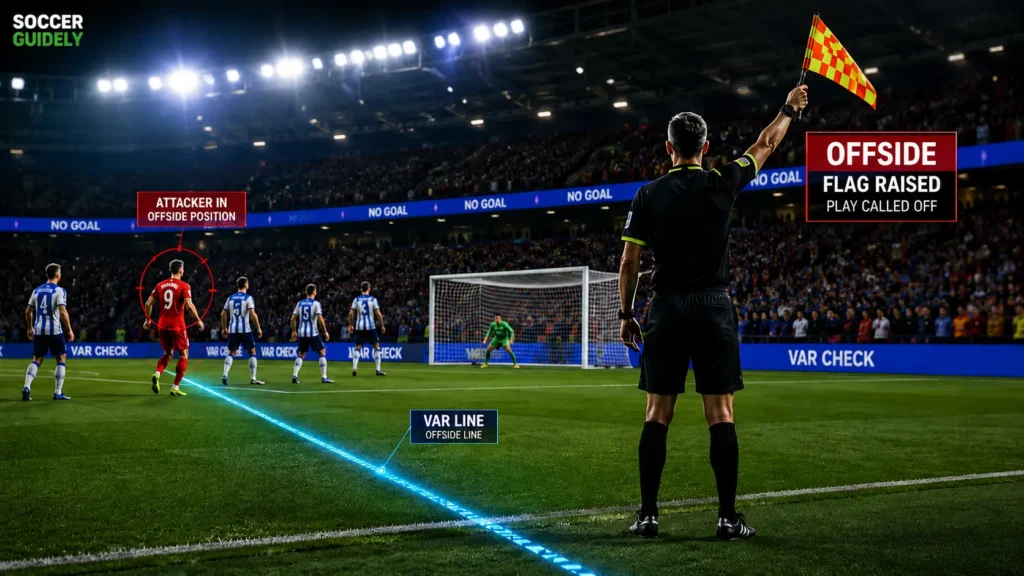
No. If the ball rebounds or deflects off an opponent, an attacker who was in an offside position when their teammate played the ball can still be penalized for gaining an advantage. The same applies to rebounds off the goalpost, the crossbar or a match official.
Attacker Defender Goalkeeper Dashed yellow line: second-last defender
Does a deliberate pass by a defender reset offside?
Yes. If a defender deliberately plays the ball, including by a deliberate handball, an attacker who receives it is not considered to have gained an advantage from their offside position. Law 11 defines deliberate play as when a player has control of the ball with the possibility of passing it to a teammate, gaining possession, or clearing it.
So a defender who tries to clear the ball but miskicks it to an attacker has usually played it deliberately, and the attacker is onside. A defender who sticks out a foot in reflex as a shot flies past has usually only deflected it. Deciding between the two is a judgment for the referee.
A player in an offside position receiving the ball from an opponent who deliberately played the ball … is not considered to have gained an advantage, unless it was a deliberate save by any opponent.
IFAB Laws of the Game, Law 11
What if the goalkeeper makes a save?
A deliberate save does not reset offside. Law 11 treats a save like a rebound: an attacker in an offside position who scores from the rebound after a save is penalized. A save is when a player stops, or attempts to stop, a ball going into or very close to the goal. The goalkeeper may use the hands inside the penalty area; other players may not.
| What happened to the ball | Does it reset offside? |
|---|---|
| Defender deliberately plays it (pass, clearance, control) | Yes |
| Defender deliberately handles it | Yes |
| Ball deflects or rebounds off a defender | No |
| Goalkeeper or defender makes a deliberate save | No |
| Ball rebounds off the post, crossbar or a match official | No |
What if a defender is off the field?
A defender cannot step off the field to put an attacker offside. Law 11 says a defending player who leaves the field without the referee’s permission is considered to be on the goal line or touchline for offside until the next stoppage, or until the defending team plays the ball toward the halfway line and it is outside their penalty area. If the defender left deliberately, they are cautioned at the next stoppage.
What if an attacker steps off the field?
An attacker may step or stay off the field to show they are not involved in play. But if they come back on from the goal line and become involved before the next stoppage, or before the defending team has played the ball toward the halfway line and out of their penalty area, they are treated as standing on the goal line. A player who deliberately leaves and re-enters without permission, is not penalized for offside and gains an advantage must be cautioned.
What about an attacker standing inside the goal?
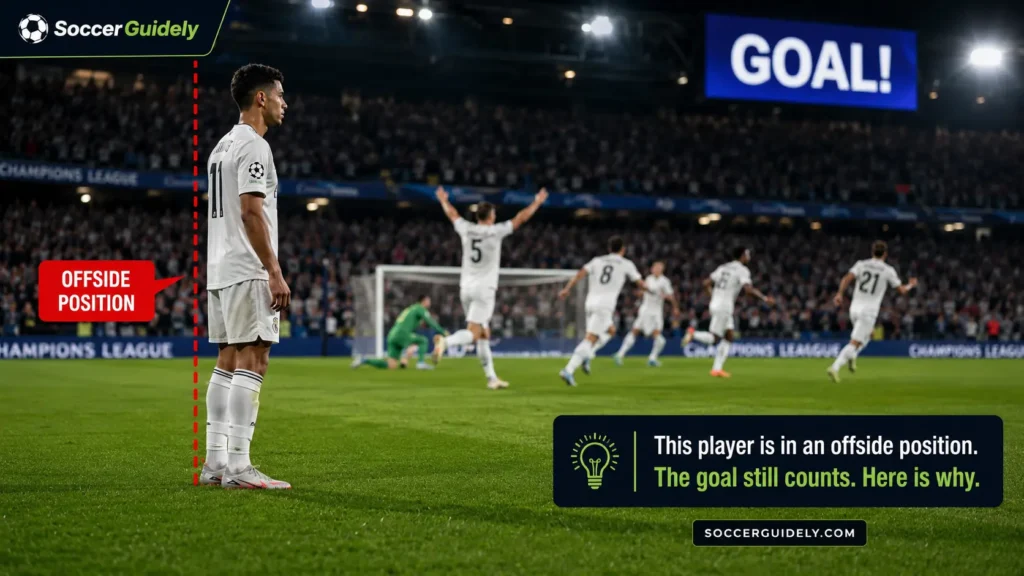
If an attacker stays still between the goalposts and inside the goal as the ball goes in, the goal is awarded, unless that player commits an offside offense or another foul. For example, if they block the goalkeeper’s view or touch the ball, offside or a foul can still be called.
When exactly is the ball “played” on a long throw by the goalkeeper?
Offside is judged at the first point of contact when a teammate plays or touches the ball. There is one exception: when the goalkeeper throws the ball, the last point of contact is used.
Can you be offside if you are behind the ball?
No. To be in an offside position, a player must be nearer to the goal line than both the ball and the second-last opponent. A player level with or behind the ball when it is played cannot be offside. That is why a square or backward pass can never create an offside offense.
Which edge cases showed up at the 2026 World Cup?
Two of them, in the same USMNT game. Against Australia on June 19, 2026, Sergiño Dest’s shot was blocked and looped up, and Alex Freeman headed it in. The flag went up, but replays showed Freeman was onside when Dest shot, so the goal stood.
Australia’s bench also felt Folarin Balogun, standing near the play, had impeded the goalkeeper. ESPN referee analyst Andy Davies said Balogun neither blocked the keeper’s line of vision nor physically disrupted him, so there was no offense. That’s the edge case to remember. Under Law 11, an offside player can be penalized without touching the ball if they clearly block the goalkeeper’s view or challenge them for it. Just standing nearby isn’t enough. More on that in active vs passive offside.
Technology doesn’t settle these alone, either. ESPN reported that even the Premier League’s system, which tracks 10,000 surface points per player at 100 frames per second, can’t judge deliberate play or line of sight. Those checks still need a human and usually take longer.
What offside myths do even big outlets get wrong?
The big one: “any touch by a defender resets offside.” You’ll see it in some mainstream explainers. It’s wrong. Law 11 only resets offside when a defender deliberately plays the ball, and not even then if it was a deliberate save. A deflection, a rebound or a block doesn’t help the attacker.
Another myth is that a defender can step off the field to put a forward offside. They can’t. They still count as standing on the goal line or touchline. Honestly, if you remember just these two, you’ll be right more often than most people yelling at the TV.
Try It: 3 Tricky Calls to Test Yourself
Decide each one, then check the answer in brackets.
- A defender tries to clear the ball but miskicks it to an attacker in an offside position. (Usually onside, because the defender deliberately played it.)
- The goalkeeper saves a shot and it rebounds to an attacker who was offside when the shot was taken. (Offside. A save does not reset it.)
- A defender steps off the field behind the goal line to catch a forward offside. (It doesn’t work. The defender still counts as being on the goal line.)
Frequently Asked Questions About Offside Edge Cases
Yes, it can be. A deflection or rebound off an opponent does not reset offside, so an attacker who was in an offside position when the ball was played can still be penalized.
If the defender deliberately played the ball, for example a poor clearance or a misplaced pass, the attacker is not penalized for offside. A reflex deflection does not count as deliberate play.
Yes. A deliberate save by any opponent does not reset offside, so an attacker who was in an offside position cannot benefit from the rebound.
Yes. A defender who leaves the field without permission still counts as being on the goal line or touchline for offside purposes.
No. A player level with or behind the ball when it is played cannot be in an offside position.
Want plain-English rule guides like this when they drop? Join SoccerGuidely. It’s free, and we only send soccer.