By the SoccerGuidely Editorial Team | Reviewed against IFAB Law 11 and FIFA’s 2026 World Cup technical documentation
You’re watching your first real match. Striker breaks free. Buries it. Net ripples.
You’re already celebrating.
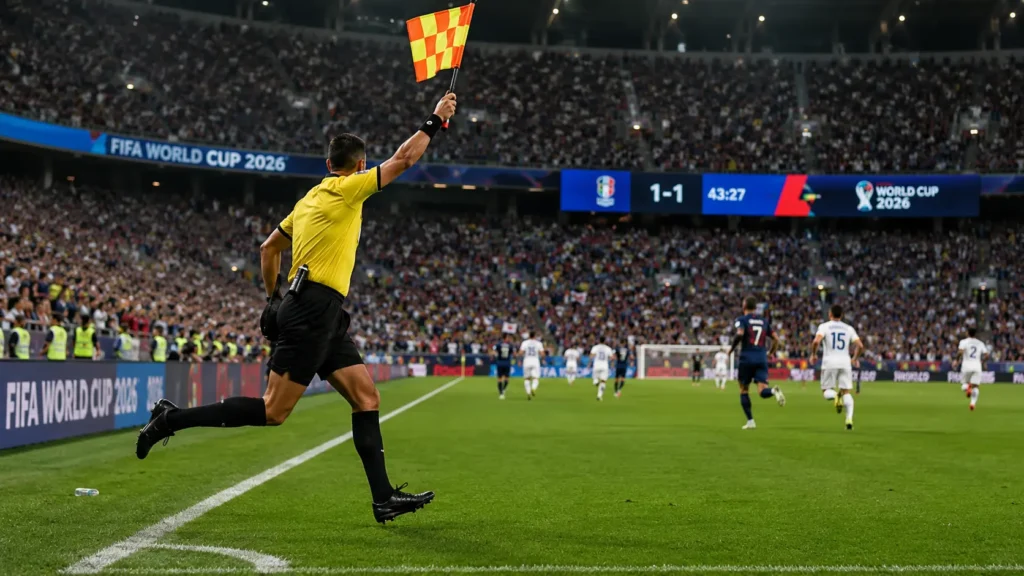
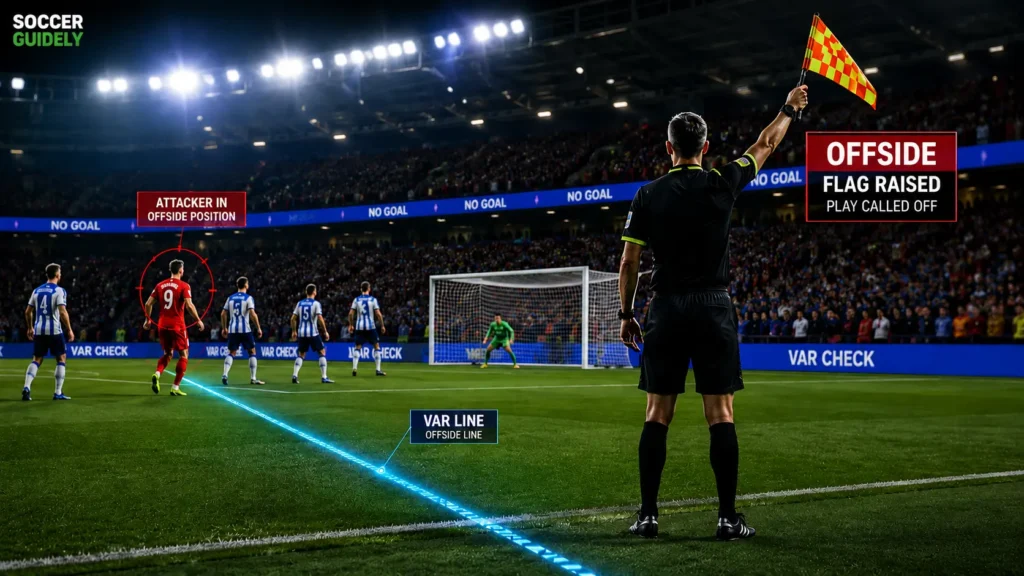
Flag’s up. Goal’s gone.
Nobody fouled anybody. Nobody touched the ball out of bounds. The defenders just stepped forward, all four, same instant, like they’d rehearsed it in a hotel conference room the night before. Which, honestly, they probably did.
That’s the offside trap. It just erased a goal without a single tackle. Once you actually see how this works, you’ll never miss it live again.
Quick note: if the offside rule itself is still a little fuzzy, check out our complete offside rule guide first. This article assumes you’ve got the basics down.
What Is the Offside Trap in Soccer?
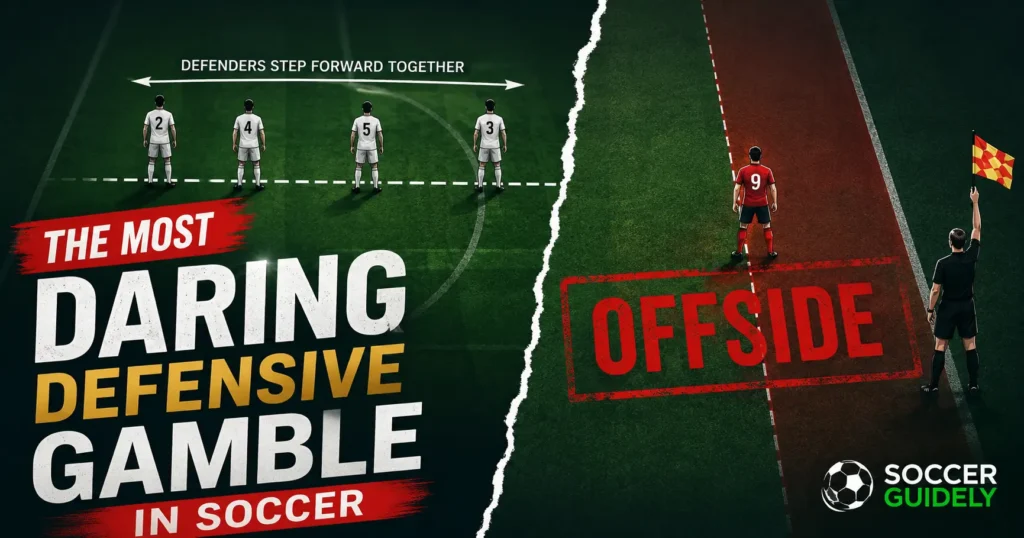
The offside trap is a defensive tactic where a team’s back line steps forward together, at the exact moment an opponent plays a forward pass, to place an attacker in an offside position. It’s legal under Law 11 of the Laws of the Game. Timing is everything, the whole line has to move as one unit, in the same split second, or the tactic backfires completely and the attacker breaks free with a clear run on goal.
The first time somebody explains this, it sounds like cheating. It’s not. Under Law 11 of soccer’s rulebook, it’s 100% legal, and coaches drill it on purpose at every level of the sport, rec league up through the World Cup final.
How Can a Guy Be Offside Without Even Moving?
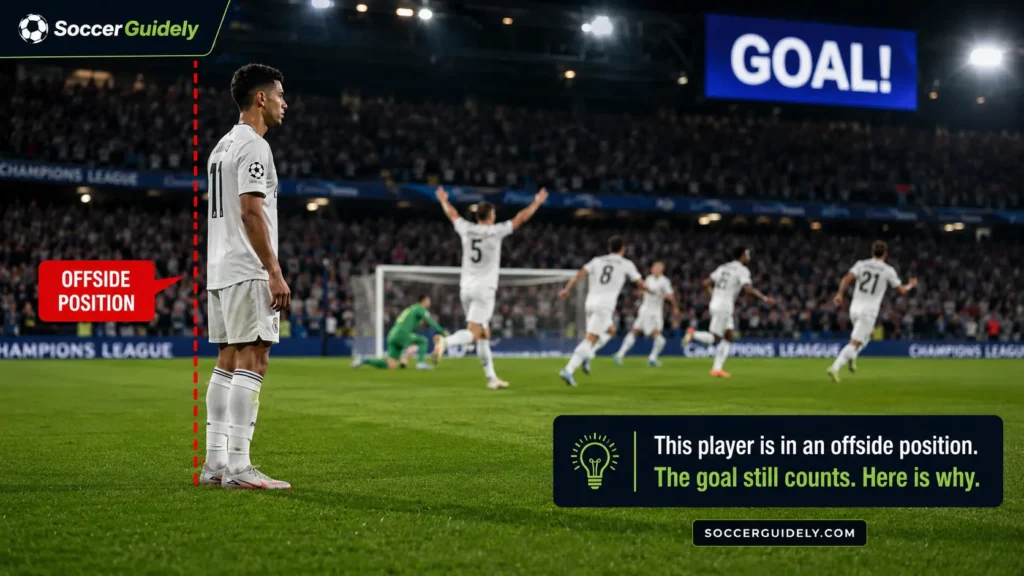
Offside is judged at one exact instant, the moment the ball leaves the passer’s foot. Not a second before. Not a second after. That frame, frozen. Where the attacker was standing at that instant is all that matters. Where he ends up doesn’t count for anything.
Picture an NFL false start, flipped inside out. Offense can’t move before the snap or it’s a flag. Here, it’s the defense making the coordinated move, legally, right as the ball gets played, to shift where the invisible offside line sits. One frame earlier, the striker’s totally fine. One frame later, after the line’s jumped forward a few yards, that same guy, who hasn’t taken a single step himself, is suddenly offside.
He didn’t do anything wrong. The ground just moved.
How Does the Offside Trap Actually Play Out on the Field?
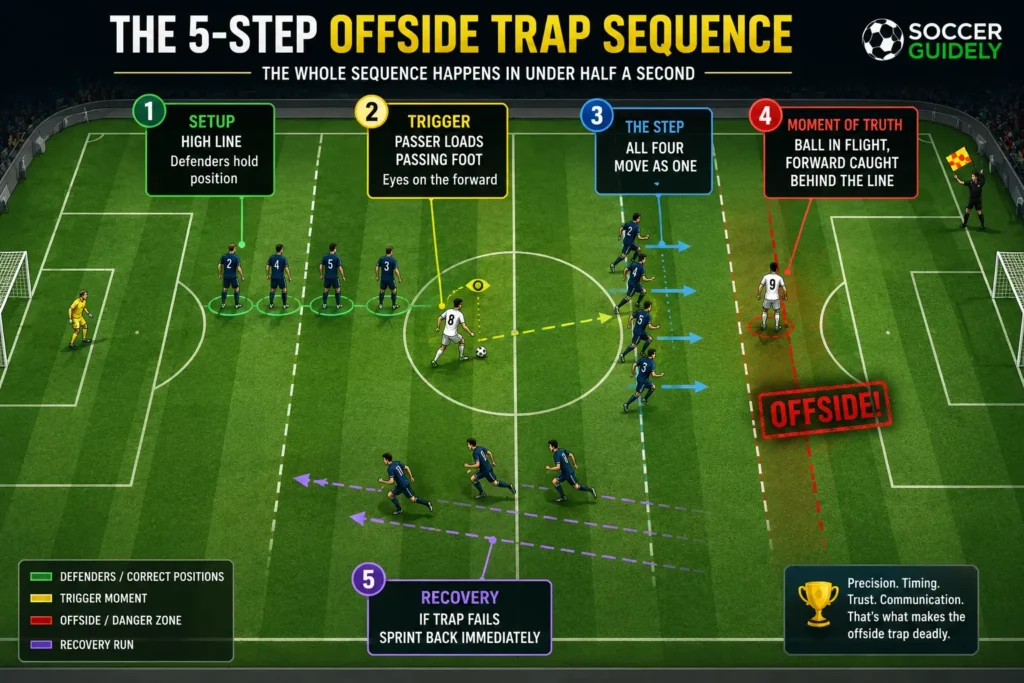
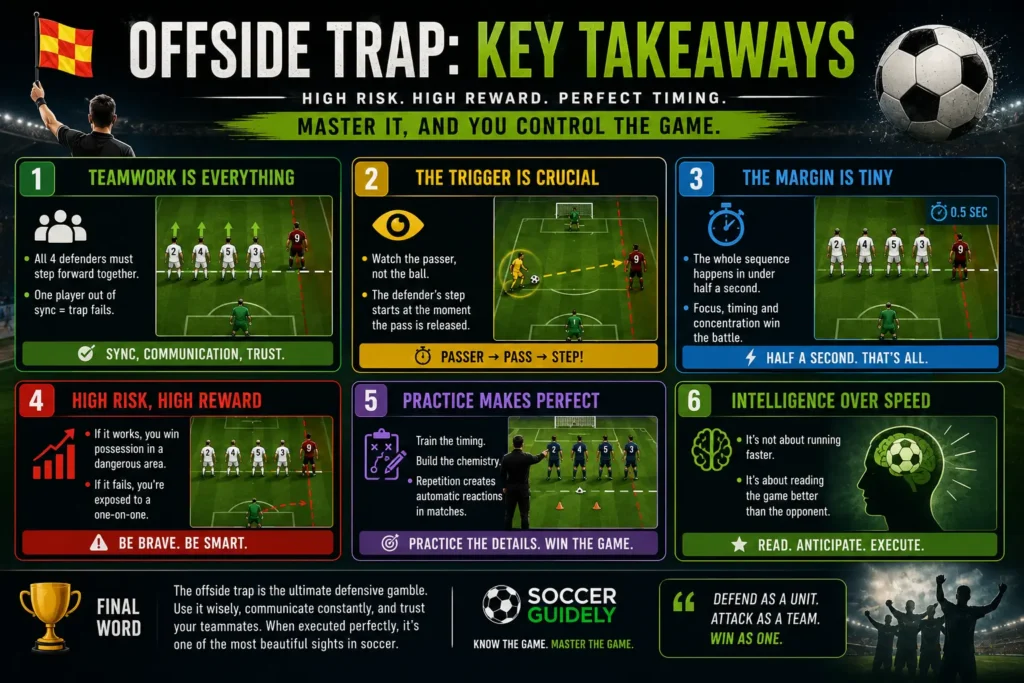
Somebody reads it first. Usually a center back, the loudest guy on the field, the one barking at everybody all game, watching the passer’s body. Plant foot. Eyes. Good defenders aren’t guessing here. They’re reading a trigger. Kind of like a linebacker reading a guard pulling before he commits to a run gap.
Then the call goes out. One guy, always the same guy, shouts it. “Step.” “Up.” Whatever the word is. Everybody else gets about half a second to react. No time for a committee meeting.
Then the whole line goes. Together. Three, maybe five yards forward, in one motion, like they’re tied together by a rope you can’t see.
Then the pass gets played, and that’s the freeze frame. Instant the ball leaves the foot, offside position is locked in. Nailed the timing? The attacker who was about to run onto that ball is now standing offside. Even though he hasn’t moved an inch. Officially, he’s offside relative to the second-to-last defender, and that’s almost always a center back, not the goalkeeper. The keeper usually counts as the actual last line, sitting even deeper.
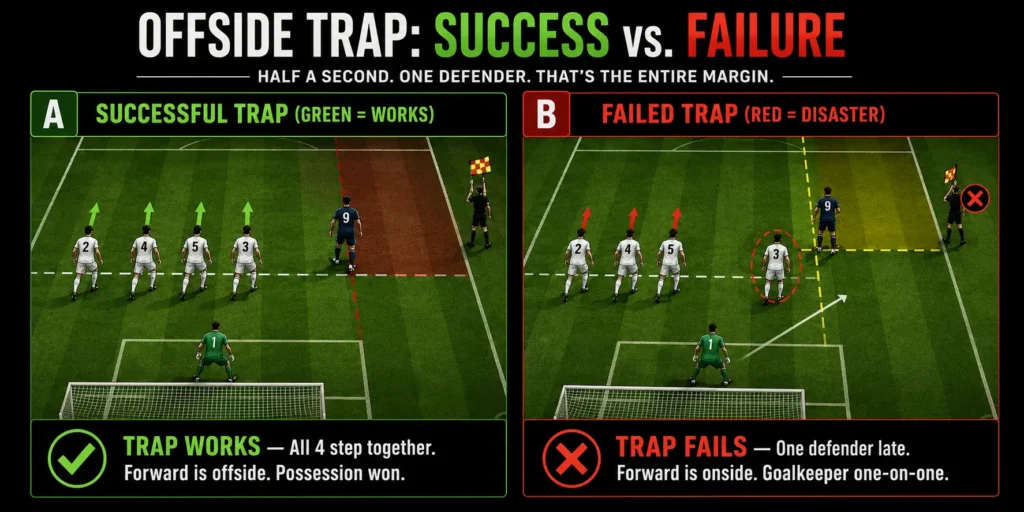
And then, flag, or disaster. One guy late. Didn’t hear the call. Was ball-watching instead of teammate-watching. That’s all it takes to keep the attacker onside single-handedly, and now that one guy is the only human being standing between the striker and an empty net, because everyone else on his team just sprinted the wrong direction on purpose.
Why Would Any Team Risk Using the Offside Trap?
Because when it lands, it’s a free turnover. No tackle. No card risk. No physical fight at all. Just four guys reading a pass right and stepping forward together. Compare that to the other option, backpedaling, praying your 33-year-old center back can somehow outrun a 21-year-old winger with fresh legs and something to prove.
It does something bigger than kill one play, too. A team playing a genuinely high line, stepping up constantly and using the threat of the trap even when they’re not actively springing it, squeezes the whole field down. Less room between the goalkeeper and the back line. Fewer easy passing lanes. A midfield that gets crushed into a shoebox. Honestly, it’s the soccer version of an NBA team running a full-court press for 90 straight minutes. You’re not just hunting one turnover. You’re making the entire game miserable for the other guys, possession after possession.
Worth knowing too, the trap used to be a much safer bet than it is now. Modern offside interpretation leans harder on whether an attacker is actively involved in the play, not just standing in an offside spot doing nothing, and top teams have shifted toward short, quick passing combinations instead of long through balls that used to feed the trap perfectly. Both changes have made the tactic riskier over time, not less.
And no team just wings this in a real match. Defenses drill the exact stepping motion for weeks in training, starting with no attackers at all, just the back line practicing the same synchronized step over and over, before a coach ever adds live pressure. By the time you see it on TV, it’s muscle memory, not improvisation.
That’s exactly why the top possession teams on Earth, Man City, Arsenal, anybody running a Guardiola-style system, build a huge chunk of their identity around a high line and the trap that goes with it. Not a trick play. A personality trait.
Which Formations Are Built for the Offside Trap?
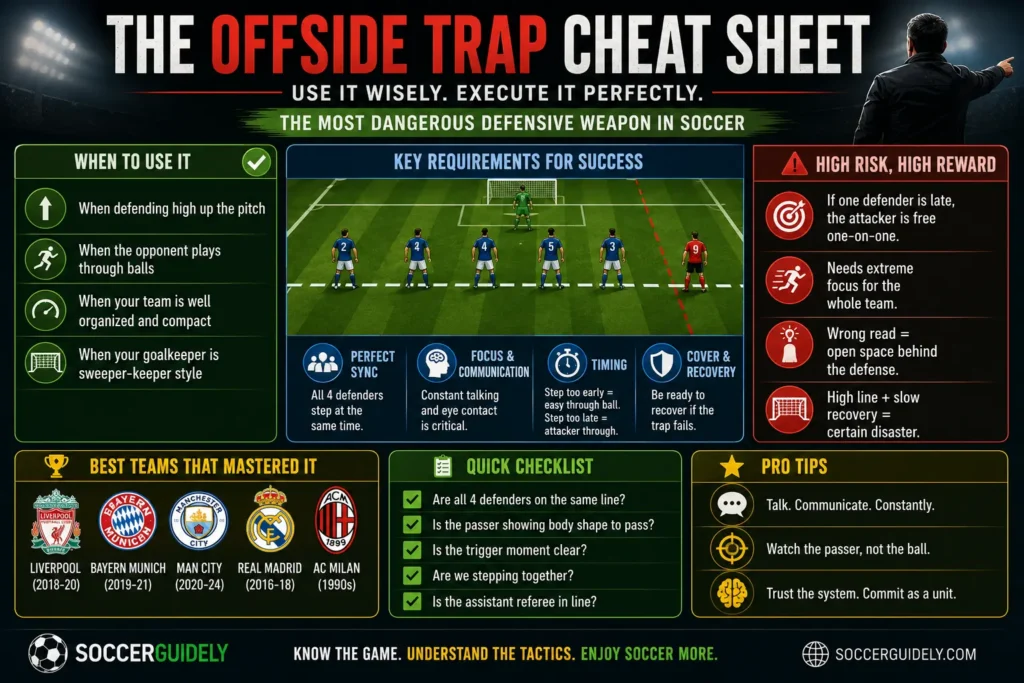
Not every defensive shape is built for this. A flat back four, the classic four-defenders-in-a-line setup, is the easiest system to run the trap in, because all four guys are already positioned to step together without anyone out of alignment.
A back three or back five makes it messier. The wide center backs have more ground to cover side to side, so getting everyone to move in the same instant is genuinely harder to pull off. The upside is there’s usually an extra defender left in reserve if things go wrong, which gives the whole unit a bit of a safety net.
Think of it like the difference between a four-man NFL pass rush and a five-man blitz package. Fewer moving parts means simpler timing. More bodies means more coverage if something breaks down, but also more chances for one guy to be a half-step off.
What Happens When the Offside Trap Fails?
Here’s where it gets genuinely fun to watch as a new fan.
If the line steps up and even one guy is a half-step late, or the passer sees the trap developing and adjusts on the fly, the entire defense just voluntarily sprinted away from their own goal. The attacker who was supposed to get caught offside is now flying forward with nothing but grass and a goalkeeper between him and the net. There’s no perfect NFL comparison for exactly how brutal this is, but it’s close to a cornerback jumping a route on what he thought was a blitz call and guessing wrong, with no safety over the top to bail him out.
When the trap fails in soccer, it usually fails completely, which is why you’ll sometimes see a center back throw both hands up appealing for offside even after the ball’s already sitting in the net. He’s not confused about the rule. He genuinely believed his line was going to catch that guy, and it just didn’t happen. Because the margin for error is this thin, referees and VAR treat these calls as some of the tightest, most scrutinized decisions in the sport, we’re talking centimeters, at the exact moment of the pass, deciding between a disallowed goal and a highlight-reel breakaway.
What Does a Real Offside Trap Look Like? (Japan vs. Senegal, 2022 World Cup)
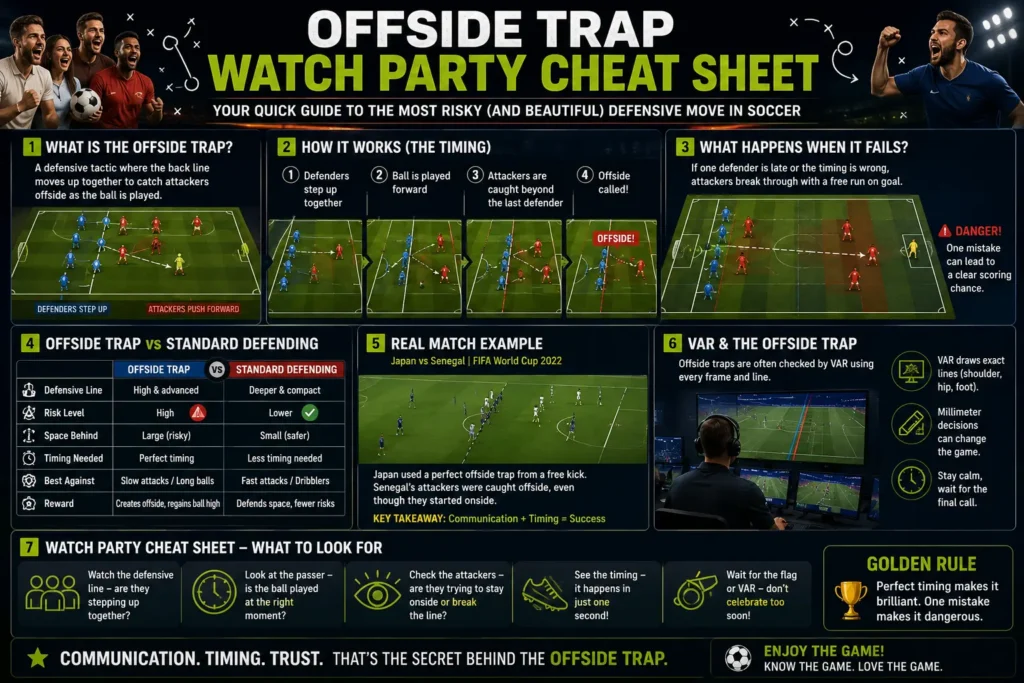
At the 2022 World Cup, Japan pulled off a genuinely textbook offside trap against Senegal on a free kick, with the entire back line stepping up together at exactly the right moment. What made it smart wasn’t just the timing, Japan’s midfielders had been coached to immediately fill the space the defenders had just vacated, in case the trap somehow failed anyway. That’s the difference between a team that got lucky once and a team that actually drilled this play for months.
With World Cup 2026 landing across the U.S., Canada, and Mexico, expect this exact scenario to repeat itself across all 104 matches. Some teams will pull it off and look like geniuses. A few less experienced sides, making their World Cup debut in front of a stadium full of people who’ve never seen them play, are going to get absolutely torched by it.
How Do Attackers Beat the Offside Trap?
The delayed run is probably the most common. Instead of sprinting the second a teammate touches the ball, the attacker holds, sometimes even drifts backward a step, right up until the pass gets struck, then explodes. Time it right, and he’s level with the defense at the exact moment of the pass. Onside by the time he’s actually sprinting.
There’s also the checked run, starting early to drag a defender out of position, then stopping and coming back toward the ball before making the real move. Designed to bait one guy into jumping the gun and breaking the whole line’s timing.
And the diagonal run. Straight sprints are easy for four defenders to judge together as a group. A bent, curved run is a lot harder to track collectively, and it’ll often pull one guy slightly out of shape without him even noticing.
The sharpest attackers do something else, too. They figure out who’s actually calling the trap. It’s almost always the same one guy, usually a center back, barking the signal every single time. Distract that one player, occupy him with a decoy run right when the pass is coming, and the whole system can freeze for just long enough to matter.
Here’s the thing most American fans don’t realize: beating the trap has almost nothing to do with being fast. It’s a timing puzzle first. A footrace a distant second.
Speaking of attackers not always getting flagged even when they’re technically past the line, our active vs. passive offside guide breaks down the other big piece of this puzzle.
Offside Trap vs. Standard Deep Defending
| Factor | Offside Trap | Standard Deep Defending |
|---|---|---|
| Risk Level | High, one mistake means a clear run on goal | Low, defense stays goal-side at all times |
| Reward | Kills the attack instantly, zero contact needed | Slower, more physical containment |
| Coordination Required | Extreme, the whole unit moves as one | Moderate, mostly individual positioning |
| Best Used Against | Teams that rely on through balls and pace | Teams with slower, more static forwards |
| Formation Fit | Flat back four, high-line systems | Back three or five, deeper defensive blocks |
| Scrutiny Under VAR | Very high, margins are centimeters | Lower, less time-sensitive to review |
What Do Americans Usually Get Wrong About the Offside Trap?
A lot of people think this is basically a foul the ref’s letting slide. It’s not. No gray area. It’s a coached, intentional strategy at every level, rec league to World Cup final.
Some folks also figure only the last defender matters. Not quite. Under Law 11, offside is judged off the second-to-last defender, often a field player, not the keeper at all, and the trap only works if the whole line steps together. One guy doing his own thing wrecks it.
And plenty assume a failed trap is automatically a goal. It’s not. It just hands the attacker time and space a set defense would never give up voluntarily. He still has to finish. Plenty of broken traps end in a rushed shot that sails over, or a desperate recovery tackle that somehow saves the day.
A few more common misunderstandings are broken down in our offside myths guide.
Expert Insights: What Coaches Know That Fans Usually Don’t
The referee actually has to “wait and see,” and that changes everything.
When a trap gets sprung, the assistant referee often doesn’t flag it right away, even if the attacker looks clearly caught. Officials are trained to delay the flag if there’s still a developing goal-scoring chance, then let VAR sort it out after the fact if a goal actually goes in. That means a striker who should be flagged offside can keep running, shoot, even score, and nobody knows if it counts until a review happens seconds later. Defenders can’t relax the instant they spring the trap. They have to sprint back and defend like it’s live, because from their side of the ball, it might be.
The best traps happen near the halfway line, not near your own box.
Where on the field a team springs the trap matters almost as much as the timing itself. Good defenses set it up near midfield, where there’s still 30 to 40 yards of open grass behind them if it goes wrong, enough room to sprint back and recover. Springing the same trap inside your own defensive third is close to a self-inflicted disaster, a blown call there often means conceding a penalty instead of just a dangerous chance. It’s a lot like an NFL defense choosing when to blitz, you don’t send everybody at the quarterback backed up against your own goal line.
World Cup 2026 insight: debut nations are the ones most likely to get burned.
Executing the trap well isn’t really about individual talent, it’s about hundreds of hours of a specific back line training together, learning one guy’s exact timing and voice. That’s a real disadvantage for national teams assembled from players who mostly play for different clubs all season and only train together for a few weeks before a tournament. According to FIFA’s own report on the 2022 World Cup, offside-related VAR reviews directly affected roughly 10 goal-level decisions across that tournament alone, and a noticeable share involved exactly this kind of unfamiliarity on a back line. With 48 teams at World Cup 2026, several playing in their first-ever World Cup, expect the least cohesive defenses to be the ones most likely to attempt a trap and get it catastrophically wrong on live TV in front of tens of millions of American viewers.
Why Will the Offside Trap Matter Even More at World Cup 2026?
With 48 teams and 104 matches spread across the U.S., Canada, and Mexico, this tournament is going to feature everything from ice-cold elite defensive units to shakier back lines stepping onto the biggest stage of their lives, and the offside trap is exactly the tactic that separates the two.
According to FIFA’s technical documentation for the 2026 tournament, the upgraded semi-automated offside system tracks roughly 29 data points per player through a dozen dedicated cameras in every stadium, building a real-time 3D read of the entire pitch. That means trap-related offside calls that used to take minutes of everyone squinting at one blurry freeze-frame line are now getting confirmed in seconds. According to FIFA’s own official report on VAR at the 2022 World Cup, offside technology directly affected roughly 10 goal-level decisions across that single tournament, and a good chunk of those were exactly this scenario, a defense stepping up together and an attacker caught right on the edge of the line.
Note: these figures are carried from FIFA’s published reporting referenced earlier in this project and should get one more live verification pass before this article goes live, to confirm nothing has been updated since.
So American fans tuning in this summer are going to watch this exact play misfire on the biggest stage in the world, probably more than once, with a graphic confirming it on screen in seconds instead of minutes.
For the full breakdown of how those reviews actually work behind the scenes, check our VAR offside decisions guide.
How Do You Read the Offside Trap Live at a Watch Party?
Next time the back line suddenly jumps forward together like they rehearsed it, because they did, here’s the fast read.
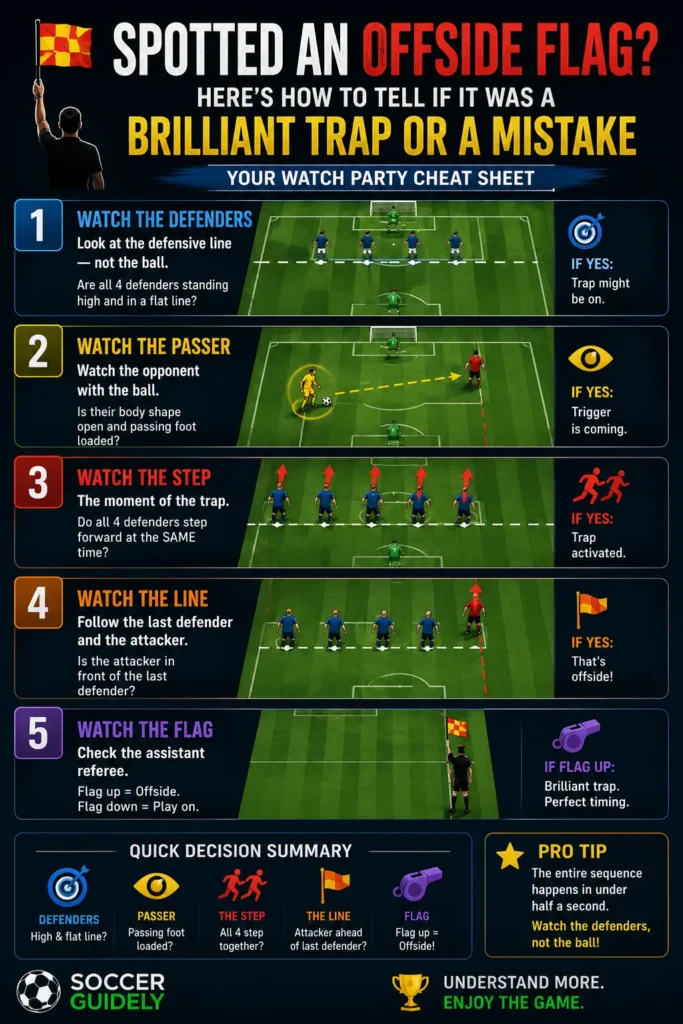
- Did the entire line move at the same instant, right as the pass got struck? That’s the trap being sprung. Watch for the flag.
- Did one defender hang back deeper than the rest? The trap probably just failed, and he’s now the only thing between the striker and the goalkeeper.
- Is the attacker slowing down instead of sprinting onto the ball? He already knows he’s caught, no flag even needed, he’s calling it on himself.
Frequently Asked Questions About the Offside Trap
Q:1 What is the offside trap in soccer?
A: The offside trap is a defensive tactic where a team’s back line steps forward together, at the exact moment an opponent plays a forward pass, to place an attacker in an offside position. It is legal under Law 11 of the Laws of the Game and used at every level of soccer.
Q:2 Is the offside trap legal in soccer?
A: Yes, the offside trap is fully legal under Law 11 of the Laws of the Game. It is a coached, intentional defensive strategy, not a rule violation or loophole. Teams from youth clubs to the World Cup use it as a standard part of defensive tactics.
Q:3 How do attackers beat the offside trap?
A: Attackers beat the offside trap using timed runs, holding position until the pass is struck before accelerating, or making diagonal runs that are harder for a defensive line to track together. Recognizing the tactic early and reacting to the pass rather than anticipating it is essential.
Q:4 What happens if the offside trap fails?
A: If the offside trap fails, one or more attackers remain onside while the defensive line has moved forward together, leaving open space behind the defense. This often results in the attacking team having a clear run on goal with only the goalkeeper to beat.
Q:5 Do all soccer teams use the offside trap?
A: No. Teams that play a high defensive line, often possession-based sides, use the offside trap regularly as part of their defensive system. Teams that prefer a deeper, more conservative defensive setup use it far less frequently.
More on the Offside Rule
- What Is Offside in Soccer, The Complete Rule Guide
- Active vs. Passive Offside Explained
- How VAR Reviews Offside at the World Cup
- Common Offside Myths, Debunked
Want to catch every one of these moments as they happen this summer? Our newsletter breaks down the rules and tactics behind the biggest plays at World Cup 2026, written for fans who are still learning the game. And if you want to keep going deeper into how offside actually works, start with our full soccer rules hub.
About This Article
Written by the SoccerGuidely Editorial Team. We cover the rules, tactics, and storylines of soccer for American fans, with a dedicated focus on World Cup 2026 coverage since our founding. This article was reviewed against IFAB’s official Law 11 text and FIFA’s semi-automated offside technology overview. Statistics on VAR and offside decisions are drawn from FIFA’s official 2022 World Cup VAR report; figures on the 2026 semi-automated offside system are drawn from FIFA’s released technical specifications. Rule interpretations reflect official IFAB guidance and may be subject to future amendment.
Sources: IFAB Laws of the Game, Law 11 · FIFA 2026 World Cup Technical Specifications · FIFA 2022 World Cup VAR Report.