Written by the SoccerGuidely Editorial Team. Covering soccer rules and history for American fans ahead of the 2026 World Cup. Last updated: July 2026. Verified against IFAB’s historical archive and Laws of the Game.
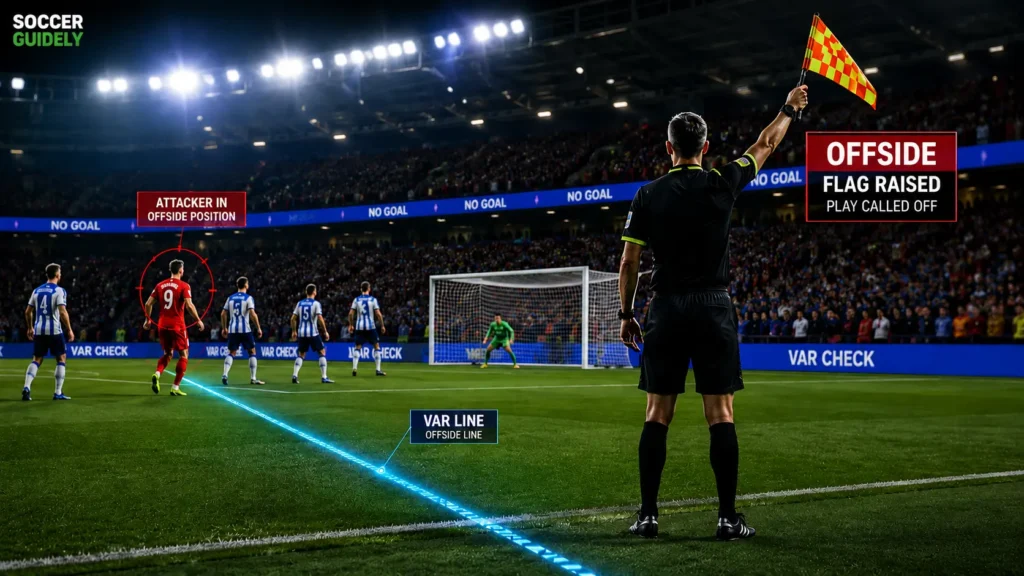
Offside myths in soccer usually come from half-remembered rules or outdated info. The biggest one? People think standing in an offside position is automatically a foul. It’s not. A player is only offside if they’re in that position AND actually get involved in play. Touching the ball. Blocking a defender’s view. Gaining a clear advantage. Being offside and being in an offside position are two different things, and that mix-up is where basically every myth on this list starts.
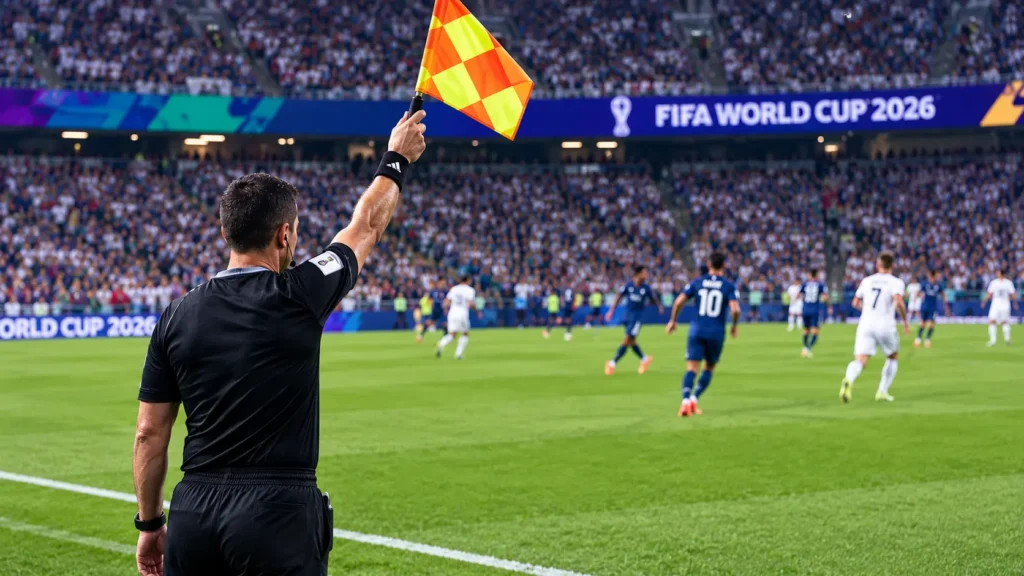
You’re at a watch party. The striker buries it, top corner, no doubt about it. Your buddy’s already screaming, high-fiving strangers he’s never met. Then the flag goes up. Goal wiped off the board. Half the room has no idea why, and now everyone’s suddenly an offside expert, and almost everything they’re saying is wrong.
Let’s fix that before the 2026 World Cup kicks off.
Why Do So Many Offside Myths Exist in Soccer?
Offside is genuinely one of the hardest rules in sports to explain out loud. That’s exactly why bad information sticks around so easily. Someone half-remembers a call from three years ago, repeats it with total confidence, and boom, it’s gospel at every watch party in America now.
Under Law 11 of the Laws of the Game, the rule is actually written pretty clearly. The problem is almost nobody’s read it. They’ve just absorbed a blurry version secondhand, like a game of telephone that’s been running since 1990.
Is Standing in an Offside Position the Same as Being Offside?
No. A player in an offside position only breaks the rule if they get actively involved in play, touching the ball, blocking a defender’s view, or clearly gaining an advantage.
This is the big one. The mother of all offside myths. Almost everyone gets it wrong the first time someone tries to explain the rule to them.
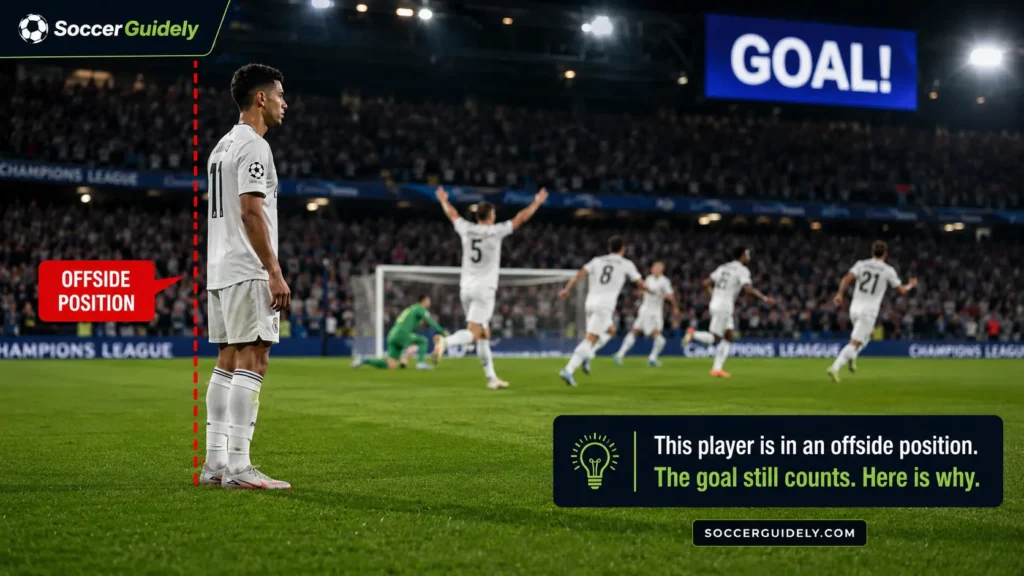
Standing in an offside position is not illegal by itself. It only becomes a violation if the player actually gets involved in play, whether that’s touching the ball, screening the goalkeeper’s view, or clearly benefiting from where he’s standing. A striker can be five yards behind the last defender, completely wide open, technically sitting in an offside position, and it means absolutely nothing. Not a thing. Until the ball actually comes his way.
Think of it like the neutral zone in hockey before the puck crosses the blue line. Position alone doesn’t trigger anything. Action does.
Real example, and this happens constantly. A striker is parked in an offside position on the far side of the box, totally uninvolved. The ball gets played to a different teammate, one who’s onside, and that guy scores. First striker never touches the ball. Never blocks anyone’s view. Never factors into the play at all. That goal counts. No flag, no whistle, nothing.
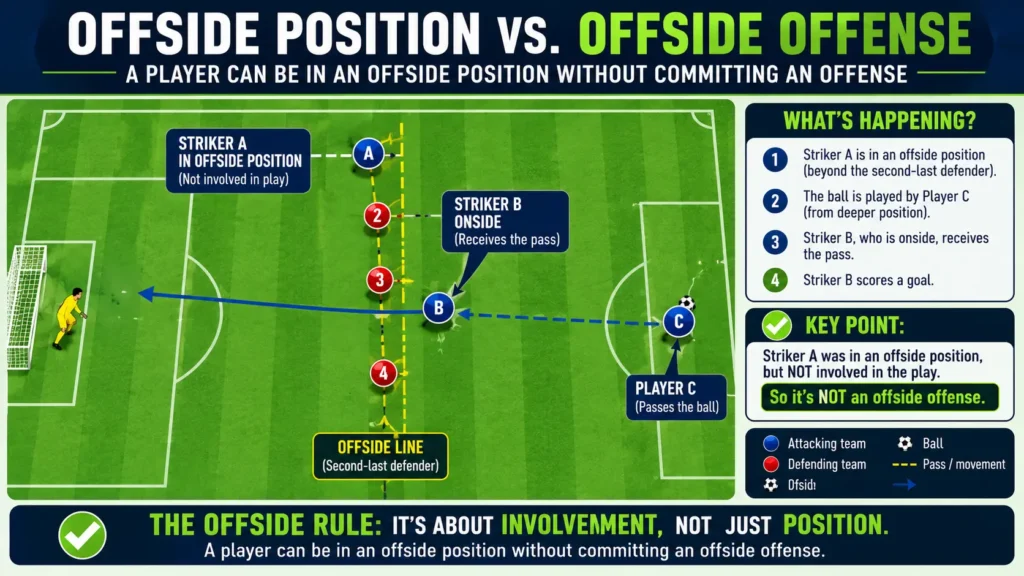
We’ve sat through enough watch parties to know this exact argument breaks out basically every single time a play like that happens. Someone always yells “but he was offside!” like clockwork, and honestly, this is the myth that ruins the most watch parties in America.
Here’s something coaches know that fans don’t: the offside trap isn’t actually about speed, it’s about synchronization. Most Americans assume the trap works because defenders are fast. It doesn’t. It works because an entire back line steps forward at the exact same instant, using a verbal call or a hand signal from the center back, so the whole line moves as one unit instead of four separate players reacting individually.
Think of it like a defensive line stunt in football. The whole line has to fire off the snap count together, not whenever each guy personally feels like it. If even one defender is a half-step late stepping up, the trap fails completely and the attacker gets in behind for free. That’s why elite teams drill this specific timing constantly in training, it’s a coordination skill, not an athleticism one. This is also exactly why the offside trap gets blamed unfairly so often. Fans assume a blown call means a defender wasn’t fast enough, when really it usually means the line wasn’t moving together.
Does the Ball Have to Be Played Forward to Be Offside?
No. Direction doesn’t matter at all. Offside applies regardless of which way the ball is played.
A backward pass, a square ball, a cross, a deflected shot off someone’s shin, any of these can create an offside situation. What matters is where the attacker’s body is relative to the last defender the moment a teammate plays the ball, not which direction that ball travels.
This one trips up American sports fans specifically, and here’s why. In football, forward progress is basically the whole point of the sport. Soccer doesn’t care about that at all. Offside is a freeze-frame at a specific instant, not a measure of which way the play moved.
Do Arms and Hands Count Toward an Offside Call?
No. Only body parts that can legally score a goal, the head, torso, legs, and feet, count toward an offside decision.
They don’t count. At all. Ever. If a player’s arm happens to be the only part of his body ahead of the last defender, that’s not offside, because, well, you can’t score with your hands anyway. (Unless you’re a keeper, and even then, not like that.)
This distinction actually matters way more at the 2026 World Cup than it used to. According to FIFA, the semi-automated offside system installed for the tournament tracks 29 separate data points on every player, 50 times per second, using 12 dedicated cameras positioned around each stadium. That’s a wild amount of precision. It means the tech can isolate exactly which body part was closest to the line, arm included, and just ignore it if it’s not a scoring body part. Want the full breakdown of how that system actually works mid-match? Check out our guide on VAR offside decisions at the 2026 World Cup.
Does a Deflection Always Cancel Out an Offside Call?
No. Whether a deflected ball still counts as offside depends on whether the defender’s touch was a genuine, controlled “deliberate play” or just an accidental deflection.
This one’s sneaky. There’s a real rule buried in here, people just mangle it constantly. If the ball deflects off a defender and reaches a player in an offside position, whether that’s offside or not depends on one thing: was the deflection a deliberate play? A genuine, controlled touch, even a bad clearance, even a rushed panic-pass, resets the whole thing and wipes out the offside. A ball that just clips off a defender’s shin with zero control involved? Still offside if it reaches the attacker.
Look, the difference between “deliberate play” and “accidental deflection” is genuinely one of the toughest calls in the sport. It’s a big reason offside gets so much hate from casual fans. This myth doesn’t really have a clean, satisfying answer, because the rule itself leaves room for judgment on purpose. That’s not a flaw. That’s just soccer being soccer.
Can You Be Called Offside on a Throw-In or Corner Kick?
No. Under Law 11 of the Laws of the Game, there is no offside offense on a throw-in, a corner kick, or a goal kick.
And this exception trips up more people than almost anything else on this list. Zero. A player can be standing directly in front of the goal, in the single most offside position imaginable, and if the ball reaches him straight off one of those three restarts, no call gets made. Feels wrong, doesn’t it? It’s still the rule.
Free kicks awarded for fouls are a totally different story, since offside absolutely applies there. Only those three specific restarts get the exception. If you want the complete list of when offside doesn’t apply, we’ve got a full breakdown on offside exceptions.
Is Offside Judged When the Player Receives the Ball or When It’s Played?
Offside is judged the instant the ball is played by a teammate, not when the receiving player touches it.
This is one of the most common misunderstandings out there, and honestly, it’s a big one. A striker can be perfectly onside the split second the ball leaves his teammate’s foot, then sprint right past the last defender while the ball’s still in the air, and still be completely legal when it lands at his feet. That’s not offside. That’s just a well-timed run, and honestly, it’s one of the more beautiful parts of the sport once you actually understand it.
This confuses a lot of American fans because most US sports track the receiving spot closely, kind of like where a receiver’s feet land at the moment of a catch in football. Soccer works off a freeze-frame at the moment of the pass, not the catch. That one difference explains half the confusion around this entire rule. Our full piece on offside timing in soccer walks through exactly how referees make that split-second read.
Does New Offside Technology Get Every Call Right at the 2026 World Cup?
No. Semi-automated tracking narrows down body positioning with extreme precision, but human referees still make the final judgment calls.
Semi-automated offside tech is doing a lot of heavy lifting this tournament. It’s a massive upgrade over a human linesman squinting from 40 yards away. But faster and more precise doesn’t mean flawless. Nothing does.
According to FIFA, the match ball itself, the Adidas Trionda, carries a motion sensor transmitting positional data 500 times per second, helping pinpoint the exact instant of contact. FIFA also narrowed its automatic alert threshold down to just 10 centimeters of clear daylight between attacker and defender this tournament, tightened way down from the 50 centimeters used in earlier trials. That’s a genuinely impressive jump.
Here’s what most American fans don’t realize, though. The technology still hands off the actual judgment calls, like whether a player was interfering with play or gaining an advantage, to an actual human being. The system narrows body positioning down to the centimeter. It does not replace the referee’s brain. Not yet, anyway.
Here’s the part almost nobody’s talking about heading into this tournament. The semi-automated system doesn’t just help referees review plays after the fact anymore, it now sends an instant audio alert to the video operations room the moment a player is clearly beyond that 10-centimeter threshold. That sounds like a small tweak, but it’s a meaningful shift in how fast these calls get confirmed. The alert only fires for clear, obvious positional offsides, not the close, marginal ones, those still get the full human review process. So when you see a call confirmed almost instantly this summer, that’s the automated alert doing its job on an obvious case. When officials take longer, that’s usually a sign the call is genuinely close and still needs a human eye on it.
Did Old-School Strikers Have It Easier Under the Offside Rule?
No. The offside rule was originally stricter than today’s version, not looser.
You’ll hear this one constantly in arguments about all-time great goal scorers, especially anytime someone brings up Pelé’s numbers. The idea floating around is that offside barely existed decades ago, so older strikers padded their stats against a weaker rule.
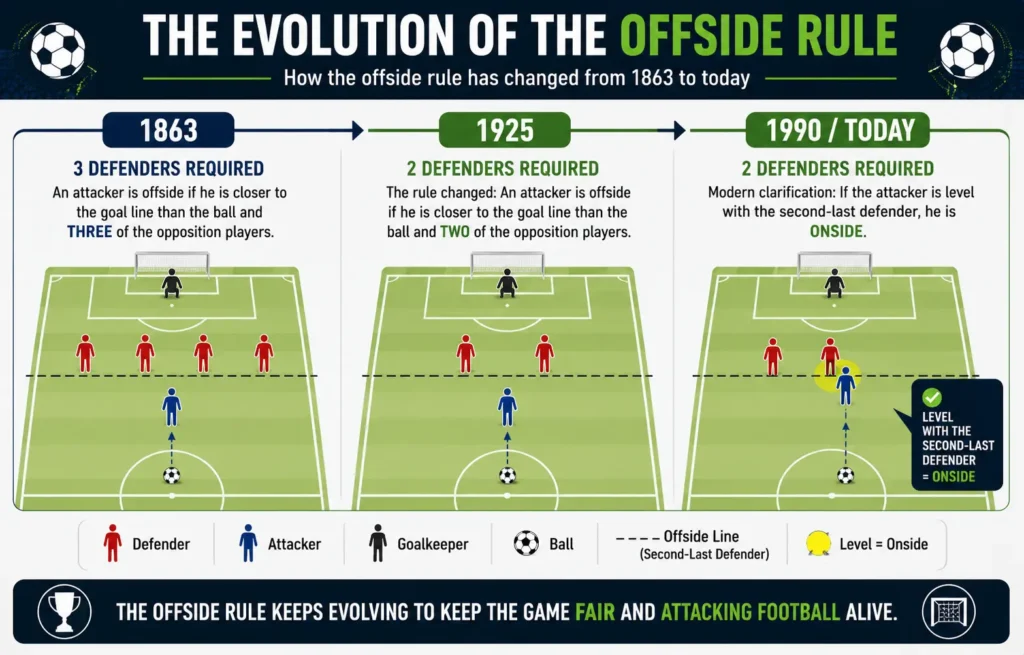
It’s actually the opposite. The offside rule was first introduced back in 1863, and it was way stricter than today’s version, requiring three opposing players between the attacker and the goal instead of the two required now. The rule loosened over time, not the other way around, with a major change in 1990 making it noticeably easier for attackers to stay onside. So if anything, older-generation strikers played under a tougher version of the rule. Not an easier one. For the full history of how we got here, our guide on the offside rule’s history covers every major shift.
Quick side-by-side, because this one’s easier to see than explain:
| Era | Defenders Required Between Attacker and Goal | Effect on Attackers |
|---|---|---|
| 1863 (original rule) | 3 opponents | Very restrictive, hard to stay onside |
| 1925 reform | 2 opponents | Loosened significantly, more goals followed |
| 1990 reform | 2 opponents, but level is now onside | Easier to time runs, favors attackers |
| 2026 World Cup (SAOT era) | 2 opponents, same legal standard | Same rule, far more precise enforcement |
The tactical reason behind this is worth knowing too. You’d think more accurate offside tech would make high defensive lines safer, since the calls are more precise now. It’s actually had the opposite effect at the elite level. Because semi-automated tracking now catches marginal offside positions a human linesman would’ve missed, attacking teams have adjusted their timing to exploit the exact edge of legality, arriving a fraction of a second later than they used to, right at the threshold instead of clearly ahead of it. It’s a bit like how NFL defensive backs had to adjust their technique once instant replay started catching contact refs previously let go uncalled. The rule didn’t change. The margin for error around it did. That’s a big reason you’ll likely see more disallowed goals by mere centimeters at this World Cup, not because attackers got sloppier, but because enforcement got sharper and attackers adapted to it.
Is the Goalkeeper Always the Last Defender in an Offside Call?
Not necessarily. The rule refers to the “second-to-last opponent,” and that’s usually the goalkeeper, but not always.
This one catches out more people than you’d think. The goalkeeper is usually the last one simply because, well, he’s guarding the goal. But if a keeper gets caught out of position, sprinting up for a corner or beaten and stranded upfield, a regular defender becomes the last line instead. The second-to-last opponent could end up being another outfield player entirely, maybe even a midfielder who got caught ball-watching.
This matters more than people think on the defensive side of the ball. Teams running a high defensive line, a tactic known as the offside trap, rely on their back line, not the keeper, to set that offside boundary correctly.
Is Offside Just a Made-Up Rule That Ruins Good Goals?
Not really. Offside exists to stop attackers from camping near the opponent’s goal waiting for long balls instead of building an actual attack.
More of an opinion dressed up as a myth, honestly, but it’s worth tackling anyway, since it’s the single most common complaint from new American fans. The purpose of offside is to stop what’s basically the soccer version of a cherry-picking layup in basketball. A player just camping near the opponent’s goal, waiting for a long ball, contributing zero on defense. Without it, soccer turns into a game where you park one guy up top all match and just boot long balls at him. Offside forces teams to actually build attacks. Time their runs. Work the ball down the field instead of hanging out in the paint waiting for an easy bucket. It’s less “arbitrary rule that ruins fun” and more “the one thing keeping this sport from turning into long-ball roulette.”
Why These Offside Myths Matter for the 2026 World Cup
With the World Cup landing on US soil for the first time since 1994, millions of Americans are about to watch soccer seriously for the first time in their lives. According to Google Trends data tracked around the 2026 tournament, “what is offside” ranks as one of the most-searched World Cup-related terms in the country, trailing only basic schedule questions. Let that sink in for a second. That’s how confusing this rule is for first-time viewers.
Every myth on this list is going to come up this summer. In some heated group chat after a controversial call wipes out a USMNT or USWNT goal. In a Reddit thread the morning after. And honestly, these same myths don’t disappear once the tournament ends, they show up every single weekend once you start watching MLS or NWSL too. Knowing the real rule instead of the myth version means you’re the person calmly explaining what happened, not the one yelling at a screen about a call that was correct the whole time.
What’s the Bottom Line on Offside Myths?
Most offside myths trace back to one root problem. People think offside is about position, when it’s actually about involvement. Standing in an offside spot isn’t illegal on its own. Getting the ball, blocking a view, or gaining an advantage while offside is what actually breaks the rule. Once that clicks, nearly every myth on this list just falls apart on its own.
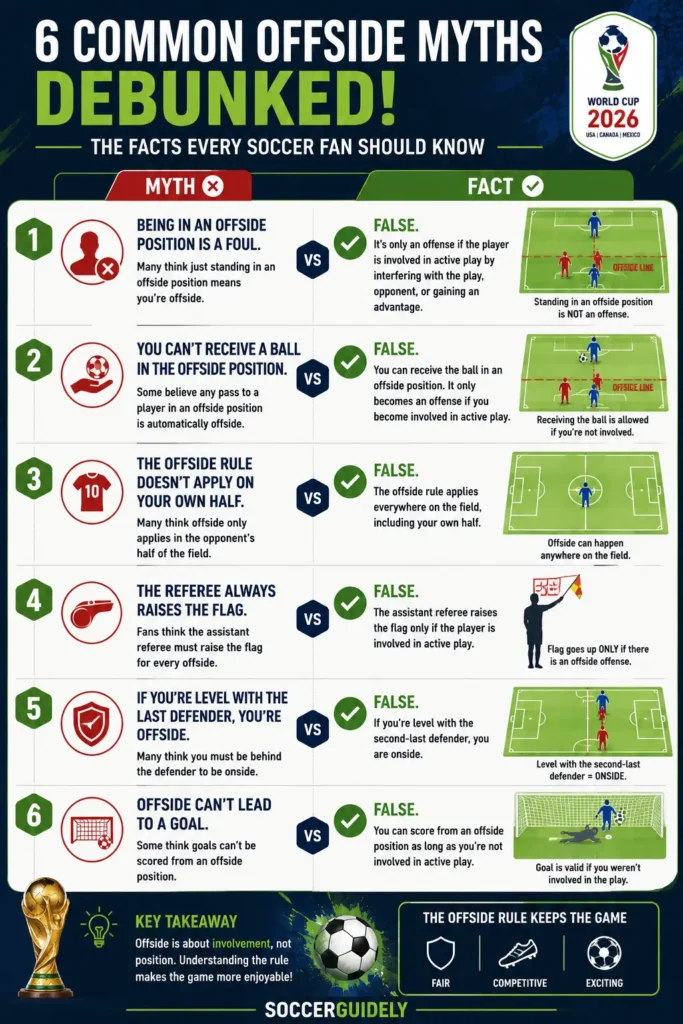
Going into the 2026 World Cup, you don’t need to memorize every clause of Law 11. You just need to stop believing the versions of this rule that make it sound dumber, stricter, or more random than it actually is. Get that part right, and honestly, you’ll understand more about offside than half the people yelling at their TV this summer.
For a complete breakdown of the rule from the ground up, start with our full offside rule guide, or dig into the difference between active and passive involvement if you want to go even deeper.
Frequently Asked Questions About Offside Myths
Q1: Is being in an offside position always a foul?
A: No. A player in an offside position only commits an offense if they become involved in active play, meaning they touch the ball, interfere with an opponent, or gain a clear advantage from that position. Simply standing in an offside spot without touching the ball is not a violation.
Q2: Does the ball have to be played forward for offside to apply?
A: No. The direction of the pass doesn’t matter. Offside applies whenever an attacking player is ahead of the second-to-last defender at the moment a teammate plays the ball, whether that pass goes forward, sideways, or backward.
Q3: Can a player be offside from a throw-in or corner kick?
A: No. Under Law 11 of the Laws of the Game, there is no offside offense on a throw-in, a corner kick, or a goal kick. Players can be in any position when the ball is played directly from these three restarts.
Q4: Do arms and hands count for offside?
A: No. Only body parts that can legally score a goal count toward an offside decision, including the head, torso, legs, and feet. Arms and hands are excluded entirely, even if they’re the closest part of the body to the defensive line.
Q5: Is offside judged when a player receives the ball or when it’s passed?
A: Offside is judged at the exact moment a teammate plays the ball, not when the receiving player touches it. A player can be onside when the pass is made and still legally run past defenders before receiving it.
More on the Offside Rule
- What Is Offside in Soccer, The Complete Rule Guide
- Active vs. Passive Offside Explained
- Offside Timing in Soccer, When Exactly Is the Call Made
- VAR Offside Decisions at the 2026 World Cup
- The Offside Trap Explained
Want to catch every one of these moments as they happen this summer? Our newsletter breaks down the rules and history behind the biggest plays at World Cup 2026, written for fans who are still learning the game. And if you want to keep going deeper into how offside actually works, start with our full soccer rules hub.
About This Article
All rule references verified against IFAB’s official historical archive and the current Laws of the Game, Law 11. Historical data on goal-scoring statistics sourced from Football League records. Additional historical detail cross-referenced against Wikipedia’s citation-heavy entry on the offside law, which draws on original IFAB meeting minutes, contemporary newspaper archives, and academic research on offside officiating. World Cup 2026 semi-automated offside technology details verified against FIFA-adjacent reporting current as of July 2026. Reviewed for accuracy before publication by the SoccerGuidely Editorial Team.