Written by the SoccerGuidely Editorial Team. Covering soccer rules and history for American fans ahead of the 2026 World Cup. Last updated: July 2026. Verified against IFAB’s historical archive and Laws of the Game.
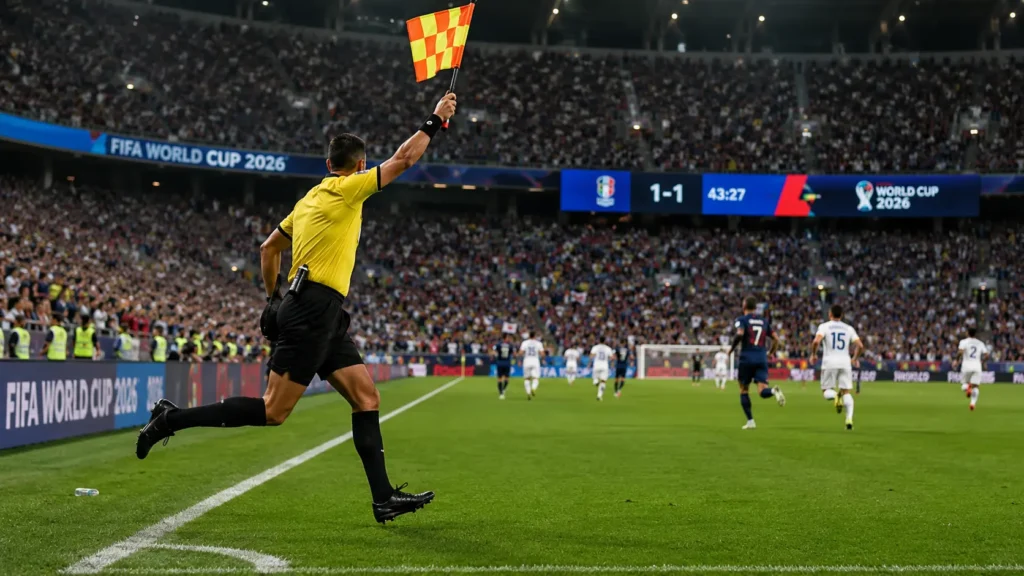
Offside is confusing for American fans because no major US sport has an equivalent rule. Football, basketball, and hockey all give fans a clear stoppage point, a down, a shot clock, a faceoff, before the action resets. Soccer’s offside is judged in a single moving instant, with no pause, based on where a player’s body was the exact second a teammate passed the ball. There’s nothing in American sports that trains your brain to watch for that.
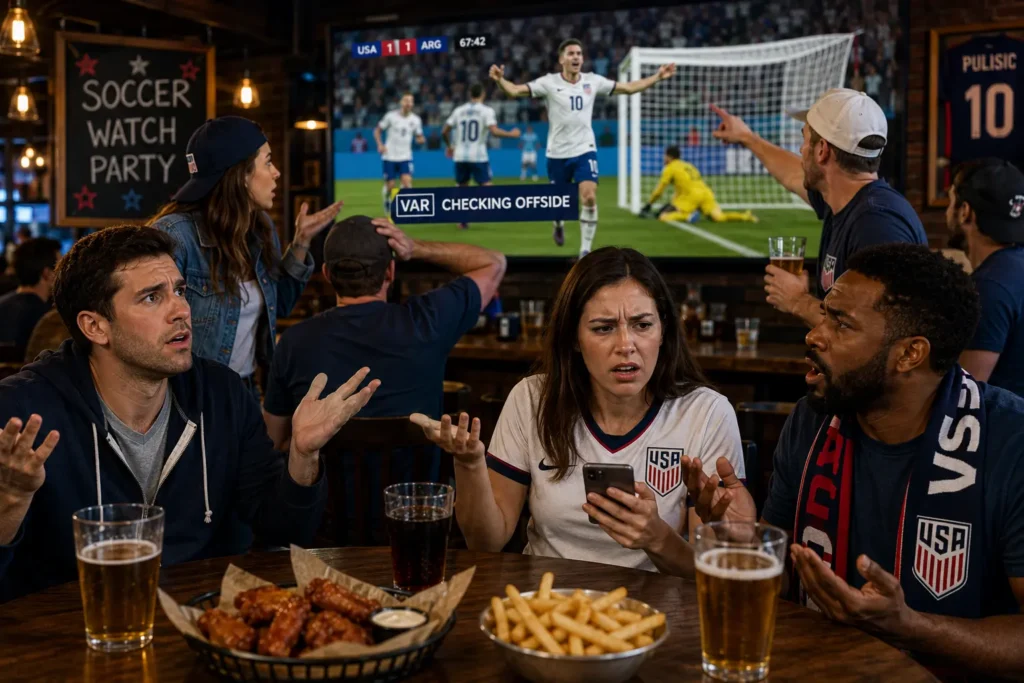
You’ve watched football your whole life. You know pass interference. You know a first down. You know a false start before the ref even throws the flag. Then soccer’s offside call happens, and suddenly you’re the one person at the party asking wait, why didn’t that count.
That’s it. That’s the whole thing right there. And it’s got nothing to do with being bad at sports.
Why Do So Many Americans Struggle With the Offside Rule?
Americans struggle with offside not because they’re bad at learning rules, but because the rule works on a completely different logic than anything in football, basketball, hockey, or baseball.
Back in June 2026, a tweet went semi-viral for exactly this reason. Someone posted that they didn’t understand why so many Americans were confused about offside. It picked up over 51,000 likes. Someone else replied that it’s actually at least 90% of the country that doesn’t get it. Both were kind of right. Neither one actually explained why, though, which is annoying, because the why is the interesting part.
Here’s the thing. Americans aren’t bad at understanding rules. Football has more rulebook pages than most people will ever sit down and read. Basketball’s got a shot clock, a three-second violation, six different flavors of foul. Americans are genuinely great at learning complicated sports rules. Offside just works differently than anything else in that toolkit. That’s the real reason it feels so hard, not some national deficiency in rule comprehension.
Turns out the answer comes down to a few specific things soccer does differently than every major American sport, and none of them have anything to do with intelligence. Let’s go through them one at a time.
Why Doesn’t Soccer Give Fans a Stoppage Point Like Other American Sports?
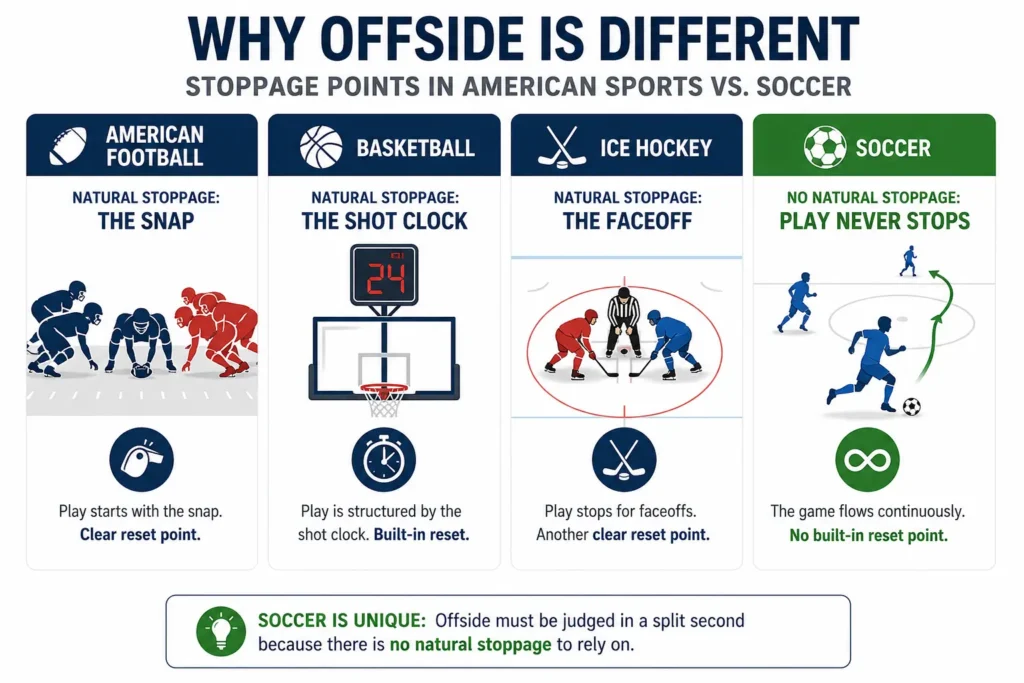
Every major American sport gives you a built-in pause before the next play starts. Football’s got the huddle and the snap. Basketball’s got the shot clock resetting, the inbound pass. Hockey’s got the faceoff.
Those pauses are doing something for you without you even clocking it. They give your brain a clean second to reset before the next thing happens. Soccer doesn’t really have that. Play just flows, continuously, for 45 minutes straight. So when an offside call happens, it happens mid-flow. Out of nowhere. Zero warning.
Quick side-by-side, because seeing it laid out helps:
| Sport | Natural Stoppage Point | What It Does for Fans |
|---|---|---|
| Football (NFL) | Huddle, snap | Resets attention before every single play |
| Basketball (NBA) | Shot clock, inbound | Signals a new possession clearly |
| Hockey (NHL) | Faceoff | Marks a clean restart after every stoppage |
| Soccer | None during open play | Offside calls arrive mid-flow, no warning |
Here’s something coaches know that fans don’t.
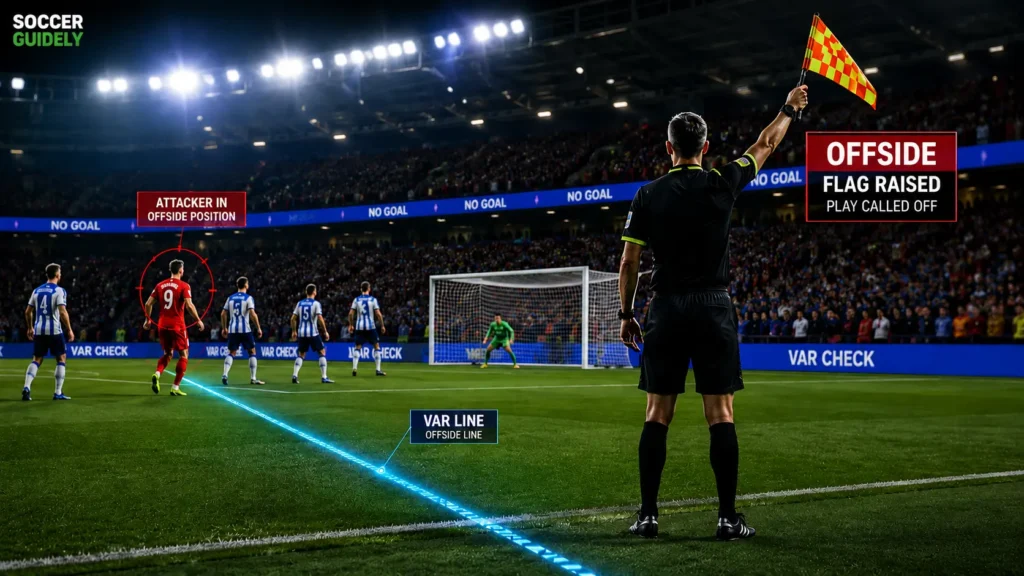
Confusion about the offside line isn’t just a fan experience problem, it’s something defenses actively exploit on purpose. When a back line steps up in perfect unison to catch an attacker offside, the goal is to create exactly the kind of visual illusion that confuses casual viewers, making a legal position look offside, or an offside position look shockingly close and legal.
This is why you’ll hear commentators use the phrase “stepping up as one” when describing a well-drilled defense. It’s not decorative language. A synchronized offside trap is specifically designed to compress the space attackers have to work with while making the boundary line as visually deceptive as possible in real time, to both the attacker and the crowd. So if you’ve ever felt like you genuinely couldn’t tell whether a player was offside just by watching with your own eyes, that’s not a failure of your perception. That’s the defense’s entire strategy working exactly as intended.
Why Is Offside Judged in a Single Frozen Instant Instead of Over Time?
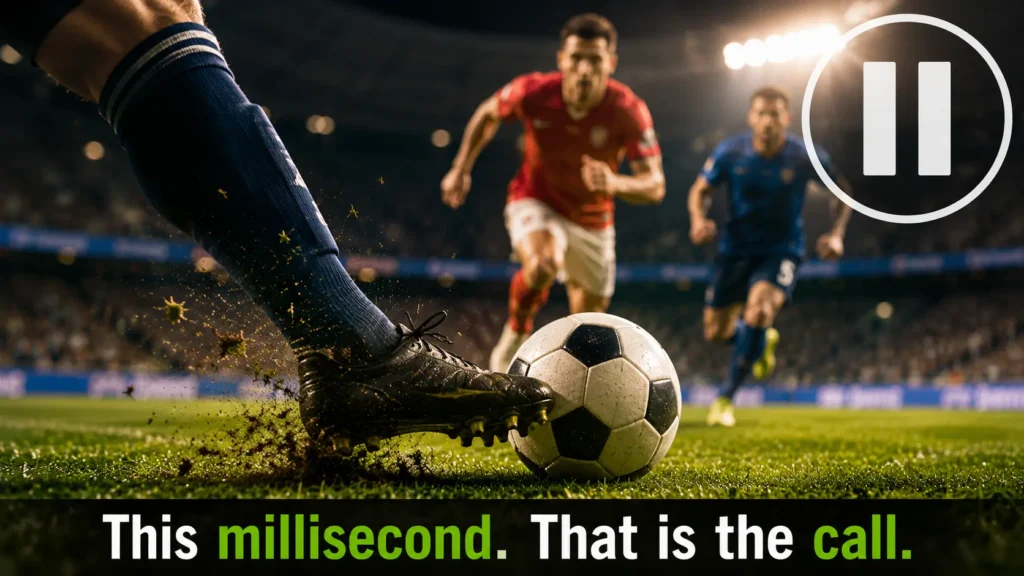
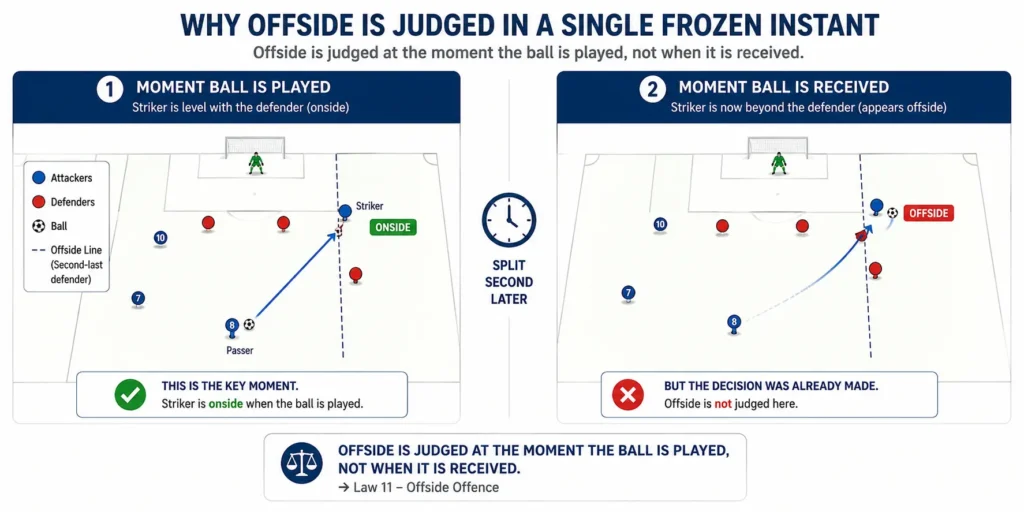
Offside is judged at one exact moment in time, the instant the ball is played, not continuously like most American sports positioning rules.
Here’s probably the single biggest reason this rule feels so weird. In American sports, position gets judged more or less continuously. A receiver has to stay onside of the line the whole play. A basketball player in the paint has three seconds to get out, a duration, not a single instant.
Offside doesn’t work like that at all. Under Law 11 of the Laws of the Game, it’s judged at one exact, frozen moment, the instant the ball leaves a teammate’s foot. Not before. Not after. A player can be totally fine a half-second earlier, totally fine a half-second later, and still somehow be offside at that one specific frame sandwiched in between. Nothing in American sports asks you to judge anything off a single frozen split-second like that. Nothing.
Quick vocabulary check before the scenario, since this word does a lot of work: “onside” just means legal, not committing any offense. It’s the opposite of offside, nothing fancier than that.
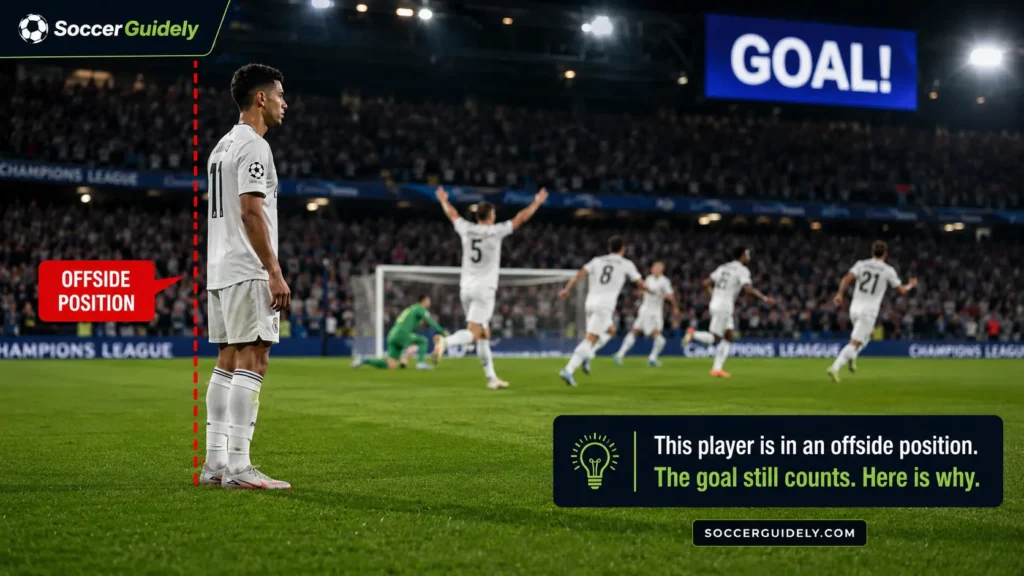
Real scenario, because this trips people up constantly. A striker times his run perfectly, starting his sprint the exact instant the ball leaves his teammate’s foot. Onside at that frame. Then he blows past the defender while the ball’s still traveling through the air, receives it in what looks, visually, like an obviously offside spot, and the goal counts anyway. The room loses it. “He was WAY offside!” No, he wasn’t. Not at the frame that actually mattered.
Why Do You See the Goal Before You Understand Why It Didn’t Count?
Here’s the part that makes it even worse for first-timers. Shot goes in. Crowd erupts. Then, a beat or two later, the flag goes up and the goal’s gone. Your brain already fully processed “goal, celebrate” before it even gets the info explaining why that goal didn’t count.
Compare that to football. A flag there usually shows up before or during the play, so you’re primed for “something’s wrong” in real time. Soccer’s offside call tends to land after the emotional payoff already happened, and that timing alone makes it feel like something got taken from you, rather than like a rule just got enforced correctly. That’s a gut-punch reaction. Not a comprehension problem.
What most fans don’t realize is that broadcast graphics can actually make this worse, not better. US soccer broadcasts often throw up an offside line graphic instantly on replay, similar to the yellow first-down line in football. That line looks authoritative, exactly like the kind of clean, official overlay American fans are trained to trust completely.
The problem is that line is drawn using the semi-automated tracking data, which locks in the frame at the moment the ball was played, not the moment the graphic actually appears on your screen a few seconds later. So by the time you see that crisp yellow line confirming an offside call, the game has already moved on visually in your head to whatever happened next. You’re mentally reconciling two different moments in time as if they were one, which is a genuinely disorienting way to process a decision, even though the graphic is more accurate than anything broadcasters had access to a decade ago.
Why Doesn’t Offside Terminology Map to Anything Familiar?
Soccer’s offside vocabulary, “second-to-last defender,” “interfering with play,” “deliberate play,” has no direct equivalent in American sports terminology, so newcomers have nothing to mentally anchor it to.
“Second-to-last defender.” “Interfering with play.” “Deliberate play” versus a plain deflection. None of that has a direct parallel anywhere in American sports vocabulary. When a broadcaster says he was offside by the width of a shoulder, you need to already understand three or four stacked concepts just to parse that one sentence.
Compare that to a holding call in football. Even a total newcomer gets that instantly. Somebody grabbed a jersey. Illegal. Done. Offside doesn’t have that one-sentence, self-explanatory quality, and again, that’s not a flaw in American fans. It’s just a genuinely more layered rule.
To be fair, this cuts both ways. A British or Brazilian fan watching their first NFL game would be just as lost trying to parse pass interference, or why a quarterback’s arm motion determines whether a fumble is actually a fumble. Every sport has at least one rule that only makes sense once you’ve absorbed it slowly over years, not read about it once. Offside just happens to be soccer’s version of that rule, and it’s the one Americans are bumping into for the first time, all at once, this summer.
What most American fans don’t realize is that commentators overseas absorb this terminology the exact same slow way Americans absorb “holding” or “pass interference.” Through decades of casual, repeated exposure starting in childhood. Not by cramming a rulebook the week before a World Cup starts. If you want to see how this same confusion fuels wrong assumptions, check out one of the most common offside myths we’ve already debunked in this cluster.
Why Does This Matter Heading Into the 2026 World Cup?
With the World Cup on US soil for the first time since 1994, millions of Americans are about to watch high-stakes soccer seriously, maybe for the first time in their lives. According to Google Trends data tracked around the tournament, “what is offside” ranks among the most-searched World Cup terms in the country, trailing only basic schedule questions. That’s not some quiet little pocket of confused people. That’s a massive, visible chunk of the country hitting the exact same wall at the exact same time.
We’ve watched this exact confusion play out in group chat after group chat during past tournaments, and this World Cup is only going to amplify it. According to FIFA, the semi-automated offside system now sends match officials an instant audio alert the moment a player is at least 10 centimeters offside, a precision upgrade for this tournament specifically. That’s genuinely great for accuracy. It also means more borderline, centimeter-level calls are going to get flagged and shown on replay than in past tournaments, which gives confused first-timers even more razor-thin decisions to argue about at the exact moment they’re still learning the basics.
Here’s the part almost nobody’s connecting for American fans specifically.
FIFA narrowed that alert threshold to 10 centimeters for 2026, down from 50 centimeters in earlier trials. That’s a huge jump in precision, and it means calls that would have simply gone unnoticed by a human linesman a decade ago are now being confidently flagged and shown on giant stadium replay screens and broadcast graphics in real time. For soccer-first countries, this just means more accurate officiating, a good thing nobody argues with. For American first-time viewers specifically, it means you’re about to see more centimeter-close offside calls, explained with more technical confidence, than any previous World Cup in history, right at the exact moment millions of Americans are watching seriously for the first time. That collision, sharper enforcement meeting a brand new audience, is exactly why this specific summer is likely to produce more “wait, why was that offside” moments per game than any World Cup before it.
Good news, though. Once you get the why behind the confusion, the rule stops feeling random. Soccer isn’t being needlessly complicated on purpose. This is just a genuinely different kind of rule than anything American sports have trained your brain to expect. And it doesn’t stop mattering once the tournament ends either, this same confusion resets every single MLS and NWSL season for whoever’s new to the sport that year. And now that you know that? You’re already ahead of half the room at the watch party.
What’s the Bottom Line on Why Offside Feels So Confusing?
Offside isn’t confusing because Americans are somehow bad at learning sports rules. It’s confusing because it’s structurally unlike anything in the four major US sports. No stoppage point. A single frozen instant instead of a duration. A result you see before you understand the cause.
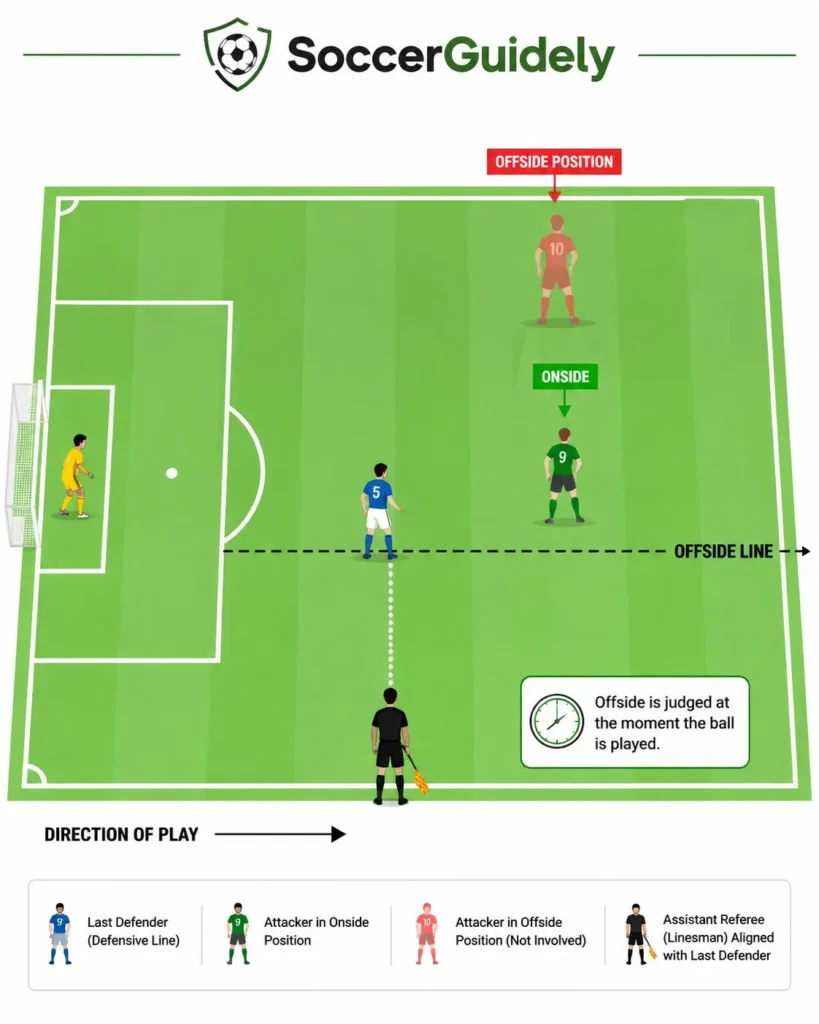
Once that clicks, the rule stops feeling like an arbitrary buzzkill. It starts feeling like what it actually is: a smart little mechanism keeping soccer from turning into cherry-picking long-ball chaos. For the full breakdown of the rule from the ground up, start with our complete offside rule guide, or dig into exactly how referees make that split-second read if you want to go even deeper.
Frequently Asked Questions About Offside Confusion
Q1: Why is offside so hard for Americans to understand?
A: Offside is hard for Americans to understand because no major US sport has an equivalent rule. Football, basketball, and hockey all give fans a natural stoppage point between plays. Soccer’s offside is judged in a single continuous instant during open play, which nothing in American sports trains fans to watch for.
Q2: Why don’t Americans understand offside compared to other countries?
A: Fans in soccer-first countries absorb offside terminology gradually over decades of casual childhood exposure, the same way Americans absorb terms like pass interference or holding. American fans encountering the World Cup for the first time are learning this vocabulary all at once, as adults, without that decades-long familiarity.
Q3: Is offside judged when the ball is passed or when it’s received?
A: Offside is judged at the exact moment a teammate plays the ball, not when the receiving player touches it. This single-instant judgment has no direct equivalent in NFL, NBA, or NHL positioning rules, which is a major reason the concept feels unfamiliar to American fans.
Q4: Will offside be more confusing at the 2026 World Cup?
A: Possibly more visible, yes. According to FIFA, the semi-automated offside system now issues an audio alert when a player is offside by at least 10 centimeters, a tighter threshold than in earlier trials. This increased precision means more borderline calls will be flagged and shown on replay.
Q5: Does this confusion only happen during the World Cup?
A: No. The same offside confusion resets for new fans every MLS and NWSL season, not just during the World Cup. Understanding the structural reasons behind the rule helps regardless of which competition or broadcast a fan is watching.
More on the Offside Rule
- What Is Offside in Soccer, The Complete Rule Guide
- Common Offside Myths, Debunked
- Offside Timing in Soccer, When Exactly Is the Call Made
- VAR Offside Decisions at the 2026 World Cup
- The Offside Trap Explained
Want to catch every one of these moments as they happen this summer? Our newsletter breaks down the rules and history behind the biggest plays at World Cup 2026, written for fans who are still learning the game. And if you want to keep going deeper into how offside actually works, start with our full soccer rules hub.
About This Article
All rule references verified against IFAB’s official historical archive and the current Laws of the Game, Law 11. Google Trends search-ranking data referenced in this article was compiled around the 2026 World Cup tournament window. World Cup 2026 semi-automated offside technology details verified against FIFA-adjacent reporting current as of July 2026. Reviewed for accuracy before publication by the SoccerGuidely Editorial Team.