Written by the SoccerGuidely Editorial Team. Covering soccer rules and history for American fans ahead of the 2026 World Cup. Last updated: July 2026. Verified against IFAB’s historical archive and Laws of the Game.
Offside and onside are opposite terms describing a player’s legal position on the field. A player is offside if they’re closer to the opponent’s goal than both the ball and the second-to-last defender when a teammate plays the ball. A player is onside if they’re level with or behind that defender, or behind the ball. Onside is legal. Offside can lead to a penalty, but only if the player gets involved in the play.
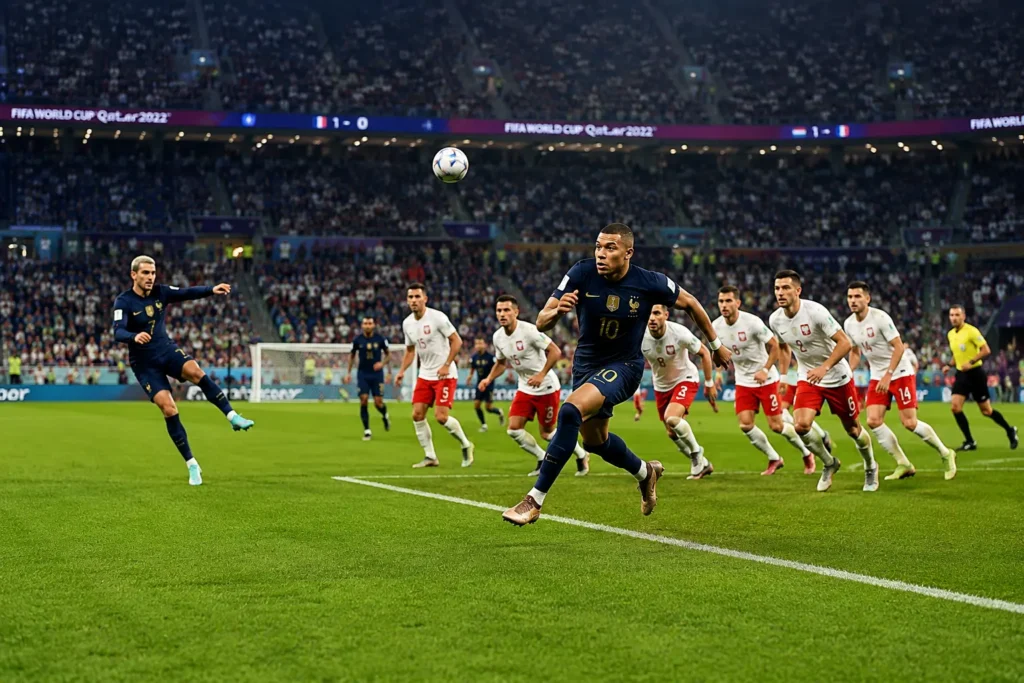
Your buddy yells “he’s onside!” Two seconds later the flag goes up and someone else yells “no, offside!” Same play. Two different words. And you’re standing there wondering if either of them actually knows the difference.
Offside vs onside sounds like a simple swap. It’s not. Mixing them up is basically the entire reason this rule feels so confusing. Once you see them side by side, though, the whole thing clicks pretty fast.
What’s the Actual Difference Between Offside and Onside?
Onside means legal. Offside means illegal, but only if the player is involved in the play. They’re direct opposites describing where a player is standing when the ball gets played.
If you’ve been to even one soccer watch party this year, you’ve heard both words tossed around like they mean the same thing. They don’t. Offside and onside are literal opposites, and getting that straight is basically the whole key to finally understanding this rule.
Think of it like a false start in football. There’s a legal position, staying set before the snap, and an illegal one, jumping early. Offside and onside work the same way. Just with a moving ball instead of a snap count.
What Does Onside Actually Mean in Soccer?
Onside just means legal. Simple as that. A player is onside if, the moment their teammate plays the ball, they’re level with or behind the second-to-last defender, or level with or behind the ball itself. Onside players can receive a pass and do whatever they want with it. No penalty. No whistle. Nothing.
This is actually the default state in soccer, by the way. Most players, most of the time, are onside. Offside is the exception that gets flagged, not the other way around, even though it sure doesn’t feel that way when you’re new to the sport.
What Does Offside Actually Mean in Soccer?
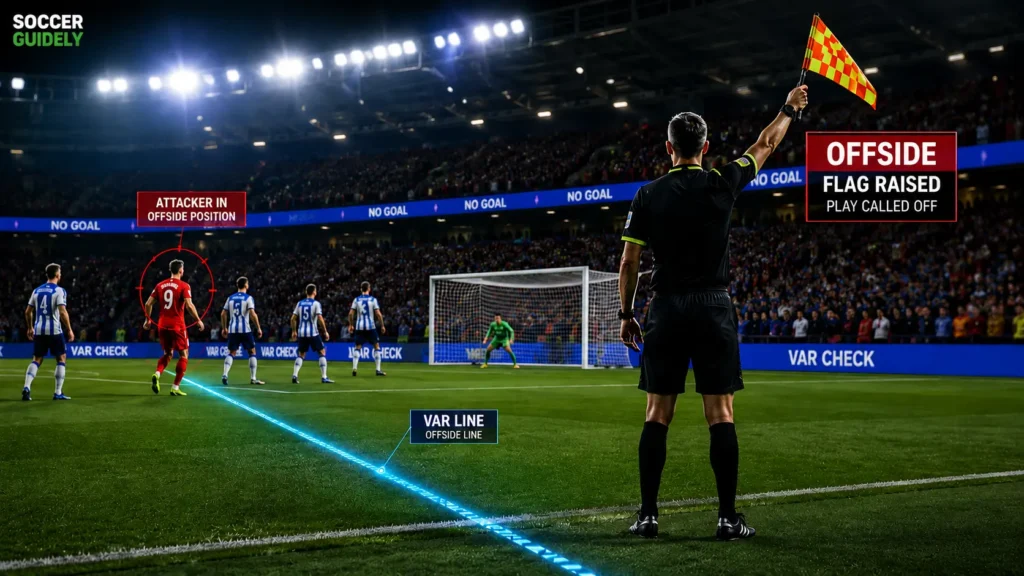
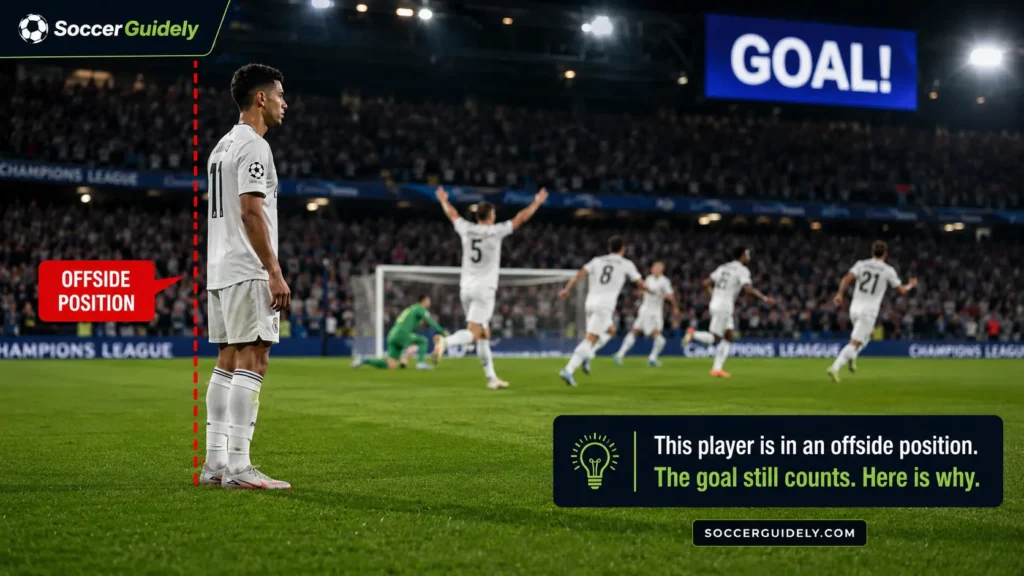
Offside means a player’s in an illegal position when the ball gets played, closer to the opponent’s goal line than both the ball and the second-to-last defender. Here’s the part that trips people up constantly, though. Being offside isn’t automatically a violation. Under Law 11 of the Laws of the Game, it only becomes one, an actual “offside offense,” if that player gets involved in the play afterward.
So there’s a real difference between an offside position and an offside offense. A player can stand in an offside position all game long and never get flagged for it once, as long as he doesn’t touch the ball or interfere with anyone while he’s standing there. If you’ve ever heard someone claim that just standing offside is always a foul, that’s one of the most common offside myths out there.
Look, this is where most of the confusion actually lives. People hear “offside position” and figure that’s the end of the story. It’s not. It’s just the setup.
How Do Offside and Onside Compare Side by Side?
| Onside | Offside | |
|---|---|---|
| Legal? | Yes, always | Only a violation if involved in play |
| Position relative to defense | Level with or behind 2nd-to-last defender | Ahead of 2nd-to-last defender and the ball |
| Can receive the ball? | Yes, freely | No, if in offside position and involved |
| Penalty if called | None | Indirect free kick to defending team |
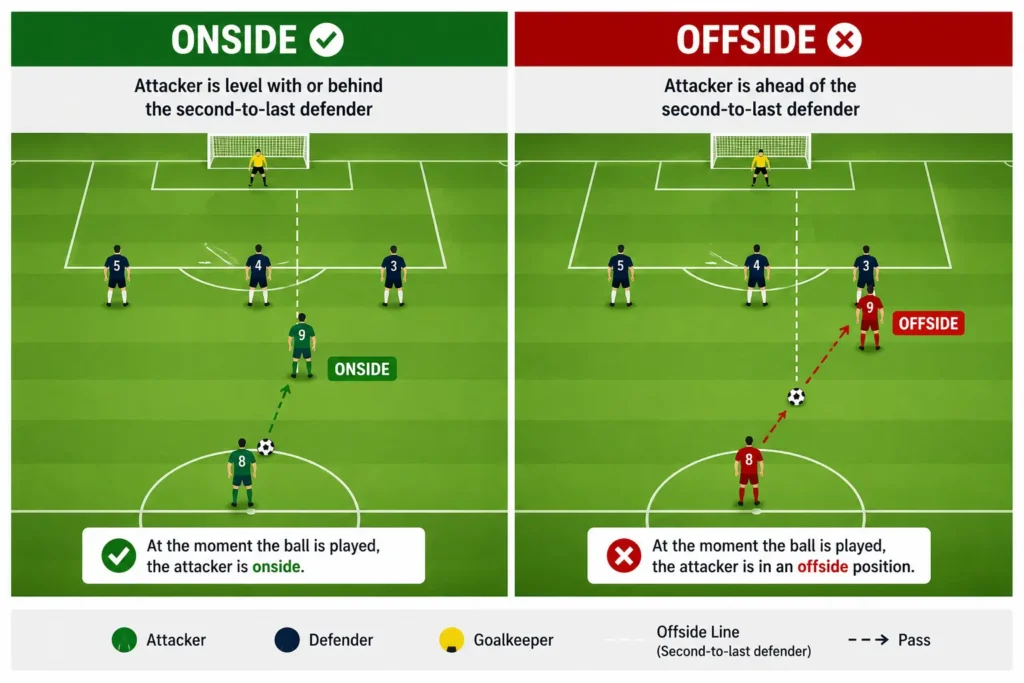
Here’s something coaches know that fans don’t. Elite defenders don’t just try to keep attackers offside, they deliberately position themselves as close to the offside line as possible without stepping over it, essentially playing a few inches from their own penalty. This is intentional. The tighter the defensive line squeezes toward midfield while staying legal, the less space attackers have to work with behind it.
This is why you’ll sometimes see a center back glance backward constantly during a game, not out of nerves, but to make micro-adjustments to stay exactly level with his teammates. If one defender drifts even a step deeper than the rest, he single-handedly creates a gap that plays every attacker onside who reaches that deeper line instead of the higher one. A back line that fails to stay synchronized is one of the most common reasons a well-organized offside trap breaks down completely. It’s not about being fast. It’s about four or five players agreeing, silently, on exactly where “onside” ends, play after play, for 90 minutes straight.
How Does a Player Go From Onside to Offside Mid-Play?
A player’s onside/offside status locks in at the moment the ball is played, so a player who was legal at that instant can sprint far ahead of the defense afterward and still be completely onside.
Quick thing to remember before the scenario: being exactly level with the second-to-last defender counts as onside, not offside. That one detail matters a lot for what happens next.
Picture this. A striker starts his run right next to the second-to-last defender, dead level with him. The moment the pass gets played, the striker’s onside. As soon as the ball leaves the passer’s foot, the striker takes off, blowing right past the defender while the ball’s still traveling through the air. By the time he actually touches it, he’s ten yards clear of everyone.
Totally legal. Offside gets judged at the moment of the pass, not the moment of reception, and at that exact moment, he was onside.
This is exactly the kind of play that makes American fans lose their minds at a watch party, because visually, in real time, it looks offside as heck. It isn’t. The timing’s what matters. Not how it looks a beat later on the replay.
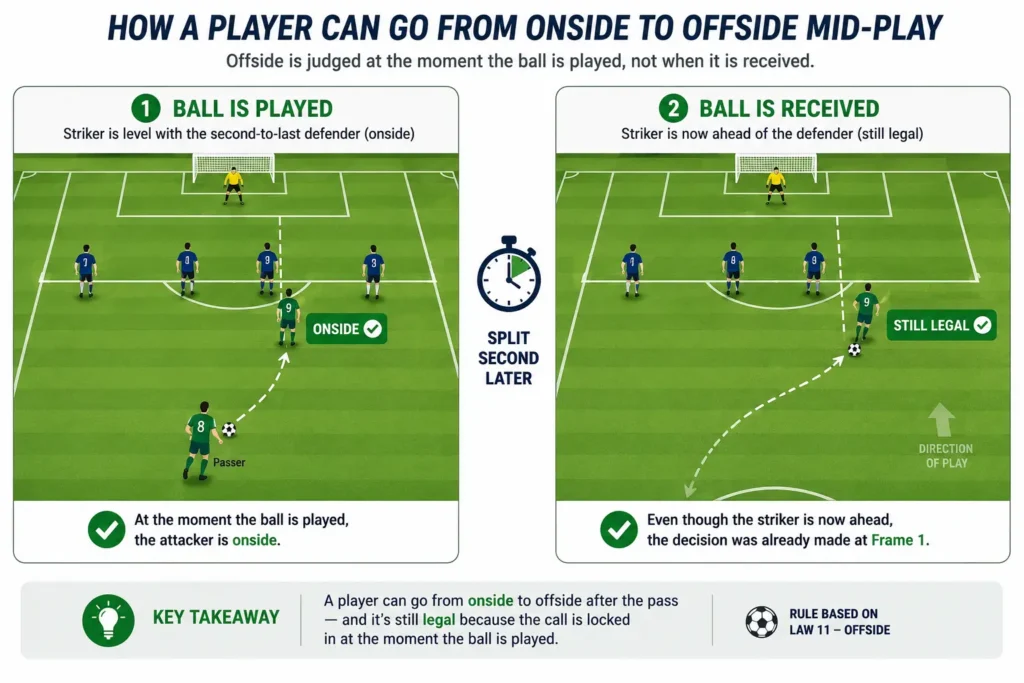
There’s a common mistake buried right in this scenario, and it happens constantly. Fans assume that because a player looks miles ahead of the defense the moment he touches the ball, he must’ve been offside. That’s judging the wrong moment entirely. The only frame that counts is when the ball left the passer’s foot, not whatever the replay shows a couple seconds after. Another common mix-up, people assume offside applies anywhere on the field. It doesn’t. A player can never be offside in his own half, no matter how far ahead of the defense he’s standing, because the rule only kicks in once you cross into the opponent’s territory.
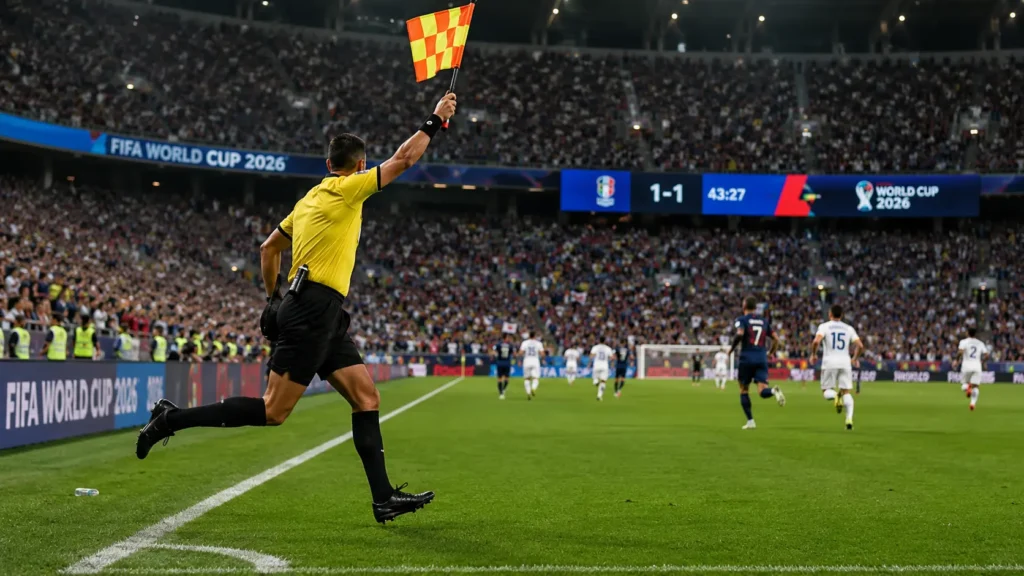
Here’s something that confuses people even more in the moment. Sometimes an offside player keeps running and even touches the ball before the flag goes up at all. That’s not the official missing it. Assistant referees are trained to briefly delay raising the flag on purpose, giving the play a second to develop in case a deflection changes things or a different, onside teammate ends up with a better shot at the ball. We’ve seen this exact pause confuse a whole room of people, the flag doesn’t go up right away and everyone assumes the ref just missed an obvious call. Usually, he didn’t. He’s just making sure the call is right before he makes it.
What most American fans don’t realize is that broadcast replay technology and official offside-review technology are not the same tool, and they don’t always agree visually, even when the official call is completely correct. The line you see drawn on your TV screen during a replay is often a simplified broadcast graphic, generated at a slight delay and rendered from a single camera angle. The actual review used by officials pulls data from multiple tracked camera angles synced to the exact moment the ball was played, a meaningfully more precise process.
This mismatch is exactly why a call can look wrong on your phone or living room TV and still be completely accurate. You’re not seeing the same data the officials used to make the decision, you’re seeing a simplified visual approximation of it, produced for broadcast, not officiating. Once you know that, a lot of “how is that even offside” moments make a lot more sense. It’s not that the call was wrong. It’s that what you saw wasn’t the actual evidence.
How Does This Compare to Position Rules in American Sports?
In football, a receiver has to stay onside of the line of scrimmage until the ball’s snapped, and that gets judged continuously through the whole play, not at one frozen moment. In basketball, a player’s got three seconds to clear the paint. Again, a duration. Not an instant.
Soccer’s offside and onside call gets judged in a single frozen instant instead. That’s honestly one of the most different things about this rule compared to anything in American sports, and it’s a huge reason it feels so foreign the first few times you see it.
Why Does Knowing the Difference Actually Matter?
Understanding onside versus offside changes how you watch the whole game, genuinely. Instead of panicking every time a striker looks way ahead of the defense, you start asking the right question. Where was everyone when the ball actually got played? That’s it. That’s the whole rule once you strip away the confusion.
What most American fans don’t realize is that even professional broadcasters occasionally call a legal onside run “offside” in the heat of the moment, purely because it looks that way in real time. If the pros can get fooled by the visual, you’re in good company when it happens to you too. For a deeper look at exactly how that split-second judgment works, see our guide on offside timing in soccer.
Why Does This Matter Heading Into the 2026 World Cup?
With the 2026 World Cup bringing a massive wave of new fans into the sport here in the US, this exact distinction is going to come up constantly. Every group chat. Every sports bar TV. and Every argument about a disallowed goal. According to Google Trends data tracked around the tournament, offside-related searches spike heavily during and after marquee matches, which tells you this confusion isn’t rare. It’s basically guaranteed to happen to somebody in your room this summer.
According to FIFA, the semi-automated offside technology used at the 2026 World Cup tracks player positioning with far more precision than a human linesman ever could, which means the exact line between onside and offside is getting drawn with real data now, not just a guess from 30 yards away. That’s good news for accuracy. It also means when a call gets confirmed, it’s genuinely correct almost all the time, even when it looks wrong on a phone screen replay.
Here’s the part almost nobody’s connecting for American fans heading into this tournament. FIFA’s semi-automated offside system doesn’t just draw a more accurate line, it fundamentally changes how quickly officials can confirm whether a player was onside or offside in the first place. Previous World Cups relied heavily on a human assistant referee’s eye for the initial call, with VAR only stepping in afterward to double-check close calls, often creating a multi-minute delay while a goal celebration hangs in limbo.
For 2026, the system is designed to flag clear offside positions to officials almost instantly, which means fewer of those long, awkward “everyone’s just standing around waiting” moments that made past tournaments frustrating for new viewers specifically. That’s a meaningful shift for American audiences in particular, since one of the biggest complaints casual US sports fans have about VAR delays is the dead time it creates in a sport that already has fewer natural stoppages than football or basketball. Faster onside and offside confirmations this summer means less standing around, which is exactly the kind of change that makes soccer feel more watchable to an audience used to constant action.
Knowing the difference cold means you’re not the person asking what happened. You’re the person explaining it. And it’s not just a World Cup thing either, this same onside and offside distinction plays out every single MLS and NWSL match too, so this knowledge sticks around long after the tournament ends.
What’s the Bottom Line on Offside vs Onside?
Onside is legal, always. Offside is only a violation if the player’s involved in the play. The dividing line is the second-to-last defender, and the moment that actually matters is when the ball is played, not when it’s received.
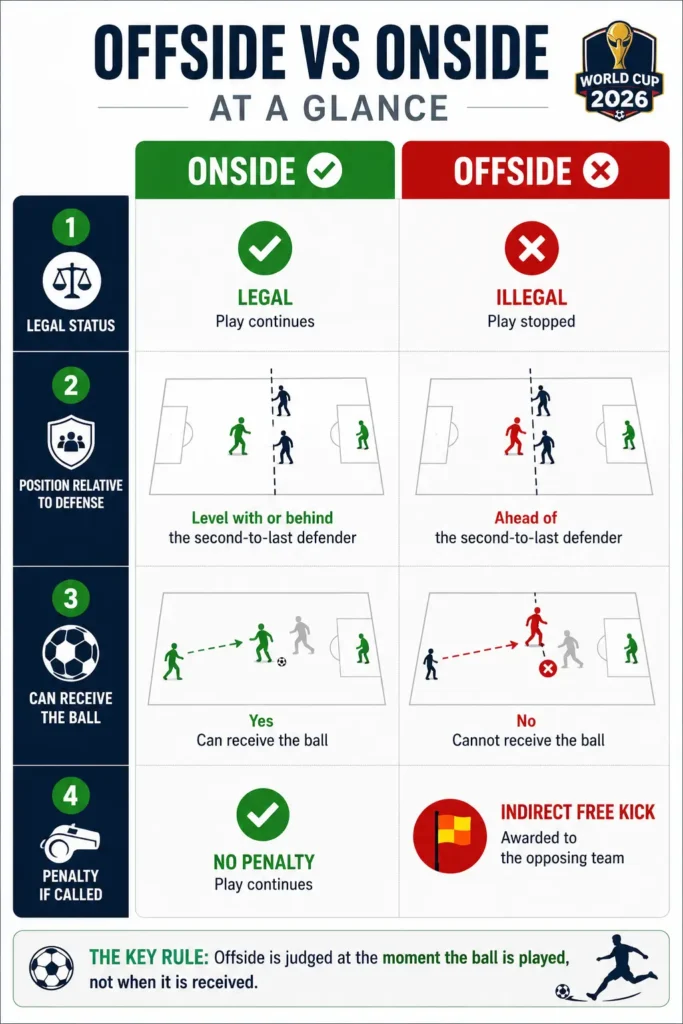
Get that timing piece right, and offside stops being the confusing rule everyone complains about. It just becomes another part of the game you actually understand. For the full breakdown of the rule from the ground up, start with our complete offside rule guide.
Frequently Asked Questions About Offside vs Onside
Q1: What is the difference between offside and onside in soccer?
A: Onside means a player is in a legal position, level with or behind the second-to-last defender or the ball, when a teammate plays the ball. Offside means a player is ahead of that defender and the ball at that same moment, which can lead to a penalty if the player gets involved in play.
Q2: Is being level with the defender offside or onside?
A: Being exactly level with the second-to-last defender counts as onside, not offside. A player must be strictly ahead of that defender, closer to the goal line, to be in an offside position when the ball is played.
Q3: Can a player be onside when the ball is played and still score legally after running past defenders?
A: Yes. Offside is judged at the exact moment a teammate plays the ball, not when it’s received. A player who is onside at that instant can legally sprint past defenders and score, even if they look far offside by the time they touch the ball.
Q4: Can a player be offside in their own half of the field?
A: No. A player can never be called offside while in their own half. The offside rule only applies once a player has crossed into the opponent’s half of the field.
Q5: Does being offside always result in a penalty?
A: No. Being in an offside position is not automatically a violation. It only becomes an offside offense, punished with an indirect free kick, if the player becomes involved in play by touching the ball, interfering with an opponent, or gaining a clear advantage.
More on the Offside Rule
- What Is Offside in Soccer, The Complete Rule Guide
- Common Offside Myths, Debunked
- Offside Timing in Soccer, When Exactly Is the Call Made
- VAR Offside Decisions at the 2026 World Cup
- The Offside Trap Explained
Want to catch every one of these moments as they happen this summer? Our newsletter breaks down the rules and history behind the biggest plays at World Cup 2026, written for fans who are still learning the game. And if you want to keep going deeper into how offside actually works, start with our full soccer rules hub.
About This Article
All rule references verified against IFAB’s official historical archive and the current Laws of the Game, Law 11. Google Trends search data referenced in this article was compiled around the 2026 World Cup tournament window. World Cup 2026 semi-automated offside technology details verified against FIFA-adjacent reporting current as of July 2026. Reviewed for accuracy before publication by the SoccerGuidely Editorial Team.