Written by the SoccerGuidely Editorial Team. Covering soccer rules and history for American fans ahead of the 2026 World Cup. Last updated: July 2026. Verified against IFAB’s historical archive and Laws of the Game.
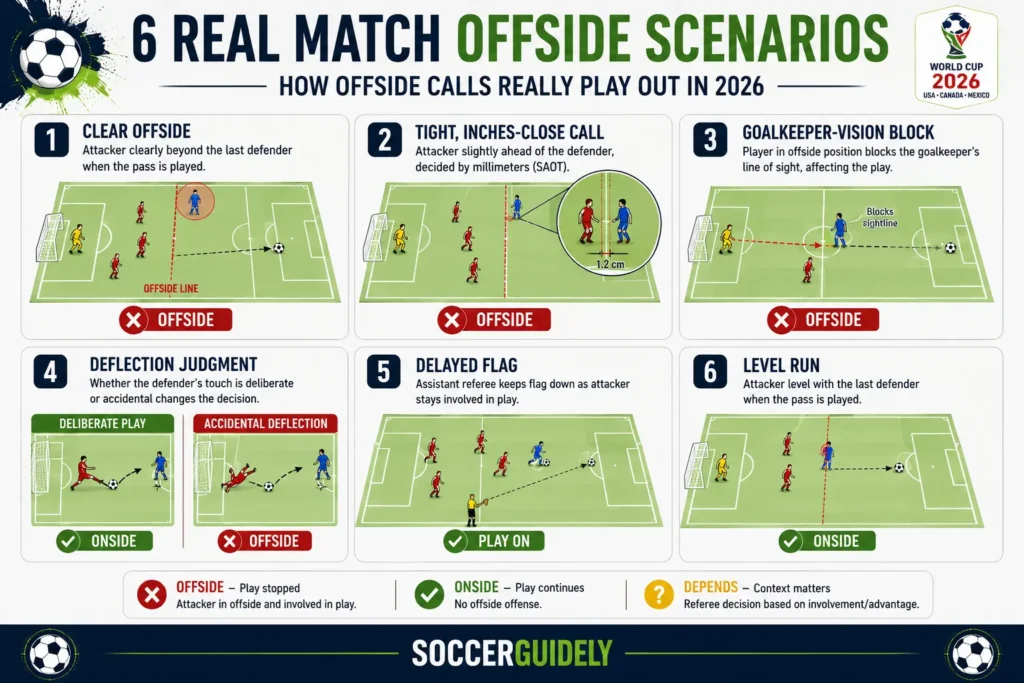
Offside in real match scenarios usually comes down to a handful of recurring situations: a clear offside run, a tight call decided by inches, a player blocking the goalkeeper’s view, and a deflection off a defender that changes everything. Each type gets judged differently depending on involvement, timing, and body position. Understanding these common patterns makes it much easier to read any offside call you see during a live match.
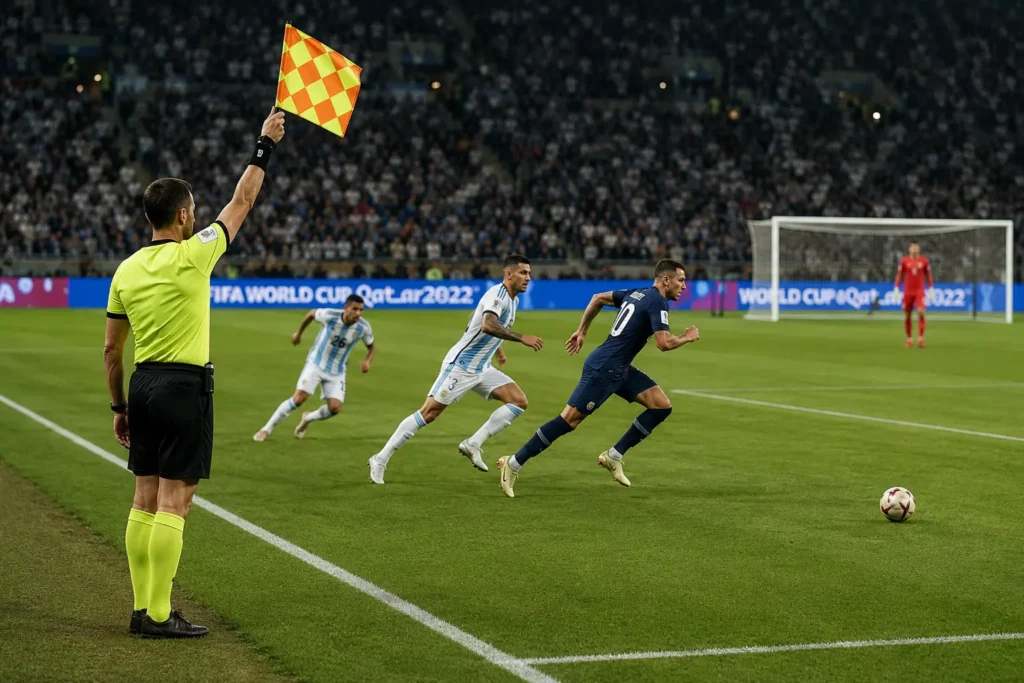
You know pass interference the second you see it in football. Somebody grabs a jersey, flag’s already in the air before you finish your sentence. Then you watch your first soccer match, a goal gets wiped out, and you have no idea which of six different things just happened.
Offside in real match scenarios rarely looks like the textbook definition. It looks like a dozen different situations that all get called the exact same word. Let’s break down what those situations actually are.
Why Does Offside Look So Different in a Real Match Than on Paper?
Real matches involve dozens of moving variables at once, position, timing, deflections, and sightlines, none of which a single textbook sentence can fully capture.
Reading the offside rule on paper is one thing. Watching it happen live, during an actual match, is a totally different experience. This is where most American fans get stuck. You know the definition, technically. Then a flag goes up during a real game and you’re left wondering how that call even applies here.
Look, the rule itself is simple. It’s the situations it shows up in that get complicated. So let’s walk through the scenarios that come up over and over in real matches. Think of this as game film study, but for a rule instead of a play.
Quick overview of the six situations we’re covering, before we break each one down:
| Scenario | What Happens | Call Result |
|---|---|---|
| Clear offside | Attacker way ahead of last defender at the pass | Offside, no debate |
| Tight, inches-close call | Attacker inches ahead, judged by tech | Offside, confirmed by SAOT |
| Goalkeeper-vision block | Player blocks keeper’s sight without touching ball | Offside, interference |
| Deflection judgment | Ball deflects off a defender to an offside player | Depends on deliberate play |
| Delayed flag | Flag held to let the play develop | Often still offside, just delayed |
| Level with defender | Attacker exactly even, not ahead | Onside, legal |
What Does a Clear, Obvious Offside Call Look Like?
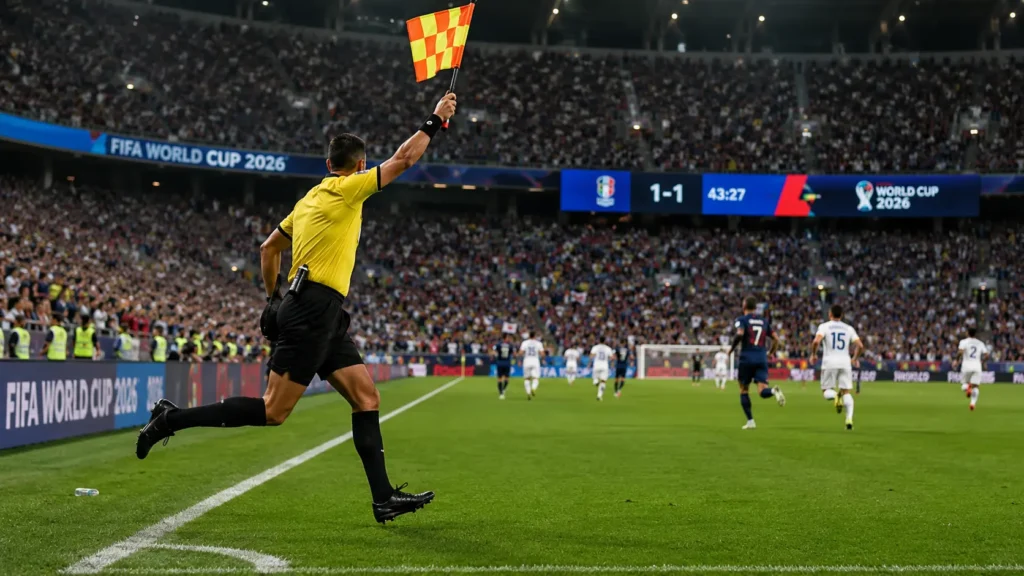
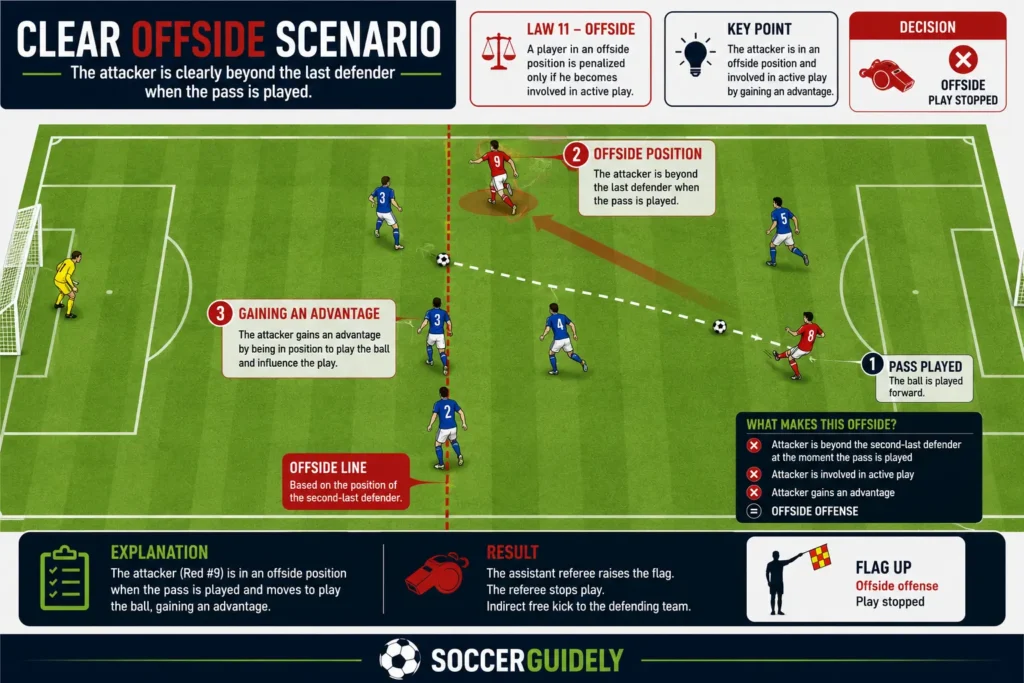
This is the most common type you’ll see. Honestly, it’s the easiest to spot once you know what to look for. A striker makes a run in behind the defense, way ahead of the last defender, and a teammate plays a through ball to him. The moment the pass is made, he’s already several yards past the last guy.
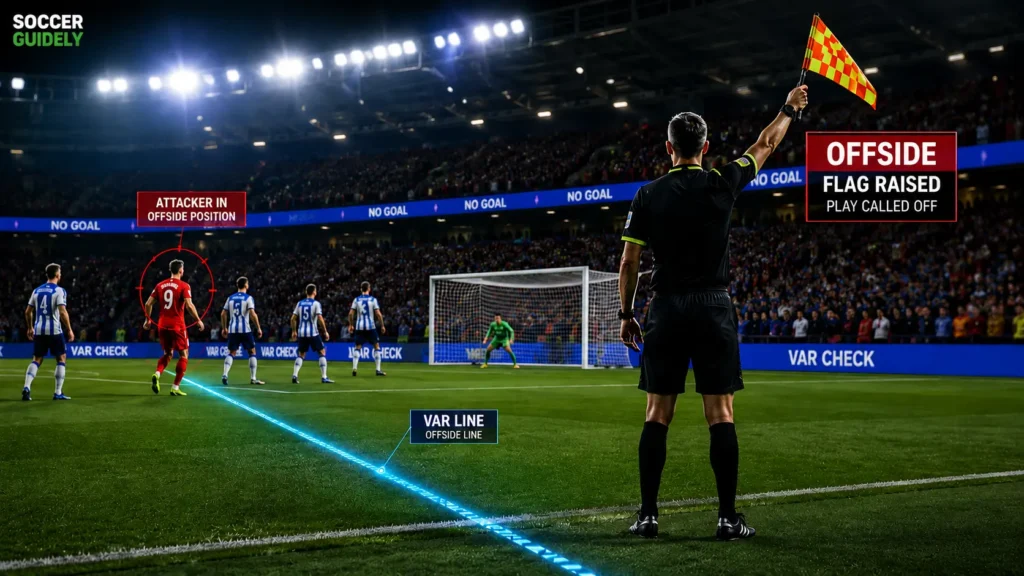
That’s a clear offside. No controversy. No debate. Flag goes up, whistle blows, indirect free kick to the defending team. In football terms, this is like a receiver who’s five yards past his defender before the ball’s even thrown. Completely uncovered. Obvious to everyone watching, refs included. If you want to go back to basics on how this position is actually defined, check out our guide on the basics of the offside position.
What Happens When Offside Comes Down to Inches?
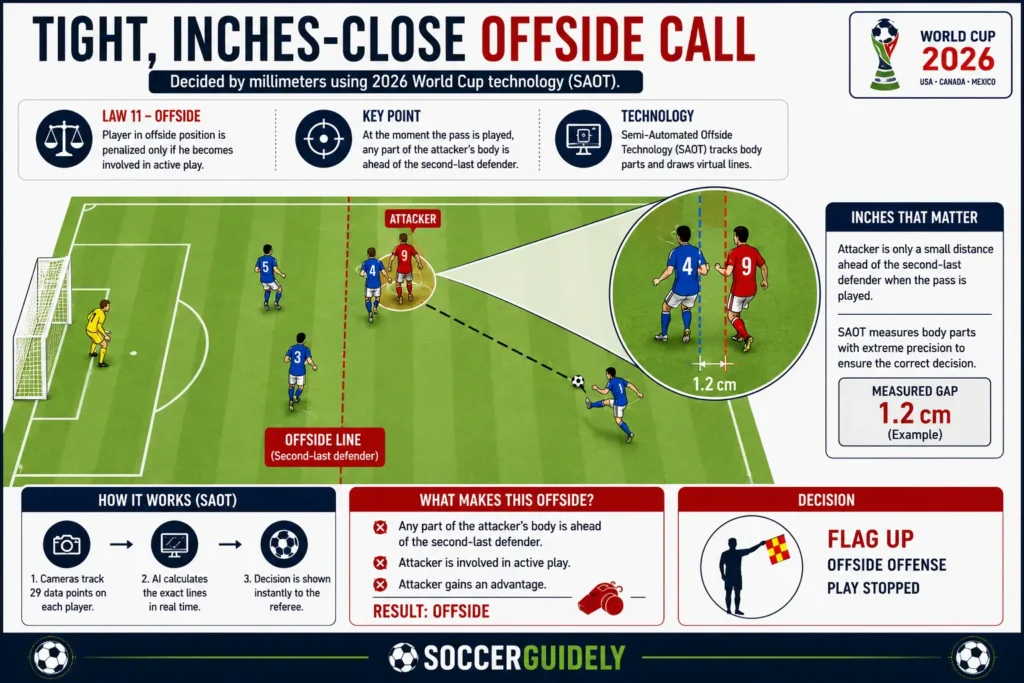
This is the scenario that actually makes people mad. A striker times his run almost perfectly, and by the time the ball’s played, he’s maybe six inches ahead of the last defender. To the naked eye, watching live, it looks dead even. It isn’t. Six inches is still offside.
According to FIFA, the semi-automated offside technology used at the 2026 World Cup tracks player positioning with far more precision than a human linesman ever could, drawing a defined line at the exact moment the ball’s played. So when you see that broadcast graphic showing a tiny sliver of daylight between attacker and defender, this is the scenario behind it.
What most American fans don’t realize is that not every offside situation actually gets sent to VAR for review, even at the 2026 World Cup, even with semi-automated tracking running constantly in the background. The technology tracks positioning on every single play, but a formal review only gets triggered when a goal is scored or a clear goal-scoring opportunity is directly impacted by the call. A tight offside call in the middle of the park, with no shot or goal attached to it, generally doesn’t get the same slow-motion scrutiny a disallowed goal does.
This explains why some genuinely close offside calls seem to fly under the radar entirely while others become the center of a multi-minute stoppage and instant replay circus. It’s not inconsistency on the officials’ part. It’s that the review process is specifically built around moments that directly change the outcome of the game, not every marginal call across 90 minutes. If you’re watching a match and notice a tight offside get waved off with zero fanfare early in a half, that’s often just because nothing decisive was riding on it at that exact moment.
Can a Player Be Called Offside Without Ever Touching the Ball?
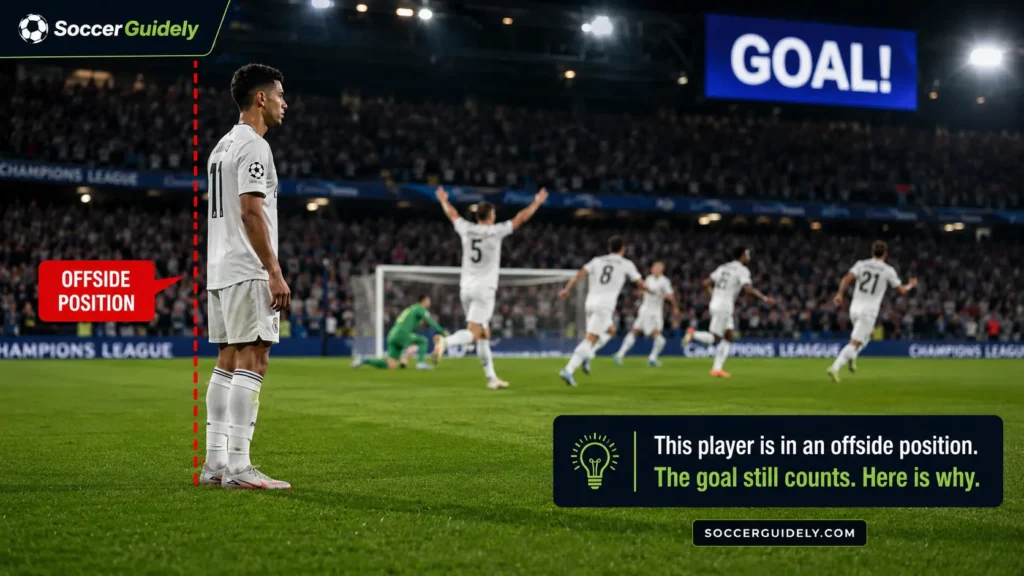
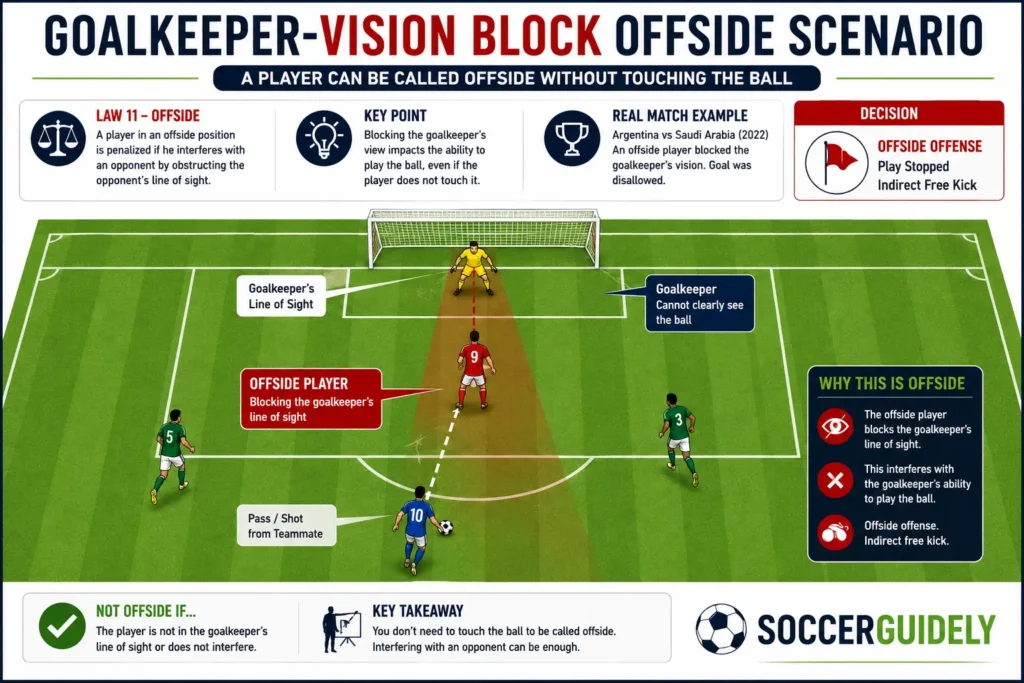
Yes. A player can be flagged offside without touching the ball at all if they block the goalkeeper’s line of sight when a teammate shoots.
This one confuses beginners constantly. A player’s standing in a clearly offside position. The ball never actually gets passed to him, though. It goes to a different, onside teammate instead, who scores. And yet, somehow, the offside guy still gets flagged.
Why? Because he was blocking the goalkeeper’s line of sight when the shot was taken. Under Law 11 of the Laws of the Game, obstructing the keeper’s ability to see and react to a shot counts as interference, even without touching the ball at all. This exact type of call made headlines during a Premier League match in October 2024, when a goal was initially disallowed because a player was ruled to be standing in the goalkeeper’s line of vision, before VAR reviewed the footage and determined he actually had no real impact on the keeper’s ability to see the shot, overturning the call. Sneaky little rule, honestly, and it trips up new fans every single time it happens.
Think of it like a wide receiver who never touches a jump ball but still gets flagged for pushing off a defender to create separation. He didn’t catch anything, but his positioning still affected the play, and that’s enough to draw a penalty. Same logic applies here.
Here’s the part almost nobody’s connecting for American fans heading into this tournament. Goalkeeper-vision interference calls, like the scenario above, have historically been some of the most inconsistently applied offside decisions in the sport, because judging a goalkeeper’s actual sightline requires a subjective read on camera angles that often don’t match what the goalkeeper themselves could see in real time.
For 2026, officials reviewing these specific situations have access to more camera angles and tracking data than in any previous tournament, giving them a far more complete picture of exactly where a goalkeeper’s line of sight was obstructed, rather than relying on a single broadcast angle that might not tell the whole story. This means the maddeningly subjective goalkeeper-vision call, the exact type of scenario that produced real controversy in recent seasons, should actually become one of the more consistently and confidently reviewed situations at this World Cup, not a less certain one. For American fans who are used to instant replay resolving disputes cleanly in football, this is one area where soccer’s officiating is genuinely catching up to that same standard for the first time on a global stage.
Does a Deflection Off a Defender Cancel an Offside Call?
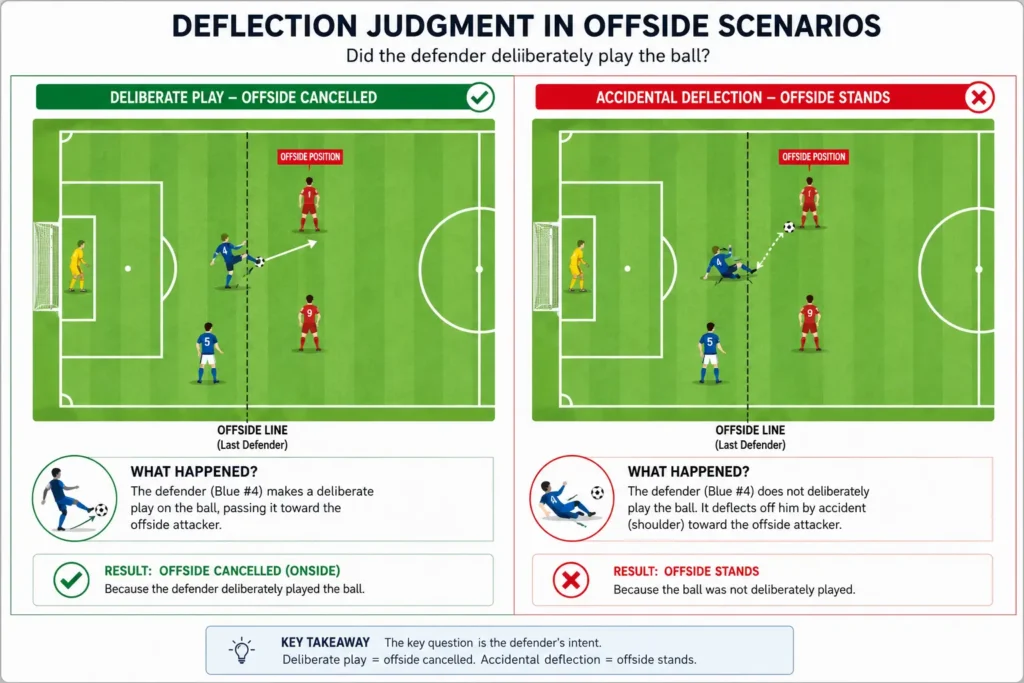
It depends. If the defender’s touch was a genuine, controlled play, the offside gets wiped out. If it was just an accidental deflection, the offside call still stands.
Here’s a genuinely tricky one. A player’s standing in an offside position. A defender then plays the ball, maybe attempting a clearance, and it deflects unintentionally right to the offside guy, who scores.
Whether that counts as offside depends entirely on one thing, was the defender’s touch a deliberate play or an accidental deflection. Genuine, intentional touch, even a bad one, and the offside usually gets wiped out. Unlucky deflection with zero real control? Offside call stands.
Picture it this way. A center back tries to clear a cross with a full swing of his leg, but shanks it badly, and the ball bounces straight to an attacker standing offside. That’s a deliberate play, a real attempt to control and clear the ball, so the offside gets canceled. Now picture the same cross clipping off the center back’s shoulder as he’s simply falling over, with zero attempt to play it, and landing at that same attacker’s feet. That’s an accidental deflection, so the offside call stands, even though visually the two situations can look almost identical in real time. This distinction is one of the most argued-about parts of the entire sport, and refs have to make the call in a split second, no instant replay in their head to fall back on.
Why Does the Assistant Referee Sometimes Delay Raising the Flag?
Officials intentionally delay the flag for a moment to let the play develop, in case the ball deflects to a different, onside player before the situation is fully clear.
Sometimes you’ll watch an offside player keep running, even touch the ball, and the flag just doesn’t go up right away. Looks like the assistant referee flat out missed it. Usually, that’s not what happened at all.
Officials are trained to briefly delay the flag on purpose, to let the play develop. If the ball might deflect to a different, onside player, or the situation isn’t fully clear yet, waiting half a second saves everyone from a wrongly stopped play. Listen for the commentator during this exact moment, you’ll often hear something like “they’re letting this play out” or “advantage being played,” which is your cue that officials are watching closely, not missing anything.
We’ve watched this exact pause get mistaken for a blown call more times than we can count. Genuinely one of the most misunderstood moments in the sport for new fans. Looks like an error. Is actually patience.
Is Being Level With the Defender Offside or Onside?
A striker’s running stride for stride with the last defender. Exactly even. Not ahead, not behind. The ball gets played into the space behind them. Because the striker was level, not ahead, at the moment of the pass, this is completely onside.
This is one of the most common mistakes casual fans make watching a real match. Level looks close enough to call offside. It isn’t. The rule’s specific here. Ahead of the defender is offside. Level with the defender is legal, full stop.
Another common mistake happens when fans judge the moment the attacker receives the ball instead of the moment it’s played. That flips the entire call in their head, even though the ref got it exactly right the whole time.
Here’s something coaches know that fans don’t. Elite strikers don’t actually try to time their run to be exactly level with the last defender, they train to stay a half-step behind on purpose, even though that seems like it’s giving up an advantage. The reasoning is simple. Reaction time isn’t instant. If a striker tries to break perfectly level, any tiny hesitation, a flinch, a late read on the pass, puts him a fraction ahead at the moment the ball is actually played, and that’s an offside call.
By deliberately starting a half-step behind the defender, strikers build in a small margin of error for their own reaction time, so that even a slightly early jump still lands them onside. This is why you’ll sometimes see a striker who looks like he “should” have gone for the ball earlier hold back for a beat, it’s not hesitation, it’s a calculated buffer against getting caught by his own timing. Coaches drill this specific habit constantly with strikers who have a tendency to break too early, since one blown offside call in a promising position can waste an entire buildup.
Why Do These Scenarios Matter for American Fans at the 2026 World Cup?
With the World Cup landing on US soil this summer, millions of Americans are going to watch all six of these exact scenarios play out across dozens of matches. According to Google Trends data tracked around the tournament, offside-related searches spike heavily right after high-profile disallowed goals. Which tells you these exact moments are already driving real confusion, in real time, for real people.
What most American fans don’t realize is that these same six scenarios repeat constantly across MLS and NWSL matches too, not just the World Cup. Recognizing the pattern instead of just reacting emotionally to a disallowed goal is what separates someone actually learning the sport from someone just yelling at the TV.
What’s the Bottom Line on Reading Real Match Offside Calls?
Real match offside calls almost always boil down to one of these situations. A clear run. A tight inch-based call. A goalkeeper-vision block. A deflection judgment. A delayed flag. Or a level, legal run.
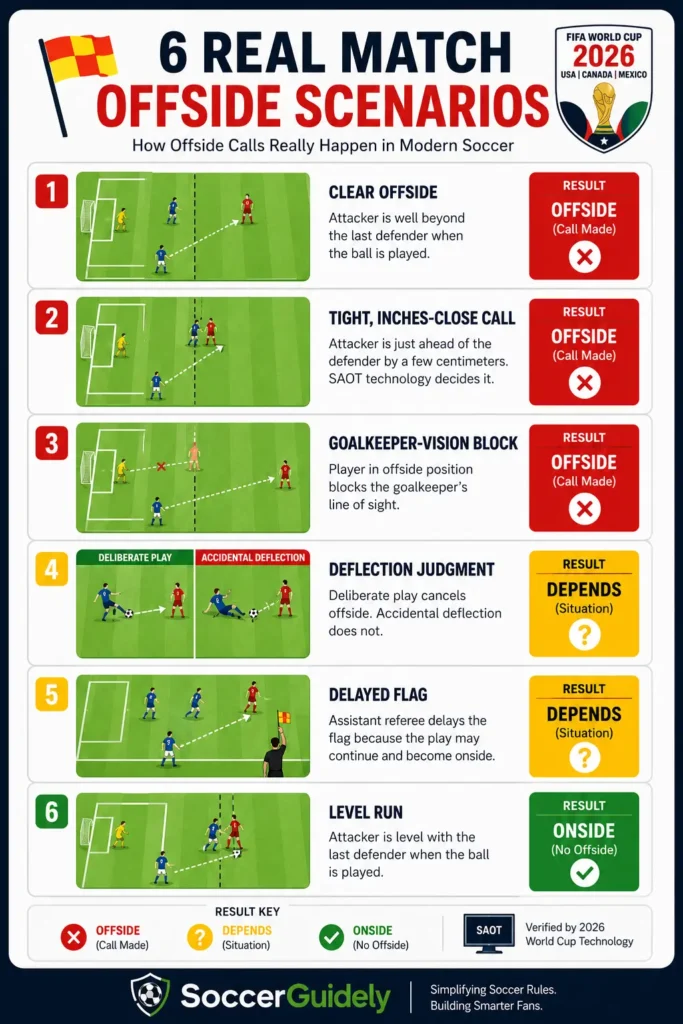
Once you can recognize which type of scenario you’re watching, the confusing flag on the screen stops feeling random. It starts making sense. For the full breakdown of the rule from the ground up, start with our complete offside rule guide.
Frequently Asked Questions About Offside in Real Matches
Q1: Can a player be offside without touching the ball?
A: Yes. A player in an offside position can be flagged even without touching the ball if they interfere with play, such as blocking the goalkeeper’s line of sight during a shot. Under Law 11 of the Laws of the Game, this counts as interference regardless of physical contact with the ball.
Q2: Does a deflection off a defender cancel an offside call?
A: It depends on whether the defender’s touch was a deliberate play or an accidental deflection. A genuine, controlled touch, even a poor one, usually cancels the offside. An accidental deflection with no real control still leaves the offside call standing.
Q3: Why does the assistant referee sometimes delay raising the offside flag?
A: Officials intentionally delay the flag for a moment to let a play develop, in case the ball deflects to a different, onside teammate before the situation is fully clear. This brief pause is a deliberate officiating technique, not a missed call.
Q4: Is a player onside if they are level with the last defender?
A: Yes. A player is onside if they are exactly level with the second-to-last defender at the moment the ball is played. Only being strictly ahead of that defender counts as an offside position.
Q5: How does technology help with tight, inches-close offside calls?
A: Semi-automated offside technology used at the 2026 World Cup tracks player positioning with far more precision than a human official can judge by eye, drawing an exact line at the moment the ball is played. This allows extremely close calls to be confirmed accurately, even when the gap is only a few inches.
More on the Offside Rule
- What Is Offside in Soccer, The Complete Rule Guide
- Offside vs Onside, The Complete Comparison
- VAR Offside Decisions at the 2026 World Cup
- Active vs. Passive Offside Explained
- Common Offside Myths, Debunked
Want to catch every one of these moments as they happen this summer? Our newsletter breaks down the rules and history behind the biggest plays at World Cup 2026, written for fans who are still learning the game. And if you want to keep going deeper into how offside actually works, start with our full soccer rules hub.
About This Article
All rule references verified against IFAB’s official historical archive and the current Laws of the Game, Law 11. The Premier League goalkeeper-vision VAR overturn referenced in this article is based on publicly reported match officiating from October 2024. Google Trends search data referenced in this article was compiled around the 2026 World Cup tournament window. World Cup 2026 semi-automated offside technology details verified against FIFA-adjacent reporting current as of July 2026. Reviewed for accuracy before publication by the SoccerGuidely Editorial Team.