Written by the SoccerGuidely Editorial Team. Covering soccer rules and officiating for American fans ahead of the 2026 World Cup. Last updated: July 2026. Verified against IFAB’s Laws of the Game 2026-27 and official Law 11 clarifications.
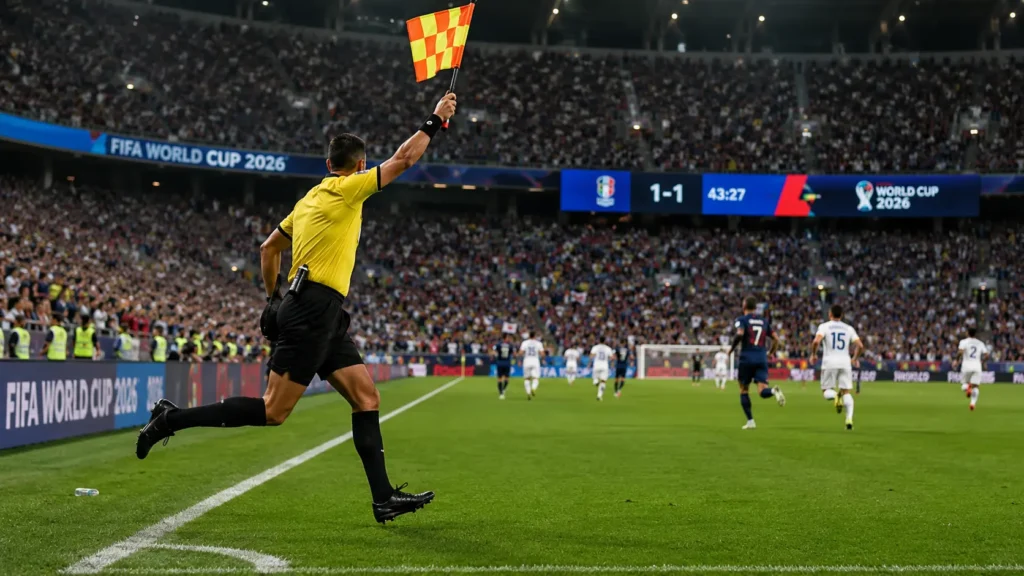
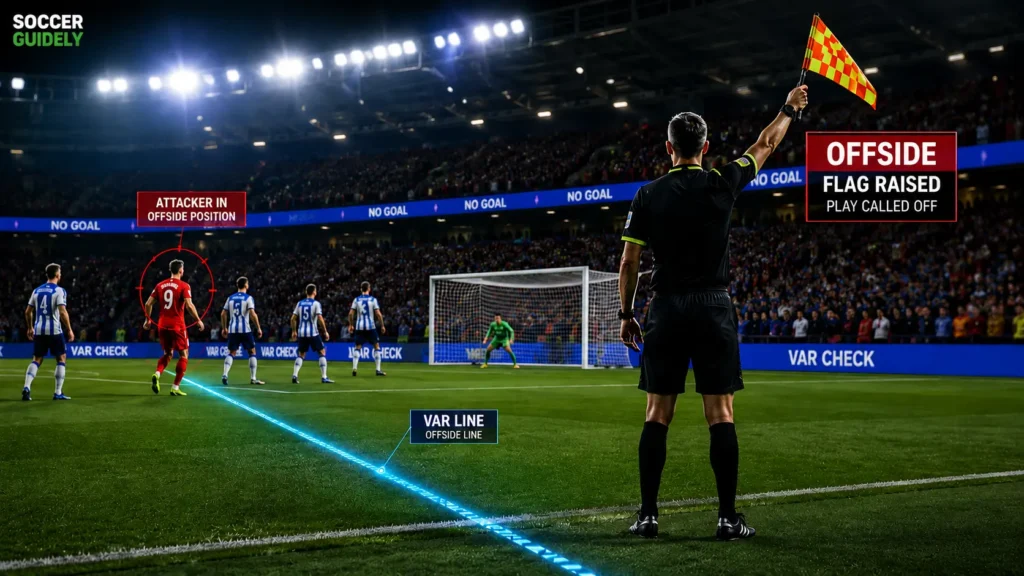
Law 11 is the official offside rule in soccer’s Laws of the Game. It states a player is in an offside position if any part of their head, body, or feet is in the opponents’ half and nearer to the goal line than both the ball and the second last opponent. Being in that position isn’t an offense by itself, a player must become actively involved in play to be penalized.
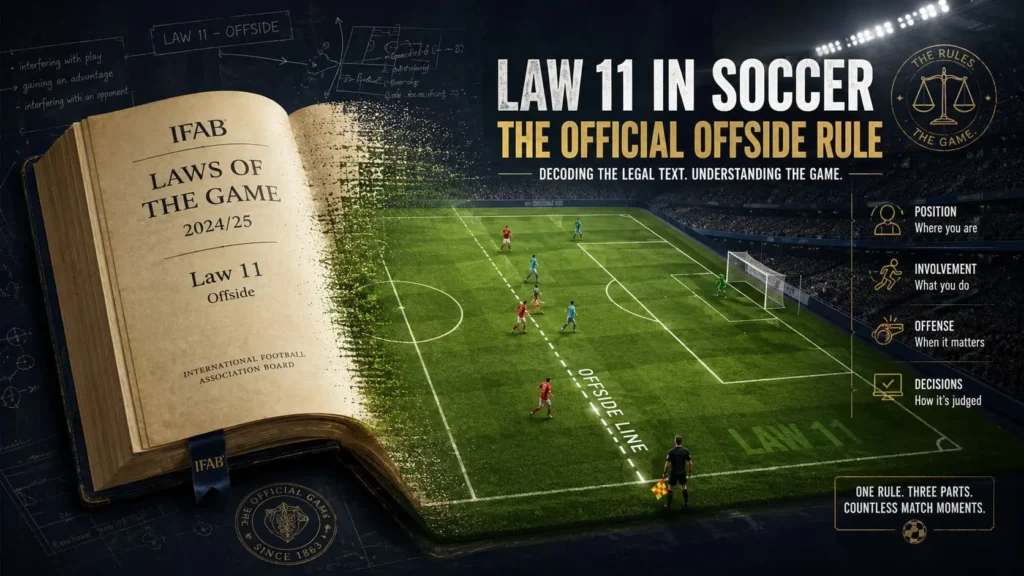
Somewhere in a rulebook nobody reads sits the exact sentence that decided whether your team’s goal counted last weekend. That sentence is Law 11, the official offside rule, and it’s written the way a legal contract is written. Technically precise. Completely unreadable to a normal person. Every argument you’ve ever had about a disallowed goal traces back to this one law.
You don’t need a law degree. You just need someone to actually translate it.
What Is Law 11 in the Laws of the Game?
Law 11 is the specific law within soccer’s seventeen official Laws of the Game that governs offside. It’s short as far as legal documents go, only a few pages, but dense. IFAB, the body that writes and maintains these laws, doesn’t rewrite Law 11 often, but it does clarify the wording periodically when confusion keeps coming up in real matches.
Since 2013, IFAB has issued at least three separate formal clarifications specifically targeting Law 11’s language, one in 2013 redefining “interfering with an opponent” and “gaining an advantage,” one around 2021 tying the arm boundary to the same definition used in the handball law, and the 2023 deliberate play versus deflection guidance covered later in this article. That’s not a coincidence. Offside is consistently rated by referees and officials as one of the hardest laws to apply consistently, which is exactly why it keeps getting revisited.
Here’s the thing. Most fans have never actually read the real text, and with the 2026 World Cup bringing millions of first-time American viewers into contact with this exact rule, that gap matters more than ever this year. They’ve absorbed a loose, secondhand version passed down from a friend or a broadcast commentator, and that version is usually close but not quite right. This article works straight from the actual legal language, translated piece by piece.
What Counts as an “Offside Position” Under Law 11?
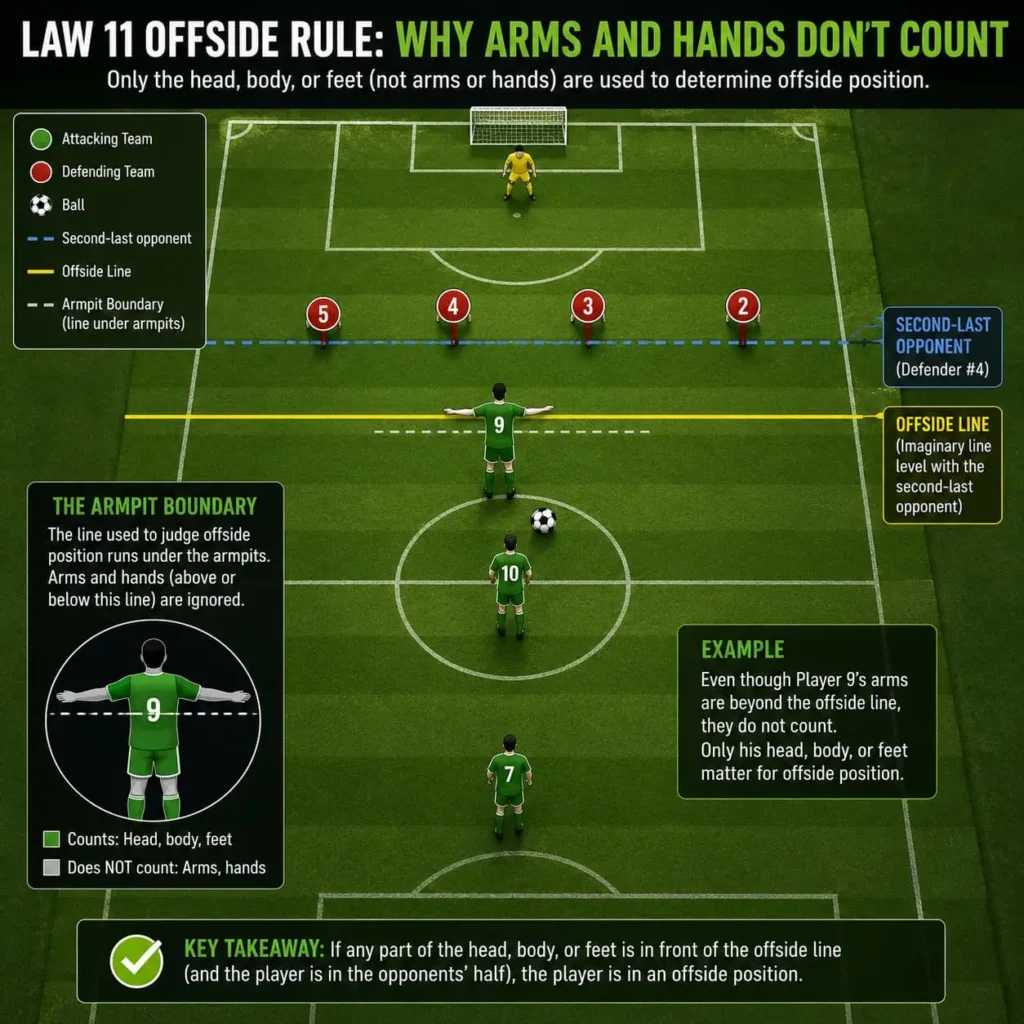
The official text says a player is in an offside position if any part of their head, body, or feet is in the opponents’ half of the field, and any part of their head, body, or feet is nearer to the opponents’ goal line than both the ball and the second last opponent. Two conditions. Both have to be true at the same time.
Why Your Own Half Is Always Safe
You can never be offside standing in your own half. Doesn’t matter how far forward you are. Doesn’t matter how obviously you’re camping near midfield waiting for a long ball. The halfway line itself is the cutoff, and standing exactly on it doesn’t count as being in the opponents’ half either, you have to be genuinely past it.
Why the Second-Last Opponent Is the Line That Matters
You need to be closer to the goal than both the ball and the second last opponent. In most situations, that second-to-last defender is a center back, since the goalkeeper is usually the very last one. Under Law 11 of the Laws of the Game, the goalkeeper counts as an opponent for this calculation, but it doesn’t technically have to be the goalkeeper. If a keeper wanders far out of position, a different defender becomes the “last” one instead.
Why Arms and Hands Don’t Count At All
Here’s a detail almost nobody explains well. Arms and hands don’t count toward the offside line. At all. The official text specifically says the hands and arms of all players, including goalkeepers, aren’t considered, and the boundary is set at the bottom of the armpit. So if a player’s arm is sticking out ahead of the defender but their torso and feet aren’t, they’re still onside.
Think of it like an NFL sideline replay checking whether a receiver’s toe stayed inbounds. Same energy. It’s this hyper-specific body part technicality that decides everything, and it exists for the same reason, somebody has to draw the line somewhere precise enough to actually enforce.
Real Scenario: The Arm That Got a Real Goal Disallowed
Here’s a real example that shows exactly how strict the arm-boundary rule actually is in practice. During a Premier League match, a forward had what looked like a legitimate goal in the build-up disallowed because VAR ruled his arm position put him marginally offside, even though his actual body, torso and legs, was level with the last defender. The armpit-boundary line from Law 11 was the entire reason for the call. Under the old, looser understanding of the rule that a lot of fans still carry around, that call looks insane, how can an arm decide an entire goal? But under the actual current text, tied directly to the same boundary definition used in the handball law, the call was completely correct. This is exactly the kind of decision that makes fans furious right up until someone shows them the real rule, and then it suddenly makes sense.
Is Standing in an Offside Position Actually Against the Rules?
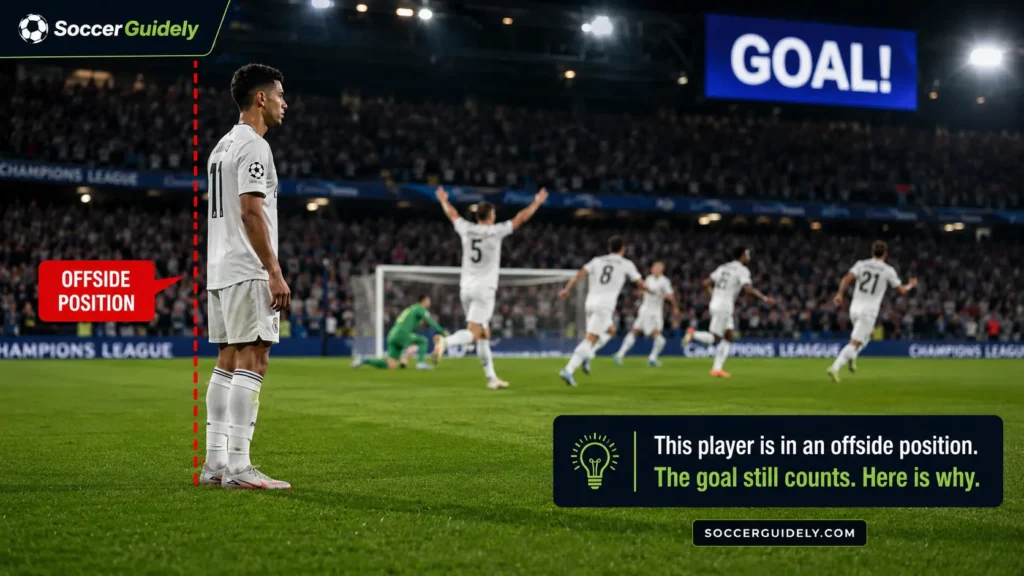
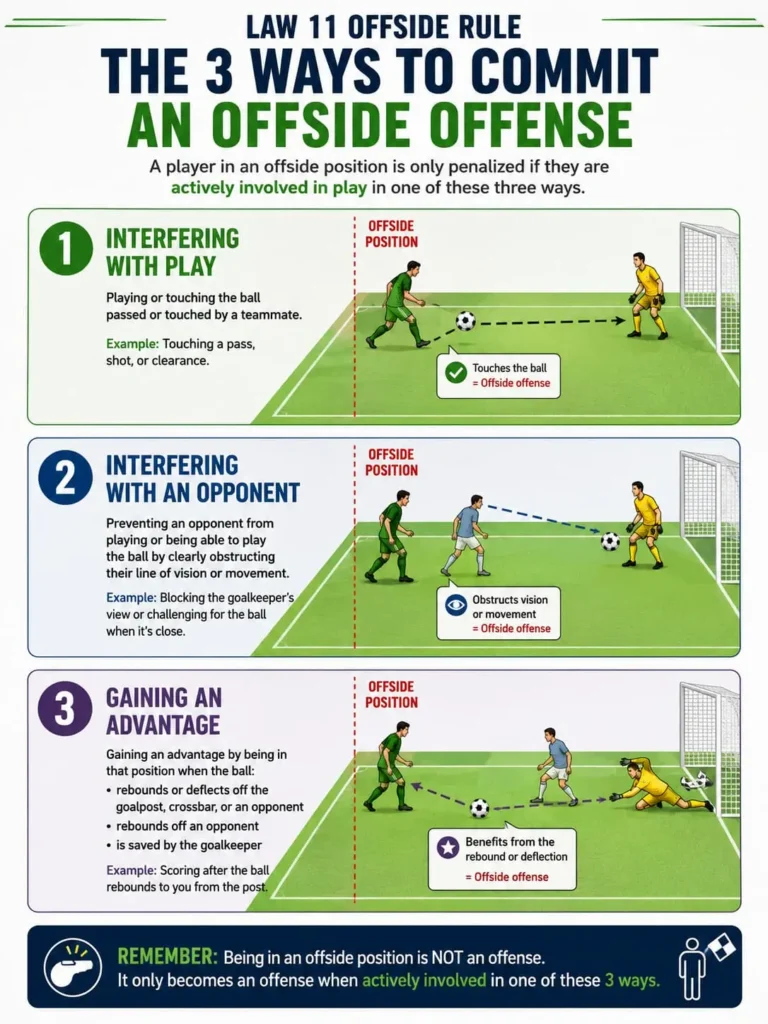
This is the single most misunderstood part of the entire law, and it trips up basically every new American fan. Being in an offside position is not, by itself, against the rules. Nothing happens. No flag. No whistle. Nothing.
The Three Ways a Player Becomes “Actively Involved”
A player only actually commits an offside offense if, at the moment the ball is played by a teammate, they become involved in active play. Under Law 11, that means one of three things: interfering with play by touching or playing a ball passed by a teammate, interfering with an opponent by clearly obstructing their line of vision or otherwise messing with their ability to play the ball, or gaining an advantage by playing a ball that rebounded or deflected off a goalpost, crossbar, or opponent.
Why a Goal Can Count Even When Two Players Are Offside
Picture a corner kick. Three attackers bunched near the goal, two of them technically standing in offside positions when the ball is struck. The header sails past both of them and lands at the feet of a fourth attacker, standing onside just outside the box, who buries it. That goal counts every single time, because neither offside player touched the ball, blocked the goalkeeper’s view, or did anything to affect the play. What most American fans don’t realize is that this exact scenario, offside players just standing around doing absolutely nothing while a teammate scores from onside, happens constantly at the professional level. And it’s completely legal under Law 11.
What Is the Deliberate Play Rule and Why Was It Added in 2023?
Here’s a genuinely recent wrinkle even a lot of longtime fans haven’t fully absorbed yet. According to IFAB’s own 2023 clarification, this part of Law 11 deals specifically with what happens when the ball touches a defender before reaching an attacker who was previously in an offside position.
Deliberate Play vs. Deflection, What’s the Real Difference
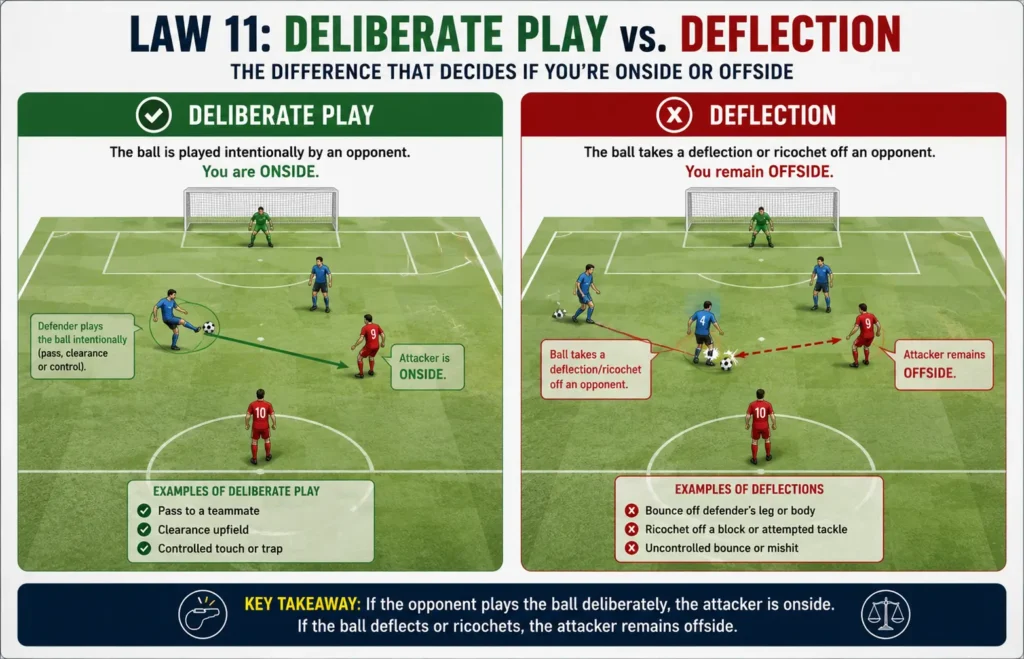
If a defender deliberately plays the ball, meaning they have genuine control of it with a real possibility of passing, shooting, or clearing it, then any attacker who was offside before that touch becomes onside again. But if the ball merely deflects off a defender, a reflexive touch with no real control involved, the previously offside attacker is still considered offside once they get the ball.
Picture a striker standing in a clearly offside position when a teammate takes a shot. A defender attempts a genuine clearance, swinging their leg through the ball with real intent to send it away, but mishits it, and the ball loops up and falls right to that same offside striker, who scores. Under the 2023 deliberate play clarification, this goal counts, because the defender had actual control and made a real attempt, even though it didn’t work out. Now picture the same scenario, except instead of a clearance attempt, the shot simply cannons off the defender’s leg without any real touch or control involved, purely a reflexive deflection. In that version, the same goal gets disallowed, because the striker never became onside again, the ball never got deliberately played, it just bounced.
Why a Failed Pass Still Counts as Deliberate Play
This is the part that surprises people most. Under IFAB’s clarified guidance, if a defender attempts a pass, a clearance, or a challenge for the ball and it simply doesn’t work out, the ball goes somewhere unintended, that still counts as deliberate play. The attempt itself is what matters. Not whether it succeeded.
Honestly, this is the one part of Law 11 I had to read three times before it clicked. Think about an NFL intentional grounding call, the difference between a quarterback deliberately throwing the ball away under pressure versus getting hit mid-throw changes the entire ruling, based on something that happens in a fraction of a second and usually comes down to a judgment call anyway.
When Does the Offside Rule Not Apply At All?
There are a few restart situations where offside gets switched off entirely. If a player receives the ball directly from a goal kick, a corner kick, or a throw-in, they cannot be called offside, no matter where they’re standing on the field.
This exists specifically so defending teams can’t camp right on the edge of an offside trap to cheaply intercept a restart. Think about it from a defensive tactics angle for a second. Without this exception, a defense could essentially force the attacking team into an impossible position every single time they tried to take a corner kick or throw-in, since attackers naturally cluster near the goal on these restarts. IFAB carved out this exception specifically to keep those restart situations fair and playable, rather than turning every corner kick into an automatic offside trap. It’s the same logic behind an NFL rule preventing defenders from lining up in a way that makes a play impossible to legally execute, the rule exists to keep the contest fair, not to hand either side a free win through a technicality.
One thing worth being precise about here. This exception only applies to the player receiving the ball directly. If that same player controls it and then plays it forward to a teammate who is offside, the offside rule applies normally again from that point on. The exception is narrow and specific, it doesn’t create some permanent loophole after a restart, it only covers that one direct first-touch moment.
How Does Law 11 Connect to VAR and Semi-Automated Offside Technology?
Every VAR offside review you’ll see at the 2026 World Cup is ultimately just a more precise way of applying this exact legal text. The technology doesn’t change what Law 11 says. It just measures the second last opponent, the ball position, and the active involvement standard with far more accuracy than a human eye managing a fraction of a second across an entire field. If you want the full breakdown of how that review process actually works, we cover it in our guide to VAR offside decisions.
Expert Insights: What Most Fans Don’t Know About Law 11
Here’s Something Coaches Know That Fans Don’t: Offside Positioning Is Actually a Legal Tactical Weapon
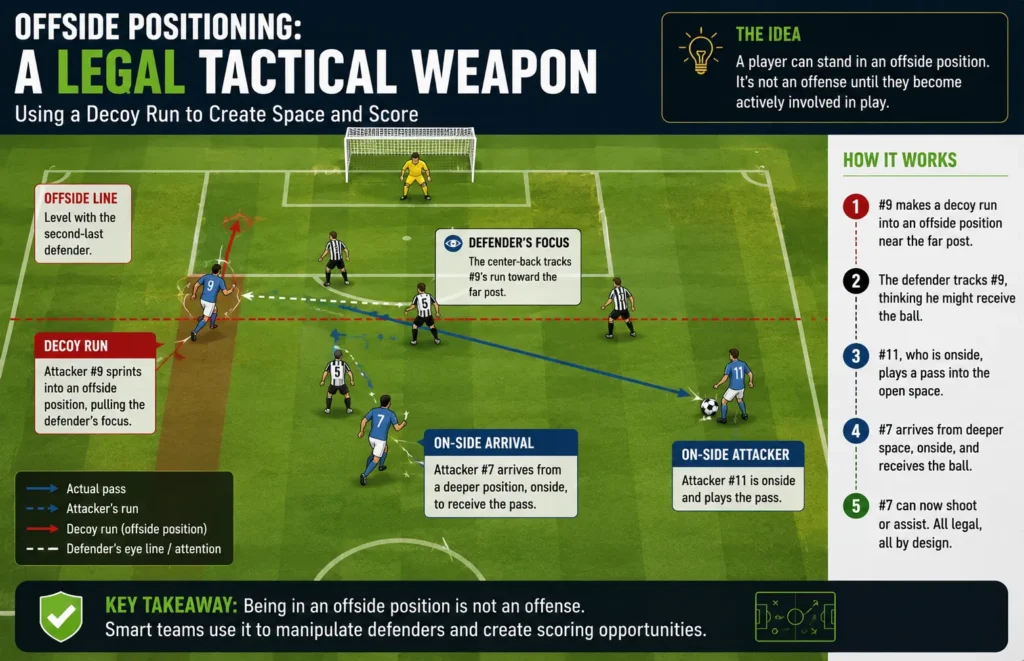
Most fans assume being in an offside position is purely a mistake, something a striker is trying to avoid. Coaches see it completely differently. Since position alone isn’t a violation under Law 11, teams deliberately send a player into an offside position on purpose, specifically to drag a defender’s attention away from the real attacking threat. This is sometimes called a “decoy run,” and it’s a legitimate, coached tactic used at the professional level constantly. A forward will sprint into a clearly offside spot near the far post, pulling a center back’s eyes and positioning with him, which opens up space for a different attacker arriving onside from deeper. As long as that decoy runner never touches the ball, never blocks the goalkeeper’s sightline, and never otherwise interferes, there’s zero penalty, even though from the stands it looks like the player did something wrong. What most fans don’t realize is that some of the best attacking sequences in the sport are built specifically around exploiting the gap between “offside position” and “offside offense,” using the rule’s own structure as a tactical tool rather than something to avoid entirely.
The Tactical Reason Behind the “Second-Last Opponent” Rule Goes Deeper Than Most Explainers Admit
Nearly every explainer mentions that the second-last opponent is usually a center back since the goalkeeper is typically last. Almost none of them explain why this detail actually matters tactically, and it’s a bigger deal than it sounds. Because the rule counts the second-last opponent rather than requiring you to beat every single defender, a team can deliberately manipulate this by pulling a specific defender out of position, say, drawing a fullback forward into a strange spot, to change who actually counts as “second-last” at the moment the pass is played. This is part of why modern defensive lines are coached to move and communicate as a coordinated unit rather than as individuals, a single defender jumping out of the line by even a step can accidentally reset who the “second-last” opponent is for offside purposes, sometimes playing an attacker onside by pure accident. It’s the soccer equivalent of an NFL defense needing every defensive back to stay disciplined in coverage, because one player breaking assignment doesn’t just create a local problem, it can change the entire math of a rule that depends on the whole line moving together.
What Most Fans Don’t Realize: Semi-Automated Technology Actually Made the “Interfering With an Opponent” Standard More Consistent, Not Just More Accurate
Most coverage of VAR and SAOT focuses on precision, measuring body position down to fractions of an inch. What gets missed is that Law 11’s language around “interfering with an opponent” by obstructing a goalkeeper’s line of vision has always been one of the most subjective calls a human referee has to make in real time, genuinely harder to judge consistently than pure position. At the 2026 World Cup, officials are using tracking data not just to measure offside position but to build a clearer, more consistent picture of exactly where a goalkeeper’s sightline was and whether an offside player was genuinely in it. This means the “interfering with an opponent” standard, which has always been the fuzziest part of Law 11 compared to the more mathematical “interfering with play” standard, is becoming measurably more consistent across matches and officials this tournament than it’s ever been in the law’s history. It’s a quiet upgrade nobody’s really talking about, but it’s arguably a bigger deal for fairness than the more publicized precision gains on pure body positioning.
Common Myths About Law 11
A lot of what casual fans assume about this rule just isn’t accurate. First myth, standing offside is always a violation. It isn’t, position alone means nothing until active involvement happens. Second myth, any touch off a defender resets offside automatically. Only true for deliberate play, a genuine deflection doesn’t reset anything under the 2023 clarification. Third myth, and this one catches even experienced fans, arms count toward the offside line the same way legs do. They don’t. The entire arm is excluded, no matter how far forward it extends.
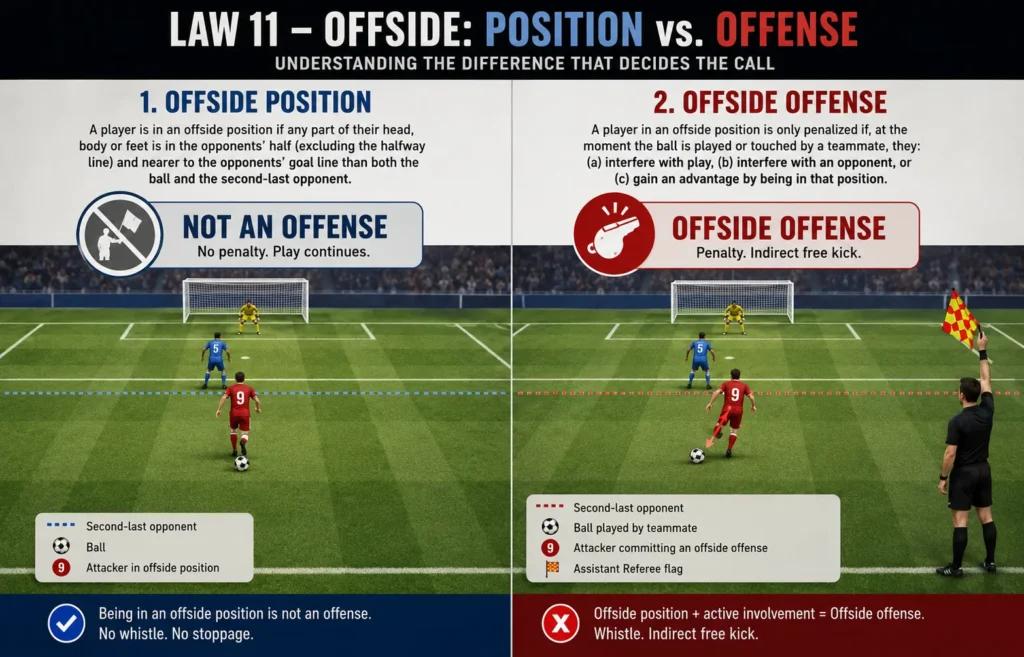
Comparison: Offside Position vs. Offside Offense Under Law 11
| Factor | Offside Position | Offside Offense |
|---|---|---|
| Definition | Player’s body is beyond the second last opponent | Player becomes actively involved in play from that position |
| Automatic penalty | No | Yes, indirect free kick awarded |
| Requires ball involvement | No | Yes, touching, interfering, or gaining advantage |
| Can occur without consequence | Yes, constantly | No, this is the actual violation |
| Applies from restarts | No offside from goal kicks, corners, throw-ins | Same restriction applies |
Why Understanding the Real Law 11 Text Matters for the 2026 World Cup
With the World Cup coming to the USA this summer, millions of first time viewers are about to watch goals get disallowed based on this exact legal language, reviewed by VAR down to fractions of an inch. Knowing the real rule, arm boundary and deliberate play clarification included, is the difference between yelling at your TV in confusion and actually understanding what just happened on screen. If you’re still building up the basics, our complete offside rule guide is a good place to start before diving deeper into the legal text covered here. That’s the same evolving standard we trace back further in our piece on offside rule history.
Now that you know what the actual rulebook says, word for word, the rest of this cluster is going to make a lot more sense. If you want to see how officials apply this exact legal text in real time, our VAR offside decisions guide picks up right where this one leaves off. And if you don’t want to miss the rest of our offside cluster as we publish it, our newsletter sends one clear, no-fluff breakdown like this straight to your inbox each week. You can also browse the full rulebook in our soccer rules hub if you want to keep exploring.
Frequently Asked Questions About Law 11
Q1: What is Law 11 in soccer?
A: Law 11 is the official offside law within soccer’s seventeen Laws of the Game. It defines when a player is in an offside position and when that position becomes an actual offside offense, based on whether the player becomes actively involved in play by touching the ball, interfering with an opponent, or gaining an advantage.
Q2: Is it illegal to stand in an offside position in soccer?
A: No. Standing in an offside position is not, by itself, against the rules. A player only commits an offside offense if they become actively involved in play at the moment a teammate plays the ball, by touching it, interfering with an opponent, or gaining an advantage from their position.
Q3: Do arms count for offside in soccer?
A: No. Under Law 11, arms and hands are excluded entirely when determining offside position. The boundary is set at the bottom of the armpit, meaning only a player’s head, torso, and legs count toward whether they are in an offside position.
Q4: What is the deliberate play rule in offside?
A: The deliberate play rule, clarified by IFAB in 2023, states that if a defender deliberately plays the ball with genuine control, any previously offside attacker becomes onside again. If the ball merely deflects off a defender without real control, the attacker remains offside.
Q5: Can a player be offside from a throw-in or corner kick?
A: No. A player cannot be called offside if they receive the ball directly from a goal kick, a corner kick, or a throw-in. This exception exists so defending teams cannot exploit these restarts to trap attackers in an artificial offside position.
More on the Offside Rule
- What Is Offside in Soccer, The Complete Rule Guide
- Active vs. Passive Offside Explained
- VAR Offside Decisions at the 2026 World Cup
- Offside Rule Changes History
Want to catch every one of these moments as they happen this summer? Our newsletter breaks down the rules and history behind the biggest plays at World Cup 2026, written for fans who are still learning the game. And if you want to keep going deeper into how offside actually works, start with our full soccer rules hub.
About This Article
All rule references verified against IFAB’s official Law 11 text and the 2023 deliberate play clarification. Real match example sourced from Premier League VAR review coverage. Reviewed for accuracy before publication by the SoccerGuidely Editorial Team.