Written by the SoccerGuidely Editorial Team. Covering soccer rules and history for American fans ahead of the 2026 World Cup. Last updated: July 2026. Verified against IFAB’s historical archive and Laws of the Game.
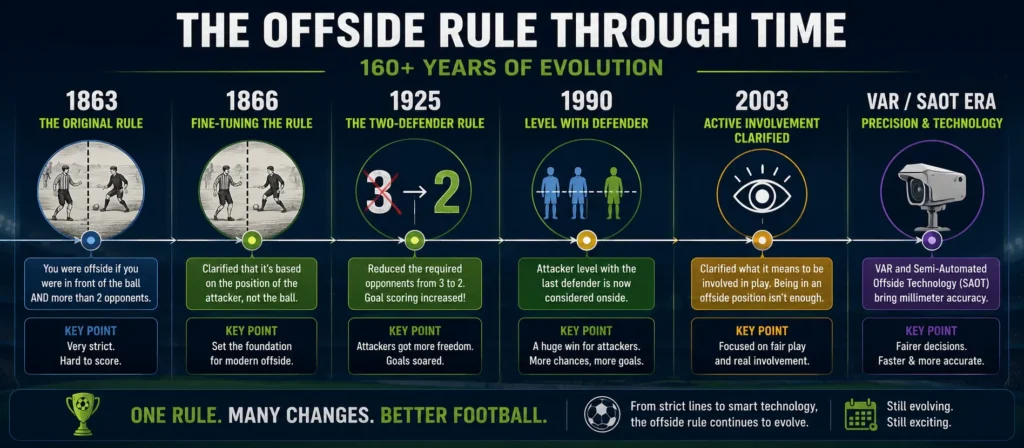
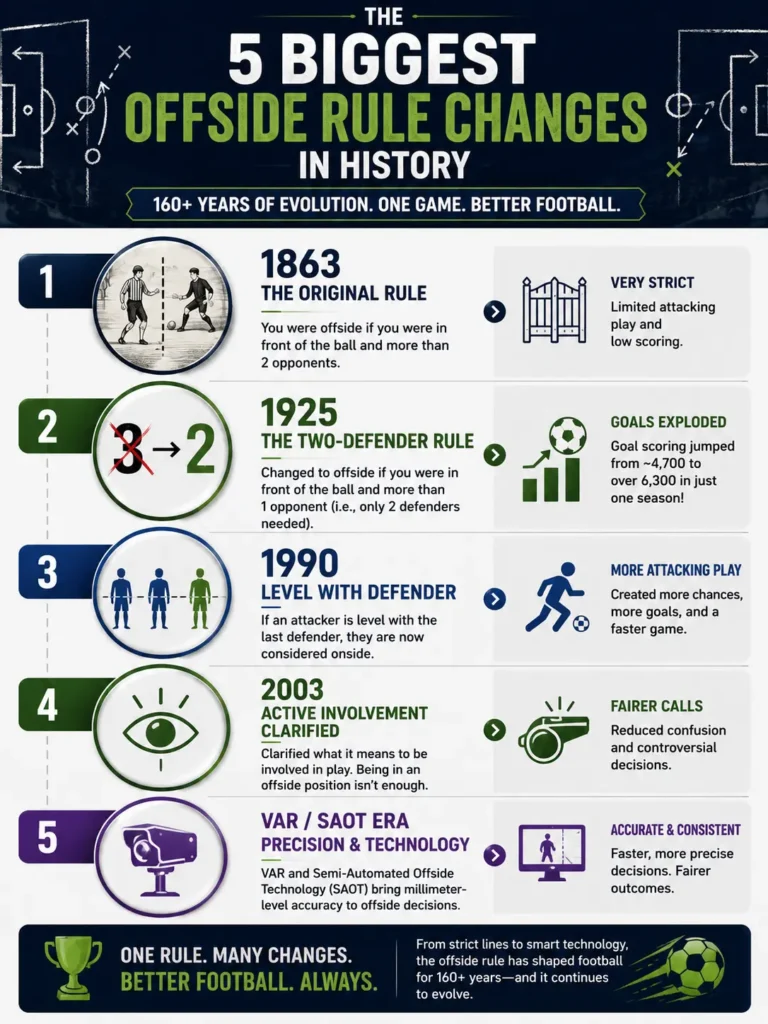
The offside rule has changed five major times since being introduced in 1863. It went from requiring three defenders between attacker and goal, down to two in 1925, then to level with the second last defender in 1990, then a 2003 clarification that simply standing offside isn’t an offense, and finally VAR and semi-automated offside technology in the 2020s. Each change made the game more attack friendly.
Picture a soccer match from the 1800s. A striker gets the ball twenty yards from goal, wide open, nobody around him. Offside. Automatically. Every time. That’s how brutal the original rule was, and if it had stayed that way, modern soccer as you know it wouldn’t exist. The offside rule changes history is basically 160 years of the sport arguing with itself about how much space attackers deserve, and every argument reshaped the game you’re about to watch at the 2026 World Cup.
You’re not just learning a rule. You’re learning why the sport looks the way it does.
Why Did Soccer Need an Offside Rule in the First Place?
Soccer needed the offside rule to stop attackers from camping out near the goal, waiting around for an easy pass into an empty net. Before soccer had official rules at all, English schools were already dealing with this exact problem.
Kids playing early football variants at Eton and Rugby had informal rules against just hanging near the other team’s goal. “Sneaking,” one school called it. “Loitering,” said another. Kind of great, honestly, that this has always been considered cheap.
The instinct is universal. It’s the same reason basketball needs goaltending rules, or football needs rules against a receiver just standing wide open forty yards downfield uncovered. Sports have always needed a way to stop people from gaming easy positioning.
What Was the Original 1863 Offside Rule and Why Was It So Strict?
When the Football Association wrote the first official rules in November 1863, the offside law was no joke. Any attacking player in front of the ball at all was out of play. Not two defenders. Not three. Just anyone ahead of the ball, full stop.
Imagine an NFL offense that could never throw a pass past the line of scrimmage unless the receiver was already standing behind it when the ball was snapped. That’s roughly the world early soccer players lived in. Nobody was springing anybody loose with a clever pass. The whole sport got built around dribbling, because passing forward simply didn’t work.
How Did the 1866 Change Make Forward Passing Possible for the First Time?
Just three years later, the FA added an exception. A forward pass became legal as long as three opposing players stood between the receiver and the goal. Genuinely big deal. For the first time, an attacking team could realistically try to spring someone forward with a pass, as long as enough defenders, usually including the goalkeeper, were still back there.
The Sixty Years Nobody Talks About: 1907 and 1920
Between the 1866 exception and the famous 1925 overhaul, the rule didn’t just sit frozen for six decades. Two smaller tweaks quietly shaped the game in between, and almost nobody outside hardcore history nerds knows about them.
In 1907, IFAB ruled that a player could no longer be called offside while standing in their own half of the field. Sounds obvious today, but before this, it was technically possible to get flagged offside without ever crossing into the attacking half, which is about as strange as an NFL receiver getting called for pass interference on his own side of the fifty yard line. Then in 1920, officials closed a loophole around throw-ins, making it impossible to be offside directly from one. Before that, defenses were reportedly using long throw-ins as a sneaky way to spring an attacker into open space, and the league decided that wasn’t in the spirit of the game.
Neither change gets the historical spotlight that 1925 or 1990 do, but both mattered. They’re proof the rule has never sat still for long, even in its supposedly “quiet” decades.
Why Was 1925 the Most Important Offside Rule Change in Soccer History?
This is the single most important change in the entire history of the rule. Doesn’t get nearly enough credit from casual fans today. In 1925, the requirement dropped from three defenders to two.
Sounds small. Wasn’t.
How the Two-Defender Rule Exploded Goal Scoring Overnight
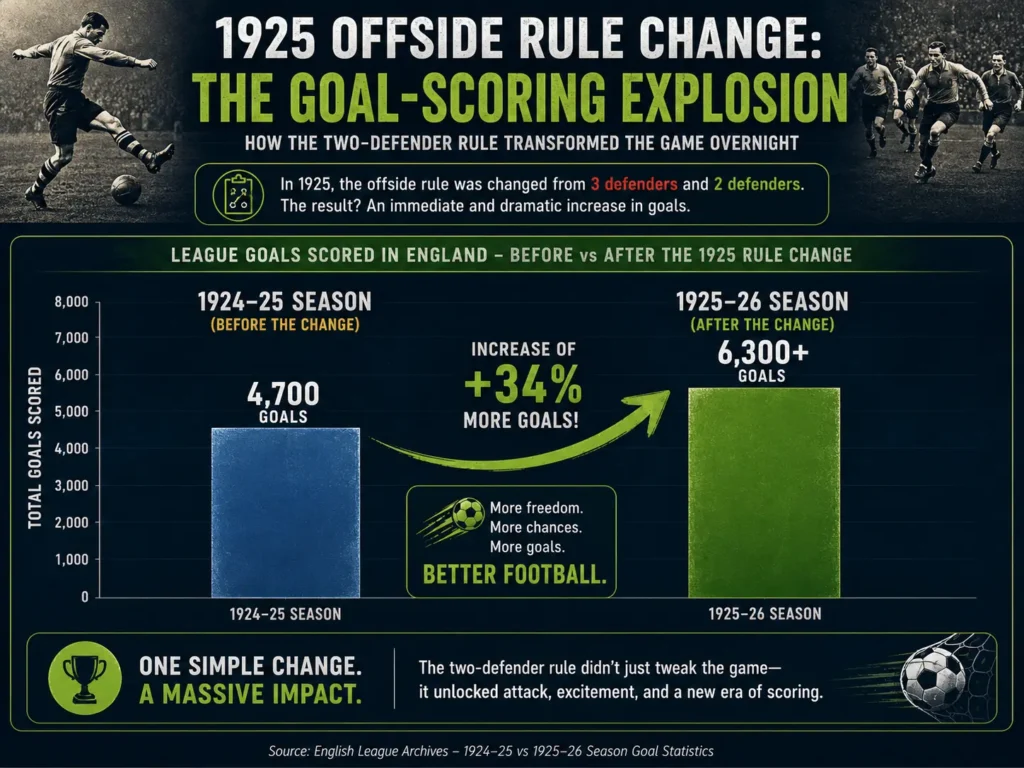
Football League records show roughly 4,700 goals were scored across about 1,850 games in the 1924-25 season. The very next season, under the new two-defender rule, that number jumped to over 6,300 goals across the same number of games. That’s not a gradual trend. That’s an overnight explosion caused by one single rule tweak.
How Herbert Chapman’s WM Formation Was Born From This One Rule
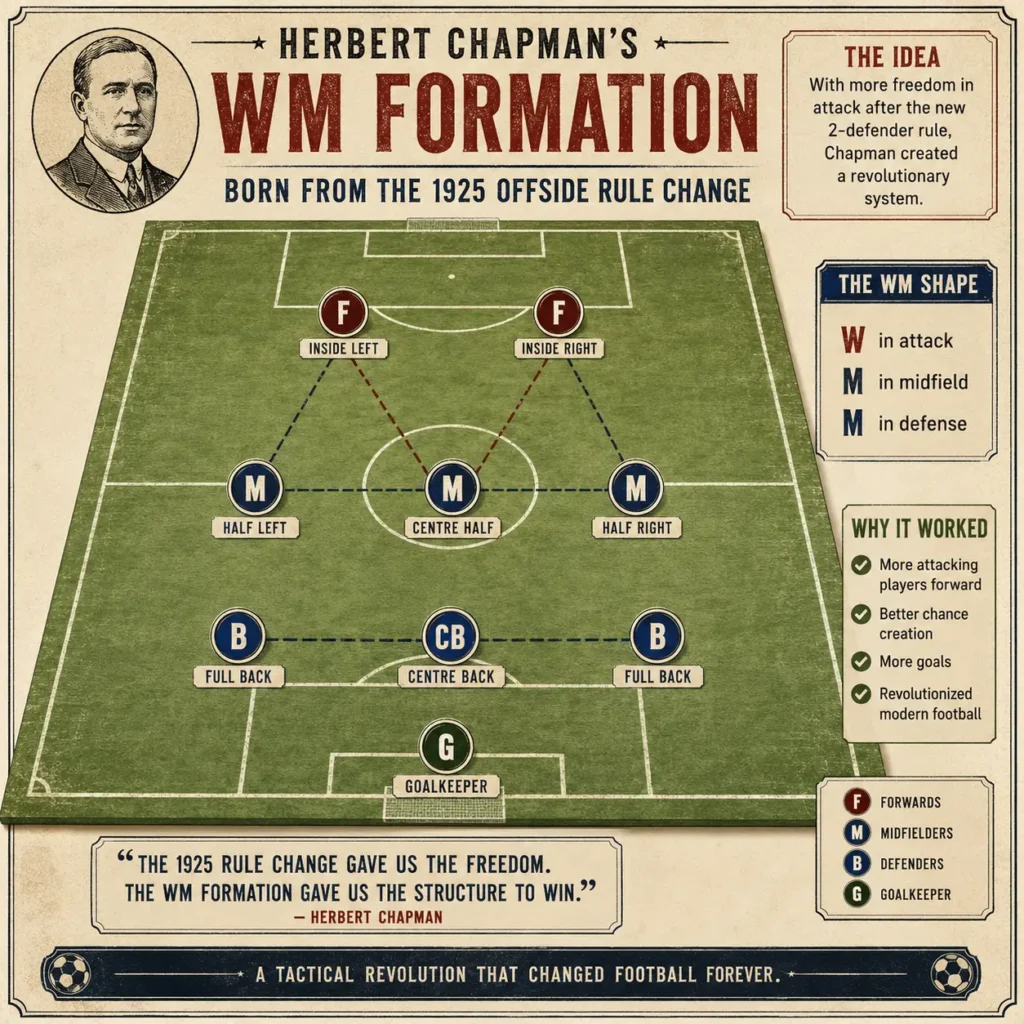
Legendary manager Herbert Chapman, running Arsenal at the time, responded to this new attacking freedom by inventing the WM formation, a tactical setup built specifically to cover the extra space defenders suddenly had to deal with.
If you’ve ever watched an NFL team completely overhaul its defensive scheme because a rule change opened up the passing game, you already get what happened to soccer tactics in 1925. One rule tweak, and the whole sport had to reinvent how it defended.
What Changed in 1990 and Why Did It Favor Attackers?
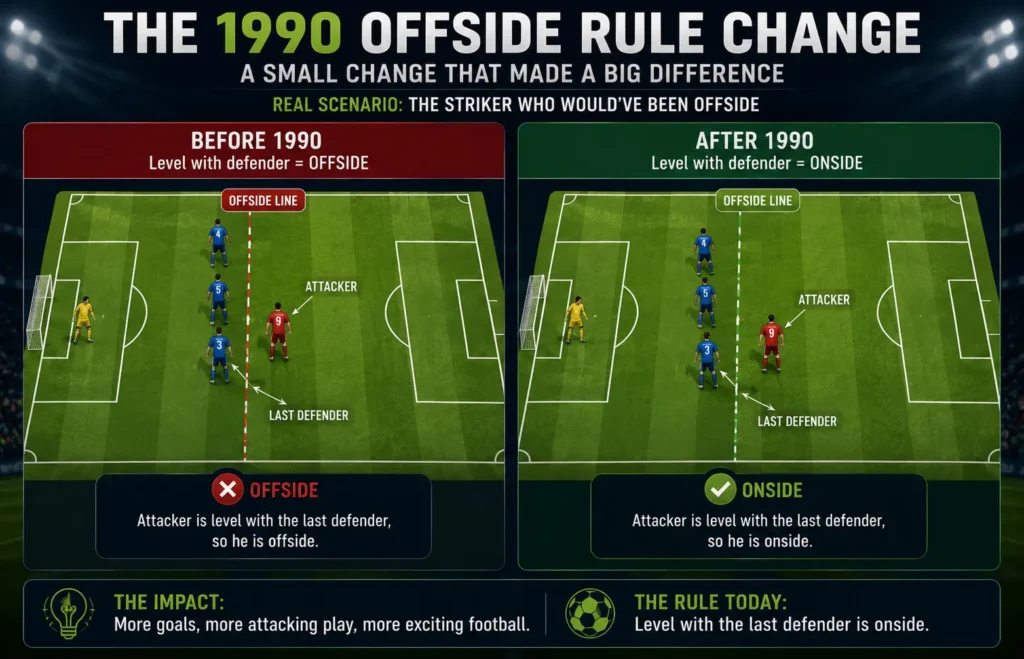
For 65 years, the two-defender rule stood mostly untouched. Then in 1990, IFAB made another significant change. Previously, an attacker had to be strictly behind the second last defender to be onside. The new rule said if the attacker was level, exactly even, with that defender, they were now onside instead of offside.
This came directly out of frustration with the 1990 World Cup in Italy, which a lot of fans and pundits considered boring and low scoring. IFAB’s own meeting minutes from that year describe the change as an effort to encourage the attacking team by giving attackers a slight benefit of the doubt in exactly these razor thin situations. The thinking was simple. Give attackers a tiny bit more benefit of the doubt, and you’ll get more goals and more exciting soccer. It’s basically the soccer equivalent of a replay rule in the NFL that says the tie goes to the offense on a close catch call. When things are that close, the rule now favors the person trying to make a play, not the person trying to stop one.
Real Scenario: The Striker Who Would’ve Been Offside Under the Old Rule
Picture a striker making a run right as a teammate slides a through ball forward. At the exact moment the pass is played, the striker’s shoulder is perfectly even with the last defender’s shoulder, not ahead, not behind, dead level. Under the pre-1990 rule, that’s offside every time, since the attacker had to be strictly behind the defender, not just even with them. Under the modern rule, that exact same moment is completely legal, the striker runs through, collects the pass, and scores. This single change is why a huge chunk of goals scored in the modern game would’ve been wiped out under the rule that existed before 1990. That’s the same razor thin margin we cover in offside timing. It’s not a small technicality, it’s the difference between a goal counting and a goal getting disallowed, based on a margin smaller than a single stride.
What Is the 2003 Offside Rule Change That Most American Fans Still Don’t Understand?
Here’s the change that causes the most confusion for American fans today. More than any other single tweak in this whole history. Before 2003, if you were standing in an offside position, that alone could get you flagged. Even if you weren’t anywhere near the ball or the play at all.
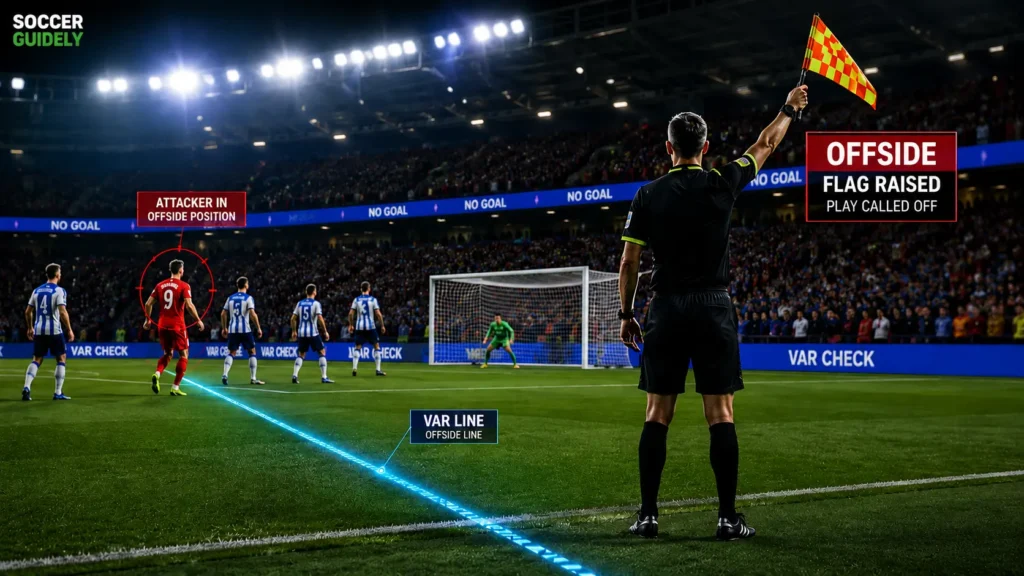
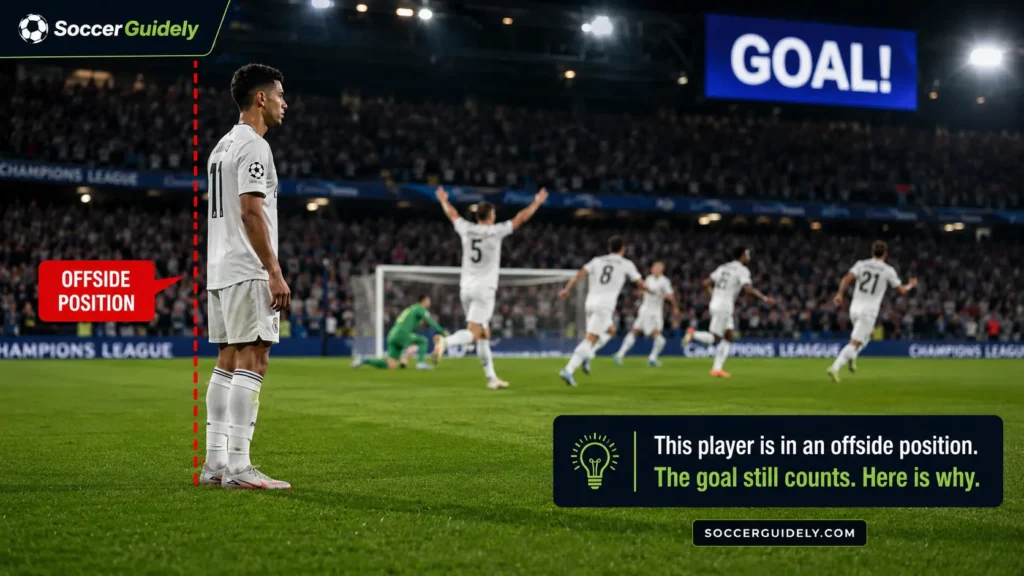
FIFA rewrote the guidance in 2003, and it got folded into the official Laws of the Game by 2005, to clarify that simply standing in an offside position is not, by itself, an offense. Under Law 11 of the Laws of the Game, a player only actually commits an offside offense if they become involved in active play, by touching the ball, interfering with an opponent’s ability to play it, or gaining an advantage from where they’re standing.
This is exactly why you’ll sometimes see a player standing in a clearly offside position right next to the goal, and nothing happens. They never touched the ball. Never got in anyone’s way. Think of it like a player standing in the paint during an NBA game while the ball never comes near them, standing there isn’t a violation on its own, what they actually do with that position is what matters.
Real Scenario: The Header That Should Have Never Been Flagged
Picture a corner kick swinging into the box. Three attacking players are bunched up near the six yard line, two of them technically standing in offside positions when the corner is struck. The ball sails past all three and lands at the feet of a fourth attacker, standing onside just outside the box, who smashes it into the net. Under the pre-2003 mindset, a nervous assistant referee might’ve flagged this instinctively, just because offside bodies were standing near the play. Under the actual modern rule, this goal counts every single time, because neither of the two offside players touched the ball, blocked the goalkeeper’s view, or did anything to affect the goalkeeper’s ability to make a save. What most American fans don’t realize is that this exact scenario, offside players just standing around doing nothing while a teammate scores from an onside position, happens constantly in professional soccer, and it’s completely legal, entirely because of a 2003 clarification most casual fans have never even heard of. For the full mechanics of how active involvement works today, see our breakdown of active vs. passive offside.
How Did VAR and Technology Finally Fix Offside’s Biggest Flaw?
For most of the rule’s history, offside calls came down entirely to a human assistant referee’s naked eye, standing on the sideline, trying to judge a moment that happens in a fraction of a second across the width of an entire field. Researchers studying this exact problem have found that some offside errors are what they call optically inevitable. Meaning a human eye physically cannot always get it right in real time, no matter how good the official is. That’s not an insult to referees, by the way. It’s just physics.
VAR changed that starting in the mid-2010s, giving officials the ability to review close calls on video after the fact. Then semi-automated offside technology took it further, using tracking cameras and ball sensors to calculate offside positions automatically, correcting for exactly the kind of split second judgment errors that plagued the sport for over a century.
Here’s the part that ties this whole 160-year story together neatly. SAOT doesn’t just measure position more accurately, it also helps officials apply the 2003 active involvement standard more consistently, tracking not just where a player was standing but building a clearer picture of exactly when and how they got involved in the play. In a real sense, modern technology is enforcing the exact same rule philosophy IFAB settled on back in 2003, just with far more precision than a human eye could ever manage. The rule didn’t change. The ability to apply it correctly finally caught up. If you want the full breakdown of how that technology actually works today, we cover it in our guide to VAR offside decisions.
What Was the NASL’s Forgotten American Offside Experiment?
Here’s a piece of offside history almost nobody talks about, and it happened right here in the United States. Honestly, the first time I came across this story, I assumed it had to be some kind of exaggeration. It’s not.
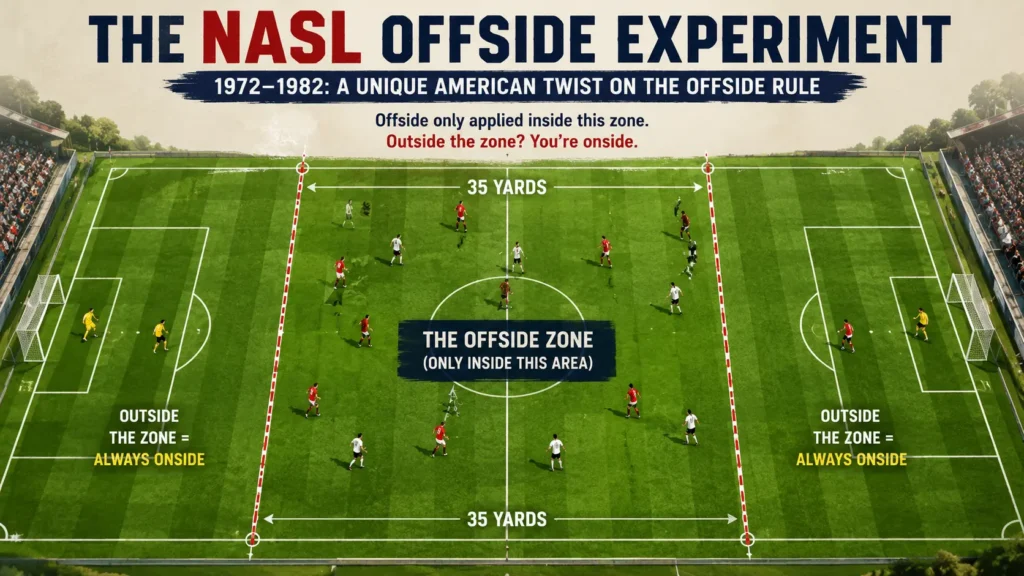
Back in 1972, the North American Soccer League, the pro league that existed before MLS, got frustrated with how offside calls kept disrupting the flow of the game. So they did something wild. They drew their own line 35 yards from each goal and said players could only be called offside inside that zone. Outside of it, near midfield, you could stand wherever you wanted.
This lasted a full decade. It wasn’t until 1982 that FIFA finally stepped in and basically told the NASL to knock it off, threatening to pull the league’s official recognition if it didn’t fall back in line with the standard international rules. Genuinely fascinating piece of soccer history, and it shows American soccer has been experimenting with this exact debate, tweaking offside to create more exciting, attacking play, for over 50 years now. The conversation happening today about whether offside is too strict? Basically a rerun of an argument American soccer was already having in the 1970s.
Expert Insights: What Most Fans Don’t Know About Offside’s History
What Most Fans Don’t Realize: Every Major Rule Change Followed a Boring Tournament
There’s a pattern buried in this history that almost nobody points out, and once you see it, you can’t unsee it. The 1925 change came after years of complaints about low scoring, defensive-minded football. The 1990 change came directly out of frustration with a famously dull 1990 World Cup. Even the 2003 clarification followed years of pundits and fans complaining that offside calls were killing exciting attacking sequences over pure technicalities. IFAB doesn’t tend to change this rule proactively, historically, it changes it reactively, usually within a few years of a tournament or season that fans and broadcasters publicly complained was boring to watch. What most fans don’t realize is that if the on-field product at the 2026 World Cup ends up feeling stale or overly cautious, there’s a real historical pattern suggesting another rule tweak could follow within the next cycle. This rule has never once stayed still for more than a few decades, and every single change traces back to the same root cause, the sport getting nervous about becoming boring.
The Tactical Reason Behind Chapman’s WM Formation Goes Deeper Than Most Coaching Explainers Admit
Most soccer history content mentions that Herbert Chapman invented the WM formation in response to the 1925 rule change and leaves it there. Here’s the deeper tactical reason coaches actually study this for. Before 1925, defenses only needed to worry about maintaining a strict offside line with three players, which meant a fairly simple, narrow defensive shape could cover the requirement. Once the rule dropped to two defenders, defenses suddenly had far less margin for error on that last line, one mistimed step and an attacker was in behind. Chapman’s WM formation specifically pulled a center half back into a dedicated last-line defensive role for the first time, essentially creating the first true center back position as we understand it today. That single tactical innovation, born directly out of this one rule change, is the ancestor of literally every modern defensive formation that relies on center backs holding a coordinated offside line. It’s the soccer equivalent of the NFL’s shift toward specialized nickel and dime defensive packages once passing offenses started spreading the field, one rule or trend shift, and the entire defensive blueprint of the sport gets rewritten.
Here’s Something Referees Know That Fans Don’t: The 1990 Change Made Officiating Objectively Harder, Not Easier
This is a genuinely underappreciated angle. Fans generally assume rule changes that favor attackers make the game more fun and don’t think much about the flip side, what it does to the people actually enforcing the rule. The 1990 level-with-the-defender standard sounds simple on paper, but it actually made the assistant referee’s job significantly harder, not easier. Judging whether an attacker is clearly behind a defender is a relatively forgiving standard, there’s margin for error. Judging whether two players are exactly level, down to inches, at the precise moment a ball is struck, while both players are sprinting in different directions, is an extraordinarily difficult visual judgment for a human eye to make consistently. This is actually a big part of why the optically inevitable errors researchers studied became such a persistent problem in the decades after 1990, the rule itself got harder to officiate accurately at the exact same time it became more consequential. It’s a big part of why VAR and SAOT didn’t just happen to arrive eventually, they arrived because the 1990 rule change essentially demanded a technological solution the sport didn’t have yet.
Common Myths About the Offside Rule’s History
A lot of what casual fans assume about offside history just isn’t accurate. First myth: the rule has always worked the same way it does today. It hasn’t. It’s been rewritten at least five separate times, and the version being played in 1980 looked meaningfully different from the version played today. Second myth: standing in an offside position has always been enough to get flagged. True before 2003. Hasn’t been true for over twenty years now. Third myth, and this one trips up even longtime fans, VAR changed the offside rule itself. It didn’t. VAR and semi-automated offside technology changed how the existing rule gets enforced, not what counts as offside in the first place. That’s still the same 1990 level-with-the-defender standard combined with the 2003 active involvement clarification.
Comparison: How the Offside Rule Has Changed Era by Era
| Era | Defenders Required | Standard for Onside | Active Involvement Required |
|---|---|---|---|
| 1863 | Any player ahead of ball, no exceptions | N/A, essentially unenforceable for forward passing | Not applicable |
| 1866-1924 | Three defenders (including goalkeeper) | Strictly behind third defender | Not applicable |
| 1925-1989 | Two defenders (including goalkeeper) | Strictly behind second last defender | Not applicable |
| 1990-2002 | Two defenders (including goalkeeper) | Level with or behind second last defender | Not applicable |
| 2003-Present | Two defenders (including goalkeeper) | Level with or behind second last defender | Yes, must touch ball, interfere with opponent, or gain advantage |
| 2020s-Present (VAR/SAOT era) | Same standard as 2003, enforced with technology | Same standard as 2003 | Same standard as 2003, confirmed via camera tracking |
Why Does This 160-Year History Matter for the 2026 World Cup?
Every single change we just walked through got made for the exact same reason. Making the sport more exciting to watch by favoring the attacking team just a little bit more. As millions of Americans watch their first real World Cup on home soil this summer, they’re watching the end result of over a century and a half of constant tinkering, arguing, and rewriting, all pointed in the same direction.
Understanding that this rule has never been fixed in stone, and that it’s still actively evolving with technology like SAOT, makes every close call you see this tournament feel a lot less like an arbitrary mystery. And a lot more like the latest chapter in a genuinely interesting story that’s been unfolding since before anyone alive today was born. If you’re still getting comfortable with the basics, start with our complete offside rule guide for the current, modern version of everything this article just walked through.
Now that you know how we got here, the rest of this cluster is going to click into place a lot faster. And if you don’t want to miss the rest of our offside cluster as we publish it, our newsletter sends one clear, no-fluff breakdown like this straight to your inbox each week. You can also browse the full rulebook in our soccer rules hub if you want to keep exploring.
Frequently Asked Questions About Offside Rule Changes History
Q:1 When was the offside rule first introduced in soccer?
A: The offside rule was first introduced in November 1863, when the Football Association wrote the first official Laws of the Game. The original version was extremely strict, any attacking player standing in front of the ball at all was considered out of play, with no exceptions for defender count.
Q:2 How many times has the offside rule changed?
A: The offside rule has changed five major times: the 1866 three-defender exception, the 1925 reduction to two defenders, the 1990 change allowing attackers level with the last defender to be onside, the 2003 active involvement clarification, and the 2020s addition of VAR and semi-automated offside technology.
Q:3 What was the 1925 offside rule change?
A: In 1925, IFAB reduced the number of defenders required between an attacker and the goal from three to two. This single change caused goal scoring to jump dramatically the following season and led directly to new defensive tactics like Herbert Chapman’s WM formation.
Q:4 Does standing in an offside position always count as an offense?
A: No. Since a 2003 clarification later added to Law 11, a player in an offside position only commits an offense if they touch the ball, interfere with an opponent’s ability to play it, or gain an advantage from their position. Simply standing there is not a violation.
Q:5 Did VAR change the offside rule itself?
A: No. VAR and semi-automated offside technology changed how the existing offside rule gets enforced, not the rule itself. The underlying standard is still the 1990 level-with-the-defender rule combined with the 2003 active involvement clarification, just applied with far more precision.
More on the Offside Rule
- What Is Offside in Soccer, The Complete Rule Guide
- Active vs. Passive Offside Explained
- Offside Timing in Soccer, When Exactly Is the Call Made
- VAR Offside Decisions at the 2026 World Cup
- Common Offside Myths, Debunked
Want to catch every one of these moments as they happen this summer? Our newsletter breaks down the rules and history behind the biggest plays at World Cup 2026, written for fans who are still learning the game. And if you want to keep going deeper into how offside actually works, start with our full soccer rules hub.
About This Article
All rule references verified against IFAB’s official historical archive and the current Laws of the Game, Law 11. Historical data on goal-scoring statistics sourced from Football League records. Additional historical detail cross-referenced against Wikipedia’s citation-heavy entry on the offside law, which draws on original IFAB meeting minutes, contemporary newspaper archives, and academic research on offside officiating. Reviewed for accuracy before publication by the SoccerGuidely Editorial Team.