Written by the SoccerGuidely Editorial Team. Covering soccer rules and officiating for American fans ahead of the 2026 World Cup. Last updated: July 2026. Verified against IFAB 2025-26 Laws of the Game.
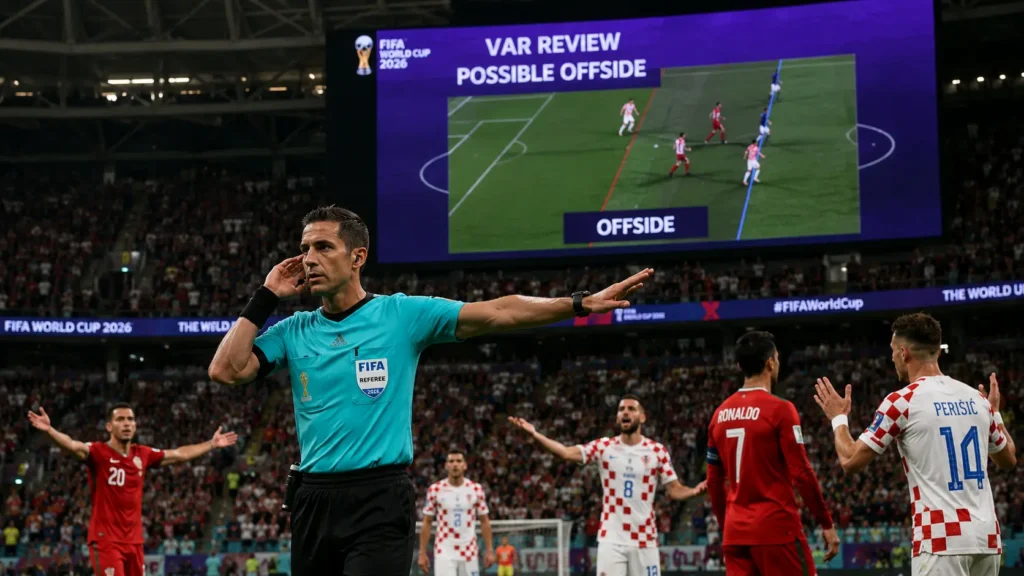
VAR offside decisions work by combining video review with, at the 2026 World Cup, semi-automated tracking technology that pinpoints exactly where an attacking player’s body was compared to the last defender the instant the ball gets played. A VAR team checks this in the background on basically every goal. If the on-field call looks off, the video match officials flag it, and the referee either trusts that read or goes to review the footage personally before making the final call stand.
You’re three beers into your first World Cup watch party. The striker buries it, top corner. Your whole bar erupts. Then everyone just stops. Some guy on screen is standing there with a finger on his ear. Thirty seconds later, the goal gets wiped off the board. No explanation. No ref talking into a mic like the NFL gives you. Just silence and a graphic with some lines on it.
That’s VAR offside doing its thing. And nobody in that bar can tell you why.
By the end of this, you will be able to.
What Is VAR and Why Does It Exist in Soccer?
VAR stands for Video Assistant Referee. Not one guy. A small team, sitting in a room, watching every camera angle in the building at once. They exist because referees used to make split second calls with zero backup, and every so often a game changing mistake would just stand. Forever. Nobody liked that. Least of all the players who lost because of it.
The Only Four Things VAR Can Actually Review
Here’s something most American fans get wrong going in. VAR can’t jump in on whatever it feels like. Under Law 5 of the Laws of the Game, the protocol only covers four things: goals, penalty decisions, direct red cards, and mistaken identity. That’s the whole list. A borderline foul in the middle of the park that isn’t a penalty? VAR stays quiet. Even if the entire stadium is losing its mind about it.
Why Every Single Goal Gets Checked Automatically
What most American fans don’t realize is that VAR isn’t waiting around for someone to complain. According to IFAB’s official protocol, the video team checks every goal, penalty, and red card automatically, whether anyone asks for it or not. Most of the time nothing happens, because the call was right. That’s called a silent check. You never see it. There’s nothing to see. It only becomes visible the moment something looks wrong.
How Does VAR Make an Offside Decision Step by Step?
This is the part that actually matters if you don’t want your buddy explaining it to you every five minutes.
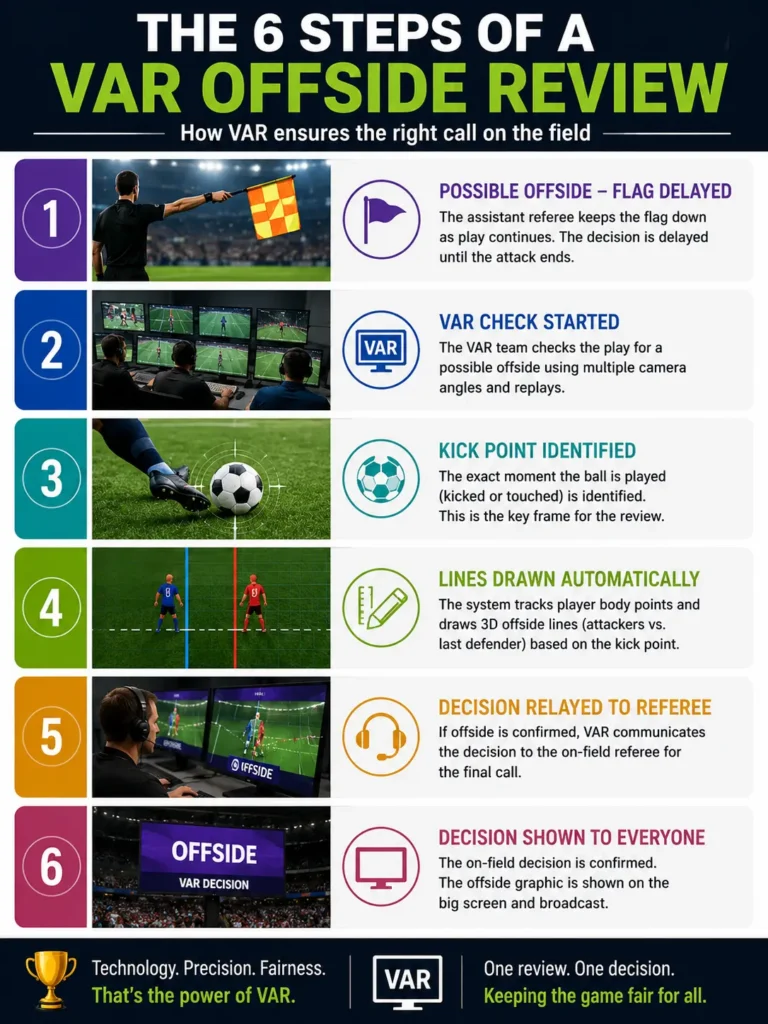
Step 1: Why Referees Keep the Flag Down After a Goal
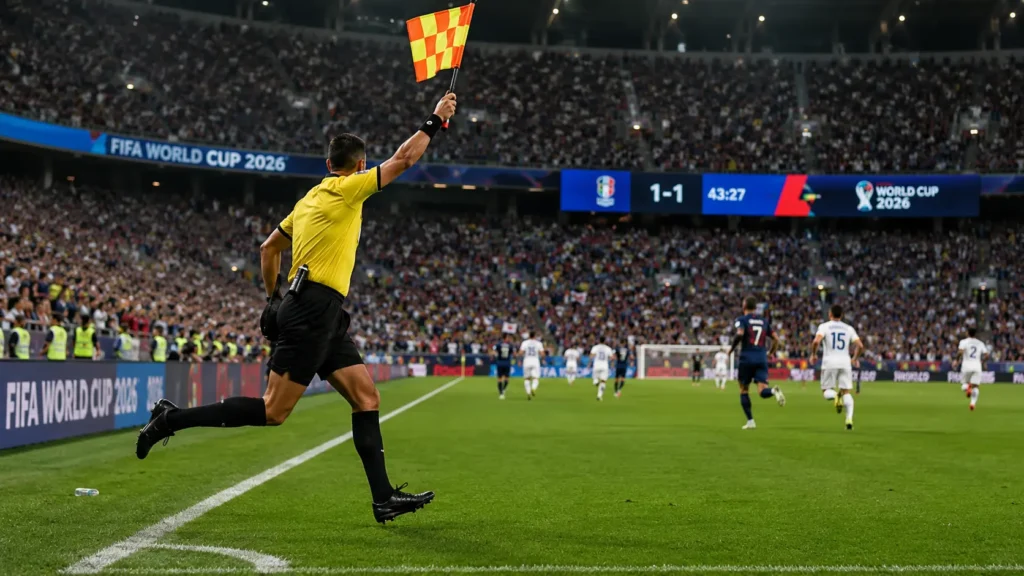
Sometimes a striker looks offside, but the play’s still developing toward a real scoring chance. The assistant referee is allowed to hold off raising the flag. That’s not a mistake. It’s built into the rules on purpose, so a promising attack doesn’t get killed early for nothing, which pairs directly with our breakdown of exact offside timing.
Step 2: What the VAR Team Is Doing While You Wait
The second a goal goes in, the video room is already pulling every relevant camera angle, tracing back through the sequence to find the exact touch that started the offside phase. Everything hinges on that one touch.
Step 3: How the Timing Moment Gets Identified
This is the single most important frame in the whole process. Everything comes down to one instant, the moment the ball leaves the passer’s foot. Not a second before. Not a second after. Under Law 11 of the Laws of the Game, offside is judged at that exact moment and only that moment. Freeze it, and everything else follows.
Step 4: How the Digital Lines Get Drawn
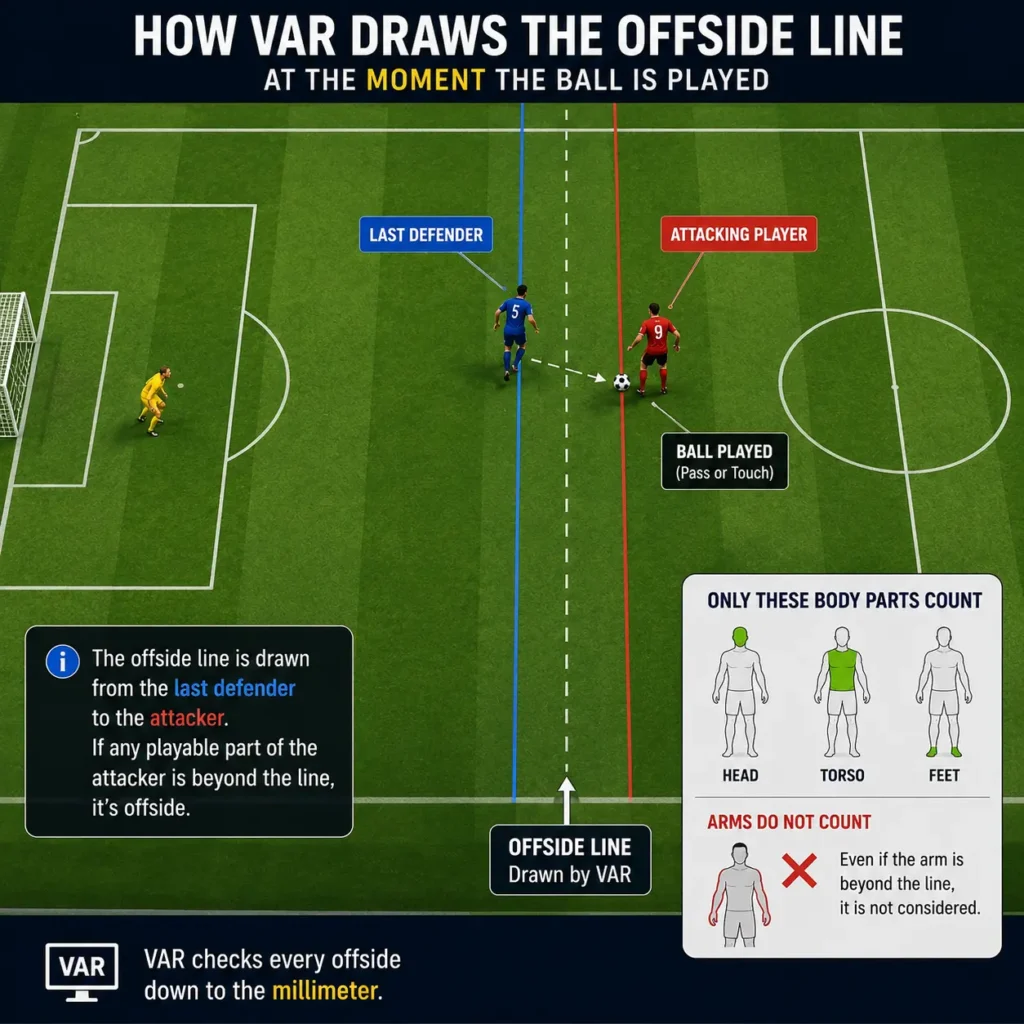
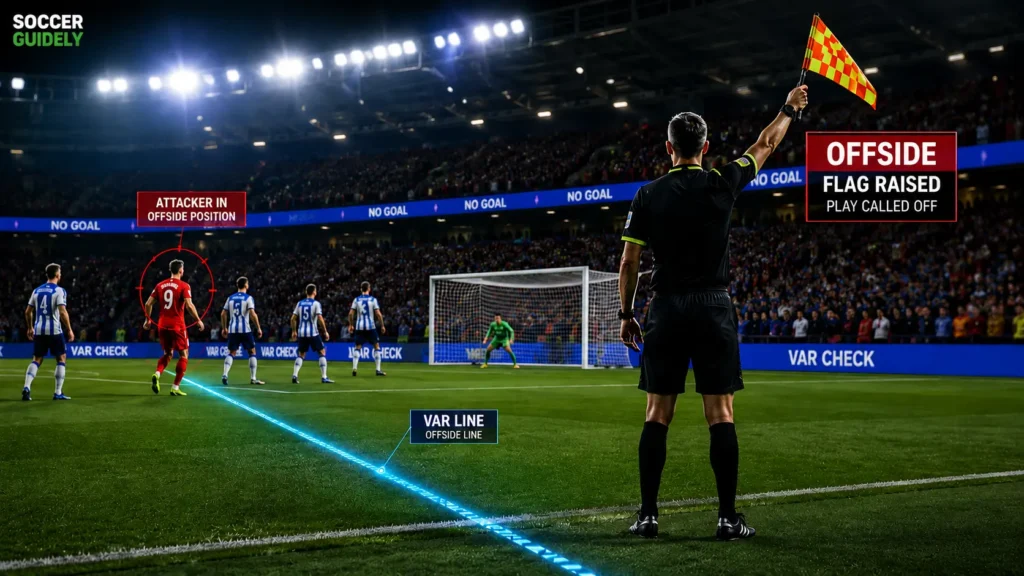
Once that moment is locked in, the system draws two lines. One at the attacker’s furthest forward legal body part. One at the last defender. Any part of the attacker’s head, torso, or feet past that line, offside position confirmed. Arms don’t count at all, since you can’t legally score with your arm.
Step 5: How the Decision Gets Back to the Referee on the Field
For a factual call like offside, the video room usually just tells the referee what the lines show, and that’s that. Compare that to a foul, where the ref often needs to go look at the monitor himself before deciding.
Step 6: What the 3D Graphic on the Stadium Screen Actually Shows
That animation everyone waits for isn’t just for TV drama. It’s the actual proof, the exact lines used to make the call, built from real tracked data on both players. Basically a yellow first down line. Except this one decides whether a goal counts.
How Does the NFL Instant Replay System Compare to VAR?
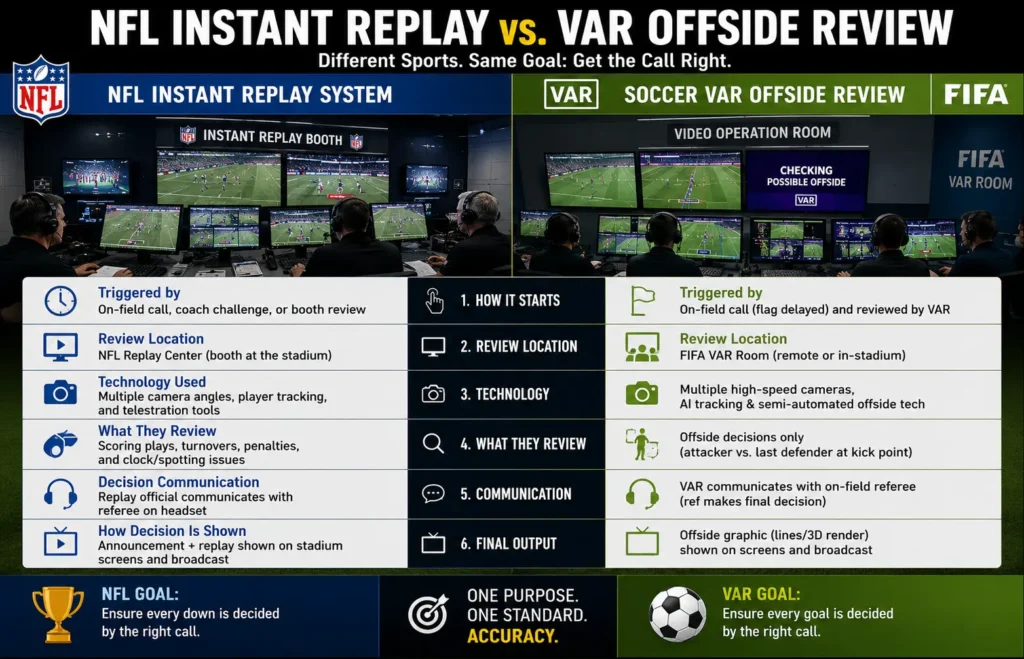
VAR and NFL replay review work almost the same way, just with different names for the same jobs. If you already get one, you basically already get the other.
When a coach throws the red challenge flag in the NFL, play stops, officials in the booth review the footage, the ref on the field gets the read through his headset, then makes the final call. VAR runs on the exact same model, the Video Operation Room is the booth, the on-field referee is still the one deciding, it’s just that certain situations get reviewed automatically instead of needing a coach to throw anything.
What Is the Same Between VAR and the NFL Booth Review
Same structure basically top to bottom. The booth reviews, the field ref decides, the goal is fixing clear mistakes, not turning every play into a review. The standard’s worded differently, soccer says “clear and obvious error,” the NFL says “indisputable visual evidence,” but functionally they’re doing the same job.
What Makes VAR Different From What American Sports Fans Already Know
Here’s the real difference. Who starts the review. NFL needs a coach’s flag, or the booth stepping in late in the game. Soccer’s got no challenge flag at all, the VAR team checks every single goal automatically, nobody asks for it. There’s also no clock on it. NFL reviews run on defined time windows now. IFAB’s rule is blunt: accuracy beats speed, no maximum time limit, period. What most American fans don’t realize is that VAR handles offside completely differently than it handles a foul, for offside the tech basically makes the call and a human confirms it, for a foul the ref goes and watches the monitor himself because that requires actual judgment. In the NFL, the booth treats every review the same way. In soccer, the type of decision changes how the whole review works.
What Is Semi-Automated Offside Technology and How Does It Work?
The Sensor Inside the Ball That Changed Everything
Here’s the part that sounds like science fiction. The Trionda match ball used at the 2026 World Cup has a sensor inside it that records data 500 times per second, detecting the exact instant a player’s foot makes contact so the system doesn’t need a camera to guess when the ball was actually kicked. According to FIFA and Adidas, that same tracking setup pairs with twelve dedicated cameras mounted around each stadium, following roughly 29 specific points on every player’s body, which together let the system calculate an offside position automatically instead of a human dragging a line by hand.
The 10cm Audio Alert Rule Nobody Talks About
Here’s a genuinely new wrinkle for 2026 that even longtime fans haven’t caught onto yet. Assistant referees now get an automatic audio alert through the system whenever an offside offense is 10cm or more, meaning it’s not remotely close. When that alert hits, the flag goes up right away. No more delaying and hoping you judged it correctly in real time. Small tweak. Big deal for fixing those confusing delayed flag moments that used to make everyone furious.
Why It Is Called “Semi” Automated and Not Fully Automatic
A human VAR official still confirms the kick point and checks the generated line before it ever reaches the referee. The system measures. A person still signs off. That’s the whole reason it’s semi-automated and not full automation. Somebody’s still making the actual call.
What Were the Biggest VAR Offside Decisions at the 2026 World Cup?
The Alex Freeman Goal That VAR Got Right for the USMNT
This one’s worth walking through fully, it’s the perfect example of how confusing a freeze frame can look versus what the rule actually says. Group stage, USA versus Australia, in Seattle. Sergiño Dest’s shot deflects high into the air. 21 year old Alex Freeman heads it home to make it 2-0 USA. The assistant referee’s flag goes up instantly. Fans in the stadium, and everyone watching at home, see a freeze frame with three different American players standing in offside positions when the ball deflected. Social media loses it. Everyone’s convinced the goal got wrongly given back.
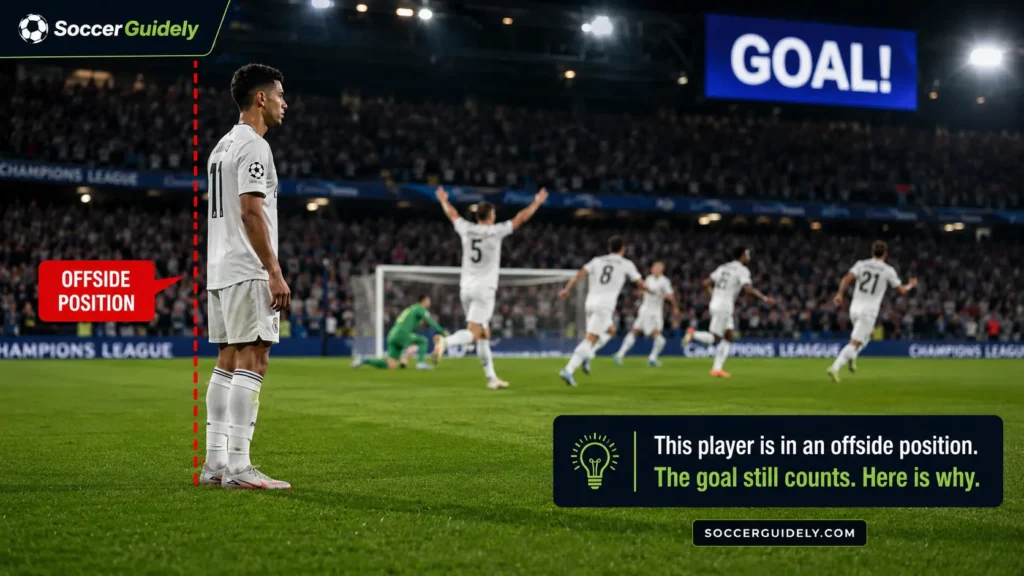
Except that freeze frame only tells half the story. Under Law 11, simply standing in an offside position isn’t an offense by itself. A player only commits one if they touch the ball, get in an opponent’s way, or gain an advantage from being there. None of the other American players near Freeman touched anything or interfered with an Australian defender, they were passively offside, which doesn’t count. Only Freeman mattered, since he’s the one who actually got the ball. After review, the goal stood, 2-0 USA, on their way to winning the group. That’s the same distinction we cover in active vs. passive offside.
Croatia vs Portugal, The Call That Ended a Tournament

If you want one moment that shows exactly why VAR offside decisions get people so worked up, this is it. Round of 32, Toronto, and the match had already gone into the 13th minute of stoppage time when Croatia’s Josko Gvardiol slid the ball into the net, sending the Croatian bench into full celebration. It looked like Croatia had rescued a draw against Portugal in the most dramatic way possible.
Then VAR stepped in. According to FIFA’s official statement, contact was made by Croatia’s Igor Matanović in the build up to the goal against Portugal, allowing the referee to correctly determine offside and disallow the goal. That contact mattered because it meant teammate Mario Pašalić, who was standing in an offside position at that instant, became the one who technically kept the sequence alive, not an untouched deflection off a Portuguese defender as it first appeared. Since Pašalić was offside when Matanović’s touch happened, Gvardiol’s goal got wiped out, and Portugal escaped with a 2-1 win.
The reactions afterward captured the whole debate in two sentences. Portugal manager Roberto Martínez defended the call, saying the balls now have a chip, and it’s very clear that’s why the VAR intervened, adding it’s not a subjective opinion. Croatia manager Zlatko Dalić saw it completely differently, saying it kills the emotions, it kills everything within you. Both men were talking about the exact same decision. That gap between them is basically the entire modern VAR argument in miniature, one side sees precision, the other sees the soul of the game getting measured out of existence. You can read the IFAB’s official VAR protocol directly if you want the full legal language behind this call.
Iran vs Egypt, The Overlooked Rule Nobody Explains
Stoppage time, Iran drawing 1-1 with Egypt. Substitute Shoja Khalilzadeh pokes home what looks like a stunning late winner. Iran’s bench goes off. VAR overturns it for offside, and at first glance the freeze frame looks flat out wrong, there’s clearly an Egyptian player standing behind Khalilzadeh when the ball comes to him. Here’s the part almost nobody explains well. The Egyptian goalkeeper had vacated his net earlier in the sequence, meaning the last opponent was a different Egyptian defender, with Khalilzadeh marginally beyond that second player. That’s what made it offside. It’s one of the rarer wrinkles in the whole law, and it’s exactly the kind of call that makes people swear VAR “makes no sense,” when really it’s just applying a part of the rule most casual fans never get taught. The match finished 1-1, and Iran remained alive in the tournament as a third-place qualifier pending other results.
Switzerland vs Qatar, What Happens When the Technology Fails
Group opener. Switzerland gets awarded a penalty after a foul inside the box. Except the offside graphic that normally confirms these calls just never shows up on the broadcast. FIFA later confirmed a technical outage prevented the onside animation graphic from being generated ahead of the penalty, even though the actual VAR check still happened fine in the background. Good reminder that semi-automated still runs on hardware. And hardware hiccups. Even when the underlying decision was right, fans lose the visual proof they’ve come to expect, and that alone is enough to spark a controversy.
Why Does VAR Overturn a Toenail Offside but Leave a Clear Foul Alone?
Factual Decisions vs Subjective Decisions, The Key Distinction
Honestly, this is the concept that unlocks everything else. Offside is what officials call a factual decision. A player either is or isn’t, no judgment involved once the lines get drawn. A foul is subjective. It depends on reading intent, force, context, all the messy human stuff. That’s why VAR will overturn a goal for an offside margin smaller than a pencil, but won’t touch a foul the whole stadium is screaming about. One’s measurable. The other genuinely depends on somebody’s read of the moment.
Why the Clear and Obvious Error Standard Matters for Fans
For subjective calls, VAR only steps in when there’s a clear and obvious error, a deliberately high bar that protects the referee’s authority on the field. For offside, there’s no buffer at all. It’s binary. Which is exactly why a millimeter close offside call feels so brutal next to a foul that gets ignored even when half the stadium disagrees.
Expert Insights: What Most Fans Don’t Know About VAR Offside
What Most Fans Don’t Realize: SAOT Changed How Coaches Coach the Offside Trap
The offside trap, where a defensive line steps up together right as the ball is played to catch attackers offside, used to carry a built in safety margin. Human assistant referees, working off the naked eye, tended to give attackers the benefit of the doubt on genuinely tight calls, which meant a slightly mistimed trap often still worked out fine in practice. Semi-automated offside technology removed that cushion entirely. According to FIFA’s own SAOT documentation, the system now catches margins as small as a few centimeters that a human eye simply cannot process in real time. What that means tactically is defensive coaches have had to retrain their back lines to step up with less room for error, since a trap that would’ve been “close enough” under the old human judgment system can now get exposed by a fraction of a step.
Here’s Something Coaches Know That Fans Don’t: The Delayed Flag Is a Deliberate Attacking Advantage
Most fans assume the assistant referee holding the flag down during a promising attack is just the official being cautious. Coaches see it differently, and so do the attacking players themselves. Because officials are required to let a clear goal scoring sequence play out before signaling offside, attacking teams have started coaching their forwards to keep running and keep competing for the ball even when they suspect they might be marginally offside, since stopping early guarantees nothing gets reviewed at all. If they play on and it turns out they were onside, the goal counts. If they were actually offside, VAR catches it afterward with the review, and nothing is lost by continuing the play.
The Tactical Reason Behind Deliberate Touches: Why Defenders Are Trained to Play It, Not Just Deflect It
This is the insight buried inside the Croatia vs Portugal controversy that almost nobody explained clearly to American audiences. Under Law 11, only a deliberate touch by a defender resets the offside phase for the attacking team, an accidental deflection does not. What most fans don’t realize is that this distinction has become a real coaching point at the professional level. Defenders are now specifically trained to make a clear, committed touch on a loose ball in the box rather than a half hearted attempt to simply block it, because a deliberate touch can actually reset the danger and put every attacker back onside for whatever happens next. For American viewers, this is the equivalent of an NFL cornerback being coached to actually play the ball on a pass breakup instead of just shoving the receiver, since the manner of contact changes the ruling, not just whether contact happened at all.
Why this matters for the 2026 World Cup: teams still alive in the knockout rounds, including the USMNT, are almost certainly coaching their forwards with exactly this delayed flag mentality. Keep playing, let SAOT make the final call.
Why Do Some VAR Offside Reviews Take 90 Seconds and Others Take 10?
When SAOT Handles It in Seconds
Most offside checks at this World Cup wrap up fast, because the tracking system does the measuring the second the kick point’s confirmed. Clean kick point, no defender blocking the view, nothing left for a human to slow down.
When Human Judgment Still Takes Over
The long ones happen when the kick point itself is genuinely debatable, a deflection that might or might not count as the pass, say, or when a defender’s body blocks the cameras from getting a clean read. That’s when a human VAR has to manually confirm what the tech is showing. That takes time the automated version just doesn’t need.
What Is the Daylight Offside Rule and Could It Replace VAR Precision?
The daylight offside rule is a proposed alternative where an attacker is only offside if there’s a clear visible gap between them and the second last defender, instead of today’s razor thin margin. It’s being trialed live, right now, in a professional league.
Why Millimeter Calls Are Dividing the Soccer World
Funny thing, the more precise VAR gets, the more people seem to hate it. Fans and pundits keep arguing that a rule meant to stop cheap goal hanging shouldn’t come down to a margin the human eye could never actually see live. That frustration is exactly what’s driving soccer’s biggest proposed rule change in years.
What the Canadian Premier League Trial Showed at the 2026 World Cup
Here’s the thing though, this isn’t just sports radio talk anymore. The Canadian Premier League, working directly with FIFA under former Arsenal manager Arsène Wenger, is actually trialing the daylight rule during its 2026 season. According to the CPL, applying it retroactively to the 2026 World Cup group stage and Round of 32 would’ve added 17 goals that got wiped out under the current law, including one of the disallowed goals from the Portugal-Croatia match above. Whether it ever reaches an actual World Cup, nobody knows yet. But it’s the clearest sign so far that soccer’s lawmakers know the precision problem is real.
How Can You Watch VAR Offside Decisions Like You Know What Is Happening?
Watch the Assistant Referee, Not the Player Who Scored
Once you know what to look for, the assistant referee running the sideline tells you almost everything before the graphic even loads. Flag goes up instantly, obvious call. Flag goes up late, after the play develops, that’s a delayed flag, and they were letting the attack finish first on purpose.
What the Rectangle Signal Means and When to Expect It
See the referee hold a finger to his earpiece, other arm out? That’s the signal a check is happening in the background. Nothing dramatic yet. Just information coming through. Basically the soccer version of an NBA ref huddling at the scorer’s table, quiet moment, usually resolves without drama.
How to Read the 3D Graphic Before the Announcer Explains It
When the animation finally pops up, look for two colored lines. Whichever body part crosses the defender’s line first decided the whole call. Now you can spot it before the broadcast even explains it. This is honestly the one habit that made the biggest difference for me personally once I started paying attention to it at watch parties, you stop waiting for the announcer and start reading the replay yourself.
What Offside Myths Do Most American Fans Still Believe About VAR?
A lot of the frustration around VAR really just comes down to a handful of myths that refuse to die. First one, people think VAR reviews every single offside call in a match. It doesn’t. Only goals, penalties, red cards, and mistaken identity get the automatic check, so plenty of tight offside moments in open play never get looked at twice. Second myth, and this one’s everywhere, getting caught in an offside position is automatically a foul. Nope. The Freeman scenario above blows that one up completely, since a player can stand in a clearly offside spot and it means absolutely nothing until they actually get involved. Third myth, maybe the most persistent of all, people think the computer makes the call. It doesn’t. A human VAR still confirms the kick point and signs off on the line before the referee hears a word about it. That’s the entire reason FIFA insists on calling it semi-automated in the first place. For the full list of misconceptions, we’ve got a whole piece dedicated to common offside myths.
Comparison: Old VAR Offside Lines vs. Semi-Automated Offside Technology
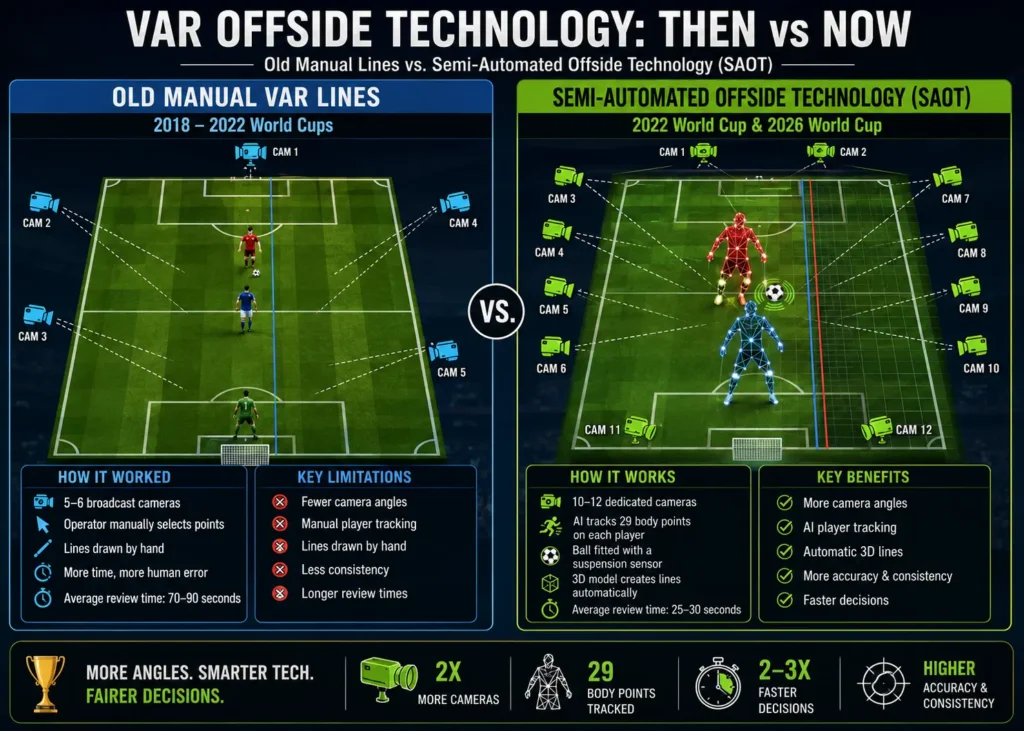
| Feature | Old Manual VAR Lines | Semi-Automated Offside Technology |
|---|---|---|
| Camera setup | Around 5 calibrated cameras | 10-12+ dedicated tracking cameras |
| Line placement | Manually positioned by a human, pixel by pixel | Auto-generated from tracked body point data |
| Ball tracking | Estimated kick point from broadcast footage | Sensor inside the ball detects the exact kick moment, 500 times per second |
| Typical speed | Often 60-90+ seconds on close calls | Frequently under 60 seconds |
| Human role | Fully manual line placement | Human still confirms kick point and final line |
| Used at 2026 World Cup | No | Yes, confirmed by FIFA |
Why Does This Matter So Much for the 2026 World Cup USA?
With the World Cup here on home soil, millions of first time viewers are about to watch matches where a single VAR offside call decides whether the US, Mexico, or Canada advances. If you’re still getting comfortable with the basics before the knockout rounds heat up, start with our complete offside rule guide. Learn this now, and you won’t be the one at the watch party asking why the goal got called back while everybody else already gets it.
Now that you know how a VAR offside review actually works, the rest of the tournament is going to make a lot more sense. And if you don’t want to miss our next breakdown the moment it’s published, our newsletter sends one clear, no fluff explainer like this straight to your inbox each week. You can also browse the full rulebook in our soccer rules hub if you want to keep exploring.
Frequently Asked Questions About VAR Offside Decisions
Q:1 How does VAR decide an offside call in soccer?
A: VAR uses tracking cameras and, at the 2026 World Cup, a sensor inside the match ball to identify the exact moment a pass is played. It then checks whether any part of the attacker’s head, torso, or feet was beyond the last defender at that instant, which determines the offside position.
Q:2 How long do VAR offside reviews take?
A: Most offside reviews resolve in under 60 seconds when the kick point is clear, since semi-automated technology handles the measurement automatically. Longer reviews happen when the kick point is debatable or a defender blocks the camera’s view, requiring a human VAR official to confirm the call manually.
Q:3 Can VAR overturn a goal even if the assistant referee’s flag was not raised?
A: Yes. VAR automatically checks every goal in the background regardless of whether a flag went up during the play. The assistant referee may deliberately delay the flag during a promising attack, and VAR reviews the sequence afterward either way.
Q:4 What is the 10cm rule in VAR offside at the 2026 World Cup?
A: It is a new audio alert system that notifies assistant referees instantly when an offside offense is 10 centimeters or more, meaning the call is clearly not close. This lets the assistant raise the flag immediately instead of delaying it and hoping the read was correct in real time.
Q:5 Why did some VAR offside reviews at the 2026 World Cup still take a long time?
A: Longer reviews usually involve multiple touches in a sequence, like determining whether a defender’s touch was deliberate, or a technology issue like the outage during Switzerland vs Qatar. In those cases a human VAR official has to manually confirm what the cameras and sensors show before the decision reaches the referee.
More on the Offside Rule
- What Is Offside in Soccer, The Complete Rule Guide
- Active vs. Passive Offside Explained
- Offside Timing in Soccer, When Exactly Is the Call Made
- Common Offside Myths, Debunked
Want to catch every one of these moments as they happen this summer? Our newsletter breaks down the rules and tactics behind the biggest plays at World Cup 2026, written for fans who are still learning the game. And if you want to keep going deeper into how offside actually works, start with our full soccer rules hub.
About This Article
All rule references verified against IFAB’s 2025-26 Laws of the Game. Match data sourced from FIFA’s official 2026 World Cup reporting, ESPN’s VAR review coverage, CNN Sports, CBC Sports, and FOX Sports. Statistics on tracking cameras and ball sensor technology sourced from FIFA and Adidas official documentation. Reviewed for accuracy before publication by the SoccerGuidely Editorial Team.