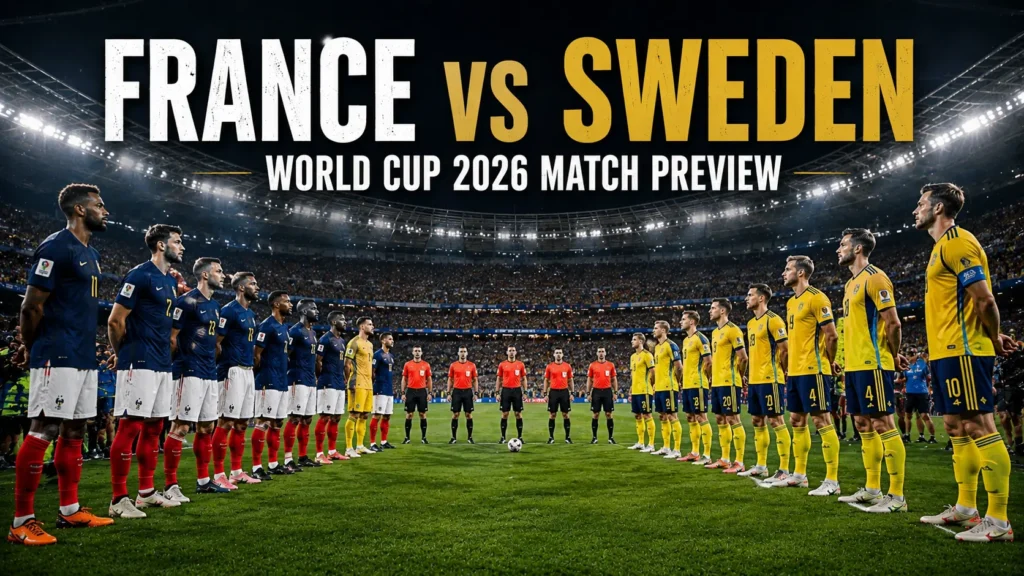
France and Sweden meet in East Rutherford with knockout football now fully in play, where control, patience, and small tactical details tend to matter more than reputation or group-stage momentum. The New York New Jersey Stadium provides the setting for a Round of 32 tie that carries immediate consequence one match, one decision, and a direct path to the Round of 16 for the winner.
France come into the fixture with a familiar identity built on technical depth and positional fluidity across midfield and attack. Sweden arrive with a more grounded structure, shaped around defensive organization and quick, direct responses when space opens up. It’s a meeting of two teams that approach the game from very different starting points, yet both are comfortable operating within tight margins.
The rhythm of the match will likely depend on which side imposes its preferred tempo first.
Tournament Context
The Round of 32 marks the beginning of elimination football at the FIFA World Cup 2026, where group performances fade into the background and the pressure becomes immediate. There’s no recovery route here. If a match slips away, the tournament ends.
France’s presence at this stage reflects a squad that typically carries both depth and tactical flexibility into knockout competitions. Their path through the earlier phase has reinforced their ability to manage games in different ways, whether through possession control or quicker attacking transitions when space opens.
Sweden’s qualification highlights a different kind of progression. Their approach has leaned on compact defending and efficient use of possession rather than sustained dominance. In knockout settings, that type of structure can travel well, especially in matches where space is limited and chances are few.
As always at this stage of a World Cup, margins tighten. Control becomes less about possession numbers and more about where and when that possession actually matters.
France – Fluid Control with Multiple Layers in Attack
France’s attacking structure is rarely fixed in one shape. Midfielders drift between lines, fullbacks push high to create width, and attacking players often rotate into pockets that pull defensive blocks apart rather than force direct confrontation. The result is a team that rarely attacks in straight lines, preferring circulation that builds pressure before accelerating into the final third.
In possession, France are comfortable slowing the tempo when needed, especially to draw opponents out of shape. Once gaps appear between midfield and defense, their passing combinations become more vertical, often targeting central zones just outside the penalty area.
Defensively, the structure is more controlled than aggressive. Instead of constant pressing, France rely on spacing and coordinated movement to limit access through central channels. The idea is not to win the ball immediately, but to reduce passing options until opponents are forced into less dangerous areas.
Transitions remain a consistent feature of their game. When possession turns over, there is usually an immediate attempt to move forward through midfield rather than reset. That ability to shift from control to acceleration without warning is one of their most difficult traits to manage.
At the time of writing, there are no confirmed squad availability updates.
Sweden – Compact Structure with Direct Outlets
Sweden’s approach is rooted in organization. Their defensive shape tends to stay narrow, with the aim of closing central passing lanes and forcing play into wider zones where pressure can be applied more predictably. The distances between lines are kept tight, making it difficult for opponents to find space between midfield and defense.
When they have the ball, Sweden are more direct than elaborate. Rather than building long possession sequences, they often look to progress quickly into forward areas, either through early passes into space or by targeting physical duels higher up the pitch. It’s an approach designed to reduce risk in deeper zones.
Out of possession, their mid-block structure is disciplined. They don’t usually chase aggressively high up the pitch, preferring instead to hold shape and react to movement in front of them. This allows them to stay compact, but it also means they can be drawn deeper if opponents maintain long spells of circulation.
Their most consistent attacking threat comes in transition. Once possession is recovered, Sweden look to move forward quickly before the opposition has time to reorganize. That speed of reaction often defines their most dangerous moments.
No official updates on squad availability have been confirmed.
Tactical Matchup
France’s ability to control possession will likely shape the early rhythm of the game, but Sweden’s compact structure is built specifically to slow that rhythm down. Central spaces are expected to be heavily contested, with Sweden aiming to limit access between the lines and force France toward wider build-up patterns.
That naturally shifts attention to the flanks. France may find more space there, but Sweden’s defensive shifting is generally disciplined, making simple crossing situations less effective unless accompanied by movement inside the box.
The real tension sits in midfield transitions. France prefer structured circulation that builds pressure gradually, while Sweden are more likely to break rhythm through direct movement once possession is regained. Each turnover carries weight, especially if it occurs in advanced zones.
What often decides matches with this kind of contrast is not sustained dominance, but how often one side can force the other out of its preferred structure. If France manage that, Sweden spend long periods defending. If Sweden can repeatedly break the flow, the match becomes far more fragmented than France would want.
Players to Watch
France’s midfield unit plays a central role in how this match unfolds. Their movement between lines and ability to receive under pressure allows France to maintain control even in congested areas. They are often the link between buildup structure and final-third acceleration.
In attack, France’s forward players offer flexibility rather than fixed positioning, drifting into spaces that can pull Sweden’s compact block out of alignment.
For Sweden, the defensive line carries significant responsibility, particularly in dealing with rotational movement around the box. Their positioning and timing in duels will be tested repeatedly if France sustain pressure.
Up front, Sweden’s attacking outlets are less about sustained possession and more about timing runs into space during transition moments, where even small gaps can become opportunities.
Key Battles
France’s structured possession against Sweden’s compact mid-block stands out as the central tactical conflict. The effectiveness of France’s circulation in pulling Sweden out of shape will influence how often chances appear in central areas.
Wide zones could become increasingly important if Sweden stay narrow. France may look to stretch the pitch before attacking inward, rather than forcing central progression too early.
Transitions remain the quiet deciding factor. Sweden’s direct counters against France’s advanced positioning create moments where structure is tested in real time rather than over long phases.
Storylines
This is a classic knockout contrast in style rather than narrative. France bring control through possession and fluid movement. Sweden bring discipline, compactness, and a reliance on timing rather than territory.
The broader question is how each team adapts when their preferred rhythm is disrupted. France are tested when space is limited and decisions must be made quickly. Sweden are tested when forced into long defensive phases without relief.
At this stage of the World Cup, identity is only useful if it holds under pressure.
Match Details
- Competition: FIFA World Cup 2026
- Stage: Round of 32
- Match: France vs Sweden
- Venue: New York New Jersey Stadium
- City: East Rutherford
- Country: United States
- Date: 30 June 2026
- Kickoff Time: 21:00 UTC (approx. 4:00 PM ET / 1:00 AM local, subject to regional display formats)
Match Outlook
France vs Sweden feels like a match that will be shaped less by volume and more by control of key moments. France’s ability to structure possession and find pockets between the lines will be tested against a Sweden side built to stay compact and respond quickly when opportunities appear.
The game’s defining patterns are likely to emerge in midfield control, defensive spacing, and the speed of transitions after turnovers. Neither side needs to dominate for long spells to influence the outcome they only need to manage the moments that matter most.
Knockout football rarely rewards comfort. It rewards precision, timing, and discipline under pressure.