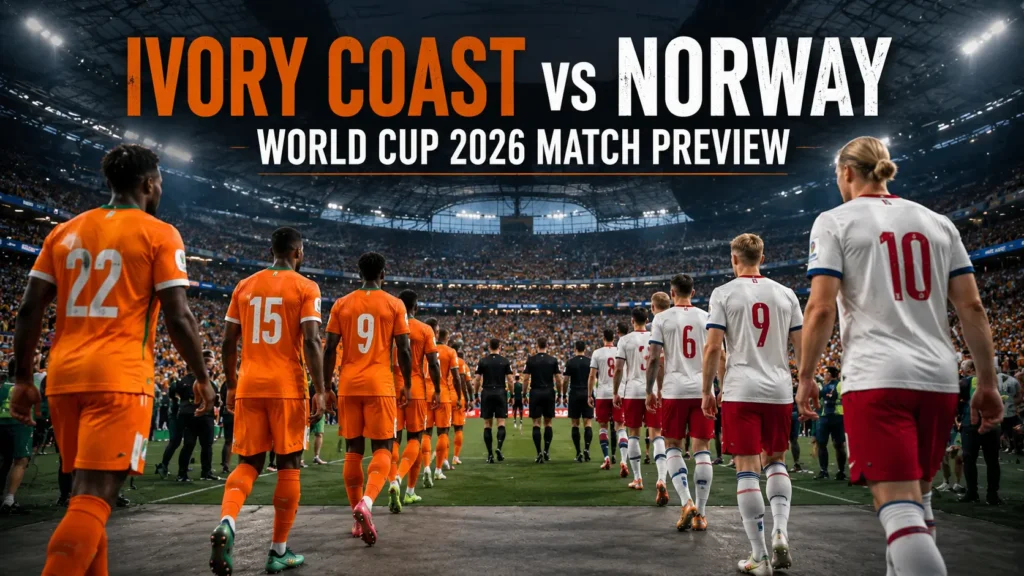
Ivory Coast and Norway meet in Dallas with a place in the Round of 16 on the line, and the contrast between them is hard to ignore. One side has built its tournament identity on structure and patience without the ball. The other leans into speed, direct attacking movement, and a willingness to take risks in the final third.
It’s the kind of knockout matchup that rarely settles into a comfortable rhythm. AT&T Stadium provides the stage, but the football itself feels set up for tension moments of control interrupted by sudden transitions, and long spells where one team is forced to defend its shape under sustained pressure.
Ivory Coast arrive with the discipline of a side that knows how to survive tight matches. Norway, meanwhile, carry an attack that can change the tone of a game in a single sequence.
Tournament Context
This is the Round of 32 at the FIFA World Cup 2026, the first step into knockout football where every decision carries immediate consequence. There is no safety net here. Ninety minutes can define a tournament campaign, and if that isn’t enough, extra time and penalties are waiting in reserve.
Ivory Coast’s presence at this stage reflects a group campaign built on control and defensive clarity. They’ve kept matches compact, often reducing the game to narrow margins rather than open exchanges.
Norway’s path has looked different. Their qualification has been driven by attacking output and moments of direct efficiency in the final third, but knockout football tends to ask different questions. It’s no longer just about scoring it’s about control without the ball, too.
At this point in the tournament, stylistic differences don’t fade. They sharpen.
Ivory Coast Structure First, Space Second
Ivory Coast tend to approach matches with a clear defensive priority. Their shape is compact, lines stay close together, and the aim is simple: deny central access and force play into areas where pressure can be managed.
When they have the ball, there’s little interest in extended buildup phases. The focus shifts quickly toward forward progression, often bypassing midfield congestion in favor of early passes into advanced zones. It’s not about possession for its own sake. It’s about choosing moments to move.
What stands out most is how synchronized their defensive work can be. The midfield drops into position quickly, the back line rarely becomes isolated, and opponents often find themselves circulating the ball without obvious entry points into dangerous areas.
That structure, however, is tested when matches stretch. If they’re forced to defend deep for long periods, the question becomes less about shape and more about concentration and spacing under fatigue.
Still, their transitions remain a key outlet. When possession is recovered cleanly, there’s an immediate attempt to turn defense into attack before the opposition resets.
At the time of writing, no official squad updates have been confirmed.
Norway Direct Attack, Constant Forward Threat
Norway’s approach is far more vertical. They don’t spend much time building slowly through phases unless necessary. The instinct is to move the ball forward early, push into attacking zones, and put defenders under immediate pressure.
That style creates a clear rhythm: quick progression, wide delivery, and presence in the box. It also means their attacking players are often engaged in high-value moments rather than prolonged possession sequences.
Defensively, that ambition comes with trade-offs. When Norway commit players forward, space can appear behind them. If possession is lost in advanced areas, the recovery phase becomes critical. They rely heavily on regaining control quickly rather than maintaining a sustained defensive block.
What makes them dangerous, though, is the immediacy of their transitions. The moment they win the ball, forward runs begin. There’s little hesitation, and that speed can stretch even well-organized defenses if spacing is not immediately reset.
Their attacking structure revolves around a central focal point supported by wide service. The intention is consistent: get the ball into dangerous areas quickly and let movement and finishing do the rest.
No official changes to squad availability have been announced.
Tactical Matchup
This is where the match becomes particularly interesting, because both teams are likely to feel most comfortable in different phases of play.
Ivory Coast will try to keep the game narrow. Their mid-block is expected to sit compact, reducing access through central passing lanes and forcing Norway into wider positions. From there, the defensive shape can shift laterally and close space around the box.
Norway will attempt to stretch that structure. Wide areas become the entry point, not just for crosses but for creating separation between defensive lines. The quicker they can move Ivory Coast’s block side to side, the more gaps may appear in central zones.
Midfield control won’t be about possession dominance alone. It’s more about timing when to slow the game, when to accelerate it, and who wins second-ball situations after direct phases.
One of the quiet tensions in this match sits in transition moments. Norway’s forward commitment can leave space behind them, and Ivory Coast are one of the teams that will look to exploit exactly that kind of opening if it appears.
Set pieces also sit in the background as a potential factor, particularly in a game where open-play chances could be tightly controlled.
Players to Watch
Ivory Coast’s central defenders carry much of the responsibility here. Their positioning against early deliveries and their ability to deal with repeated attacking phases will shape how stable the team remains under pressure.
In midfield, their role is less about creativity and more about control slowing Norway’s rhythm when possible and making sure transitions are triggered at the right moments rather than forced.
For Norway, the attacking focal point naturally draws attention. Their presence inside the penalty area anchors the entire attacking structure, with movement and timing often deciding whether chances become shots on goal.
Wide players also matter significantly. Their delivery and ability to stretch defensive lines influence how often Norway can turn possession into direct threat rather than sterile buildup.
Key Battles
The most consistent theme is Norway’s vertical attacking play against Ivory Coast’s compact defensive structure. If Ivory Coast hold their shape well, Norway may be forced into more patient circulation than they prefer.
Wide zones will carry a lot of weight. Norway want to stretch and isolate. Ivory Coast want to compress and protect. That constant push and pull will define how open or restricted the match becomes.
Transitions sit just underneath everything. Norway’s forward momentum creates risk, and Ivory Coast’s discipline gives them a platform to exploit it if the timing is right.
Storylines
This match reflects two different interpretations of knockout football. One prioritizes structure and control without the ball. The other prioritizes speed and direct attacking threat.
There’s also a subtle test of adaptability. Norway’s attacking approach is consistent, but knockout matches often demand control in phases where the game needs to slow down. Ivory Coast, meanwhile, must prove they can stay organized if forced into long defensive stretches.
At this stage of the World Cup, identity alone is not enough. Execution becomes the real measure.
Match Details
- Competition: FIFA World Cup 2026
- Stage: Round of 32
- Match: Ivory Coast vs Norway
- Date: 30 June 2026
- Kickoff Time: 1:00 PM ET
- Venue: AT&T Stadium
- City: Dallas
- Country: United States
Match Outlook
This is a knockout game shaped by contrast rather than similarity. Ivory Coast’s compact defensive structure meets Norway’s direct attacking style, and the balance between those two approaches will likely define the tempo of the match.
The key questions sit in familiar knockout territory: whether Ivory Coast can maintain defensive discipline under sustained pressure, and whether Norway can turn their attacking volume into control without exposing themselves in transition.
It may not need many chances to feel decisive. In matches like this, structure and timing tend to matter more than volume.