Match Report
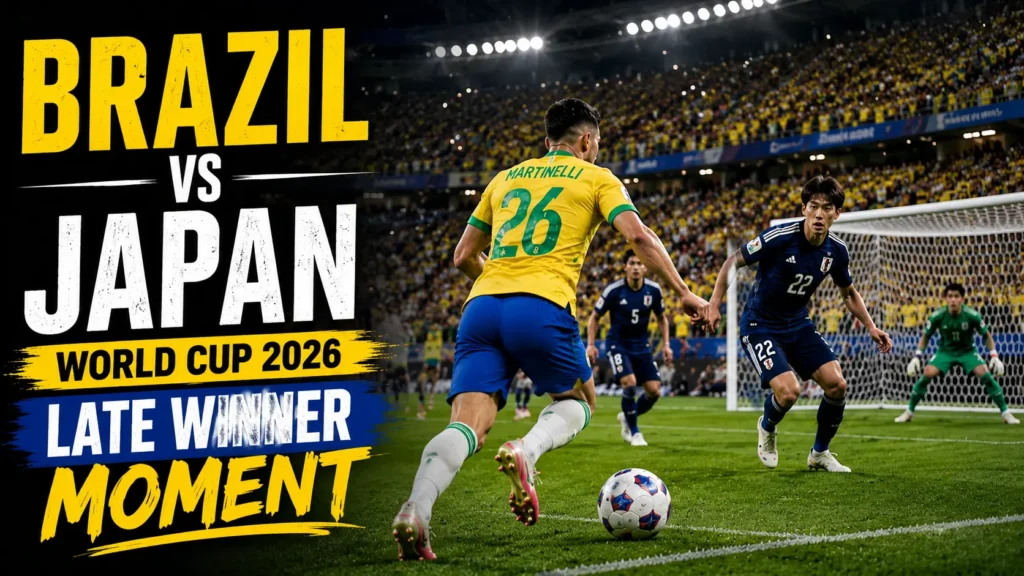
Brazil are into the Round of 16 at the FIFA World Cup 2026 after a late, composed and ultimately decisive 2-1 comeback win over Japan at Houston Stadium. For long stretches this felt like a night where Japan’s structure might hold, but stoppage-time pressure told a different story as Gabriel Martinelli delivered the winner in the 90+5th minute.
Japan had led at halftime through Kaishu Sano’s well-taken strike, and for much of the first half they controlled the rhythm with a compact defensive shape and efficient transitions. But as the game opened up after the break, Brazil gradually imposed themselves, Casemiro leveling the match before sustained pressure finally broke Japan’s resistance in the dying seconds.
It was a knockout match defined by patience on one side and persistence on the other and in the end, Brazil’s depth and territorial control in the final phase made the difference.
Match Overview
This Round of 32 clash carried the familiar tension of knockout football, where structure often matters more than flair. Japan entered with a clear identity built on discipline and compact spacing, aiming to absorb pressure and strike quickly when gaps appeared. Brazil, meanwhile, were expected to dominate possession but had to solve a well-organized defensive block that refused to stretch early on.
The early pattern reflected that contrast. Japan stayed narrow and compact, inviting Brazil forward while protecting central channels, while Brazil circulated possession without finding the final pass. What followed was a match that slowly shifted shape rather than changing suddenly—a tactical adjustment game more than a chaotic knockout encounter.
First Half Analysis
Brazil began with territorial control, but Japan’s defensive discipline limited access through central zones. The midfield stayed crowded, passing lanes were constantly screened, and Brazil were repeatedly forced wide where Japan’s defensive spacing remained compact and coordinated.
Japan’s approach wasn’t passive. Their transitions were direct and purposeful, and when space appeared, they moved quickly into attacking areas. That efficiency was rewarded in the 29th minute when Kaishu Sano finished a move that came from a brief breakdown in Brazil’s defensive spacing between midfield and back line. It was not a sustained spell of pressure, but a moment of clarity Japan recognizing and attacking the gap at exactly the right time.
From there, the match shifted psychologically. Brazil increased tempo, pushing their full-backs higher and asking more of their midfield line to operate closer to the final third. Still, Japan held their shape, and by halftime they had done more than simply defend—they had controlled Brazil’s rhythm.
Second Half Analysis
The restart brought a noticeable change in Brazil’s urgency. Their defensive line stepped higher, possession became quicker, and the spacing between midfield and attack tightened. Instead of probing slowly, Brazil began to play closer to Japan’s defensive block, forcing constant retreats.
That pressure eventually produced the equalizer in the 56th minute, when Casemiro arrived in space to finish a sustained attacking sequence. The goal wasn’t a single moment of brilliance but the outcome of repeated waves of pressure that finally pulled Japan’s structure out of alignment. Once the balance was restored, the entire dynamic of the match changed.
Japan’s response was measured but increasingly defensive. Their transitions became less frequent, partly due to Brazil’s improved counter-pressing and partly due to the physical demands of sustained defending. As the half progressed, Japan were pushed deeper, defending closer to their penalty area than they had intended for most of the match.
Brazil, meanwhile, introduced fresh attacking energy from the bench, adding width and direct movement. That shift mattered—not because it created immediate chances, but because it stretched Japan’s defensive block horizontally, opening space that had not existed earlier.
The pressure built gradually rather than explosively, until stoppage time delivered the final breakthrough. Gabriel Martinelli’s 90+5th minute finish came after Japan failed to fully clear another wave of pressure, and Brazil capitalized on the second phase with decisive execution.
Turning Point
Casemiro’s equalizer in the 56th minute altered the entire structure of the match. It removed Japan’s comfort in defending a lead and forced them into a longer, more physically demanding defensive phase.
Once Brazil leveled the score, Japan were no longer able to maintain the same attacking restraint. That shift subtle at first eventually led to deeper defensive positioning and reduced exit opportunities, setting the stage for Brazil’s late dominance.
Tactical Analysis
Japan’s game plan was built around compact defensive organization and quick vertical transitions. Their mid-block was well coordinated, especially in the first half, where they successfully denied Brazil central progression and forced play into less dangerous wide areas. When possession was regained, Japan looked to move forward quickly rather than sustain long sequences.
Brazil’s initial challenge was finding rhythm between the lines. Their midfield circulation lacked penetration early on, and the spacing between attackers and midfielders allowed Japan to defend in relatively predictable zones. That changed after halftime, when Brazil compressed their structure and increased the tempo of their circulation.
Casemiro’s forward positioning became a key tactical adjustment. Rather than remaining anchored, he stepped into advanced spaces that Japan struggled to track, adding an extra layer of pressure in central zones. Combined with wider attacking positioning from Brazil’s supporting players, this forced Japan’s defensive block to stretch in ways it had avoided in the first half.
As fatigue became a factor, Japan’s compactness gradually dropped deeper toward their penalty area. While their structure remained disciplined, the lack of attacking relief meant Brazil were able to sustain pressure in longer sequences, eventually creating the conditions for the decisive goal.
Standout Performers
Gabriel Martinelli (Brazil): His influence grew as the match opened up, but his most important contribution came in stoppage time. Beyond the goal, his movement across the front line repeatedly pulled Japan’s defenders out of position in the closing stages.
Casemiro (Brazil): Provided balance in midfield while also becoming an unexpected attacking outlet. His timing into advanced areas was crucial in breaking Japan’s defensive shape for the equalizer.
Kaishu Sano (Japan): Operated with composure in midfield and provided the game’s opening goal. His reading of space in transition was a key part of Japan’s first-half control.
Tournament Impact
Brazil move into the Round of 16, where they will face the winner of Ivory Coast vs Norway. The performance will be viewed as a reminder of their ability to manage knockout pressure, even when forced to chase the game.
Japan exit the tournament at the Round of 32 stage. Their campaign will be remembered for tactical discipline and organization, but also for the difficulty of sustaining defensive control deep into high-pressure knockout matches.
Final Takeaway
This was not a match defined by dominance, but by endurance and adjustment. Japan’s structure held for long periods, but Brazil gradually reshaped the game through pressure, positioning, and depth. In the end, the difference was not the first hour it was the final minutes, where sustained attacking persistence finally broke resistance.