
Written by the SoccerGuidely Editorial Team | Last updated: May 2026 | Verified against IFAB 2025-26 Laws of the Game
Quick Answer: Offside timing in soccer is judged at one moment only when the ball leaves a teammate’s foot. If any goal scoring body part of the attacker is past the second-to-last defender at that instant, offside is called. Arms never count. What happens after where the attacker moves, whether a defender catches up means nothing to the official.

The pass goes forward. The striker is already running. Ball hits the net. Stadium erupts. Then the flag goes up and the goal is gone. Everyone around you knew it was coming. You had no idea why. Nobody ever stops to explain offside timing, even though it is one of the most important parts of the rule.
Until now.
With the 2026 World Cup playing across US stadiums this summer MetLife in New Jersey, AT&T in Dallas, SoFi in LA offside timing calls are going to be everywhere. Every flagged goal, and VAR review. Every confused silence in a stadium full of first-time soccer fans. Now you will know exactly what is happening every single time.
When Is Offside Timing Judged in Soccer?
You already have the short version. Now here is why that one frozen millisecond is so much harder to identify than it sounds — and why even experienced fans get it completely backwards.
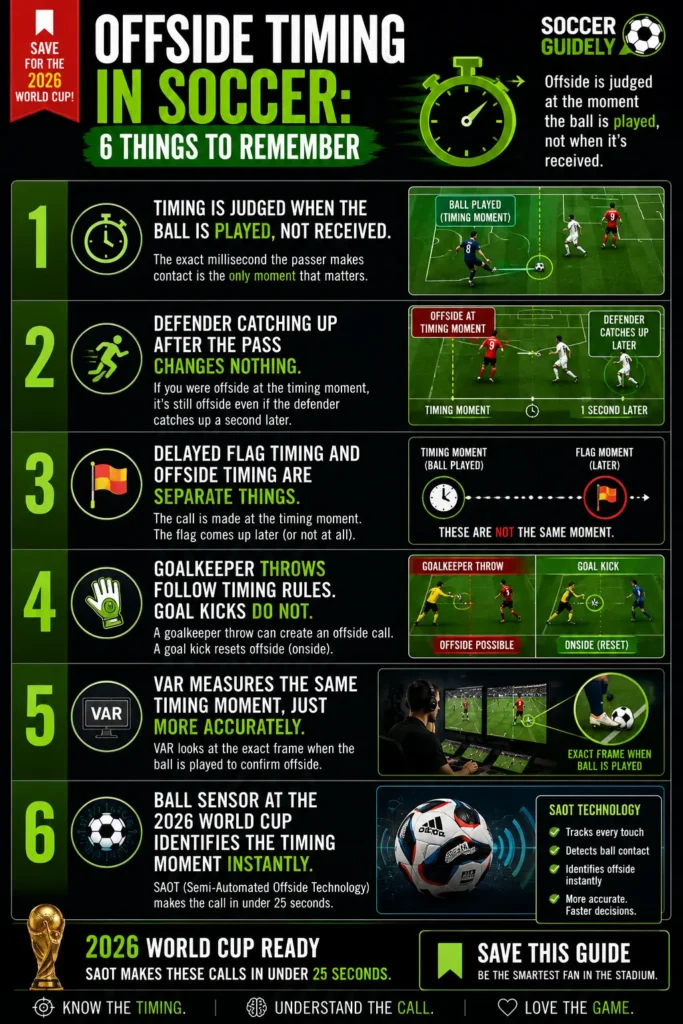
Under Law 11 of the Laws of the Game, written and maintained by IFAB (International Football Association Board), offside is judged at the exact moment a teammate touches or plays the ball. Not when the attacker receives it. Not when the ball arrives. The one frozen millisecond when the ball leaves the passer’s foot.
According to IFAB’s annual review of the Laws of the Game, offside is the most frequently reviewed decision in VAR-enabled competitions. It accounts for more than one-third of all VAR interventions across top-tier leagues worldwide.
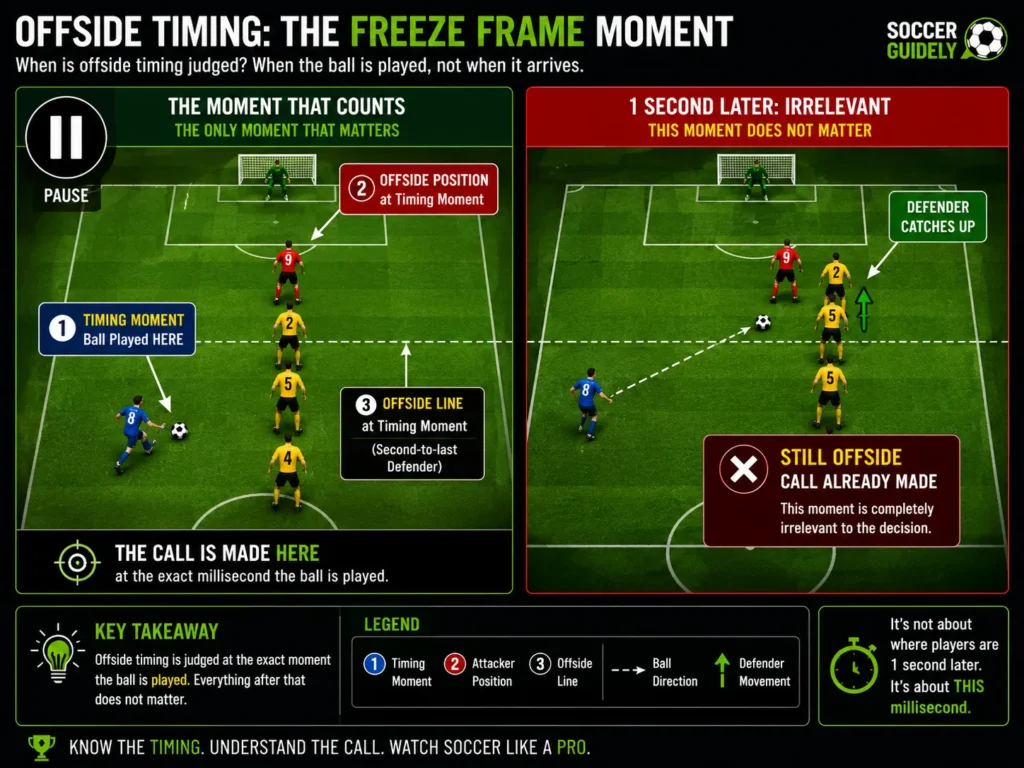
Here is how to picture it. Someone hits the pause button on a video game the exact millisecond a pass is made. That frozen frame is the only frame anyone cares about. Is any goalscoring body part of the attacker past the second-to-last defender in that frame? Yes means offside. No means play on. Simple concept. Brutally hard to see in real time.
One thing most guides skip is what actually happens when the timing call is made and offside is confirmed. The defending team is awarded an indirect free kick from the spot where the offside player became involved. Indirect means the ball must touch at least one other player before it can go into the goal. Think of it as a possession reset rather than a harsh punishment, more like losing a down in American football than getting a penalty kick.
The Freeze Frame Moment Everything Stops Here
Everything before that moment does not factor into the call. Everything after does not factor into the call. One frame. That is the whole timing rule.
What makes it so difficult is that the ball, the passer, the attacker, and every defender are all moving at the same time. By the time your brain processes what your eyes saw, half a second has already passed. The moment that mattered is already gone. This is exactly why VAR exists — because no human eye can freeze that specific millisecond and measure positions accurately at full match speed. Honestly, it is remarkable that assistant referees get it right as often as they do.
Why “When You Receive the Ball” Does Not Matter at All
This trips up basically every new fan. Every single one. And it makes complete sense you are naturally watching the ball travel and tracking where the attacker is when they pick it up.
Here is what actually happened in that play. At the exact moment the pass was played, the attacker was past the last defender by two yards. During the ball’s travel sometimes a full second of real time a defender sprinted forward and closed that gap. By the time the ball arrived, the attacker looked onside. But the determination was already made. The call was already made. Defender closing the gap afterward changes nothing at all.
How Does the NFL Help Explain Offside Timing?
If you grew up watching football, you already get this concept. You just never connected it to soccer before.
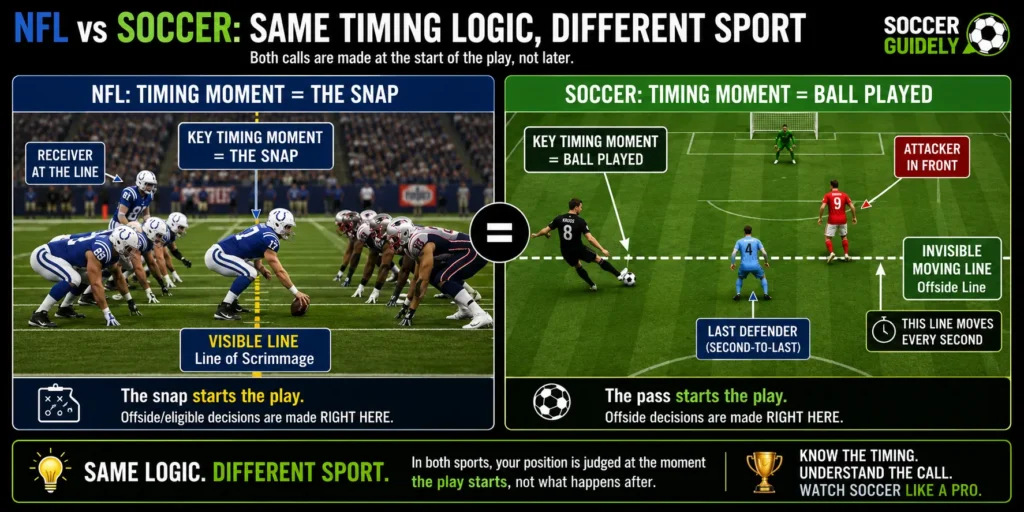
When the quarterback takes the snap and throws forward, the key moment for determining receiver eligibility is the snap itself. Not when the receiver catches it. Not when the ball is in the air. The snap. The moment the play starts. Where the receiver is at THAT moment relative to the line of scrimmage is what matters.
The Quarterback Snap vs the Moment the Ball Is Played
Soccer offside timing is built on the exact same idea. The snap equivalent in soccer is when the ball leaves the passer’s foot. That is when the play starts for offside purposes. Where the attacking player is at that moment not when they receive the ball determines the call.
Both sports are asking the same question: were you in a legal position when the play started? Football asks it at the snap. Soccer asks it when the ball is played. Same logic. Different sport. Once that clicks, the whole timing rule makes sense in a completely different way.
This is also a natural entry point into the full offside rule if you want the complete picture beyond just the timing moment.
Why Soccer Makes It Harder The Line That Never Stops Moving
Here is where soccer gets way more complicated than football. In the NFL, the line of scrimmage is painted on the field. Everyone can see it. Every player knows exactly where the boundary is at all times.
In soccer, that line is invisible. It moves every single time a defender takes a step. Forward, backward, sideways every movement shifts the offside boundary. What most American fans do not realize is that defenders actively use this as a weapon. A defensive line that steps forward together at the exact moment a pass is played can catch an attacker who was perfectly onside half a second earlier. The line moved. The attacker did not adjust. Flag goes up. That is the offside trap working exactly as designed and understanding the timing of that defensive step is what makes it so effective.
What Is the Delayed Flag System and Why Do Refs Wait?
Okay. This one genuinely confuses people. And I completely get it.
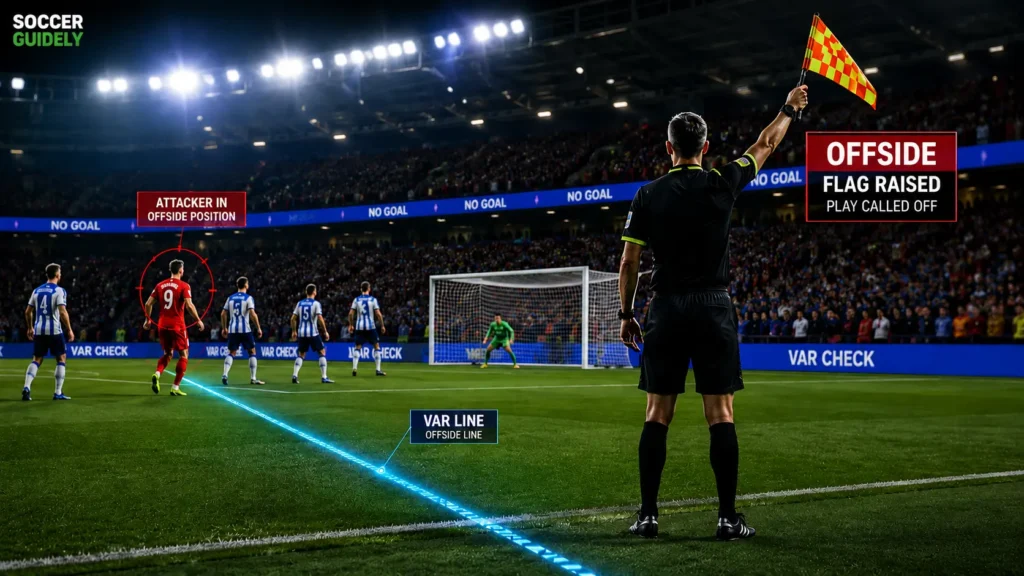
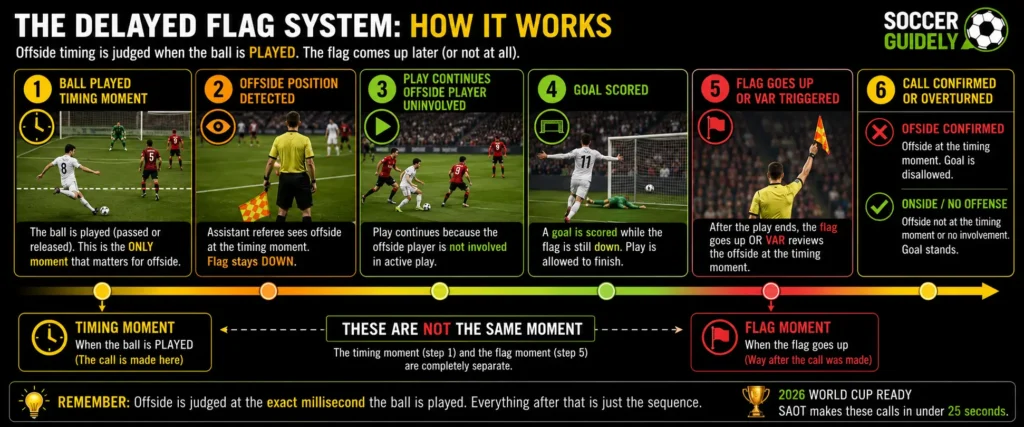
The assistant referee sees a potential offside. Does not raise the flag. Play continues. A goal gets scored. Crowd goes crazy. Then the flag goes up or VAR kicks in. Everyone is standing around wondering what just happened and when the offside actually occurred.
This is the delayed flag system. Once you understand it, you will never be confused by it again.
Why Assistant Referees Keep the Flag Down on Purpose
The logic is straightforward once you hear it. If the assistant referee raises the flag the instant they think a player is offside, they kill the play right there. But what if that offside player never touches the ball? What if they stay completely out of the action? Then no offense happened. The referee just ended a perfectly legal attack for absolutely no reason.
So the protocol is to wait. Watch the offside player. Did they touch the ball? Did they interfere with a defender? If yes, flag goes up. If no, flag stays down and the attack continues. The timing of the flag and the timing of the offside determination are two completely separate things. Not connected. Not the same moment. Remember that.
How VAR Changed the Timing of the Flag Forever
VAR pushed the delayed flag system even further than before. Assistant referees are now specifically instructed to keep their flags down even when they are completely sure an offside occurred. The reason is that if they flag immediately and they are wrong, a legitimate goal-scoring opportunity disappears that cannot be recreated. So they wait, let the sequence finish, and flag afterward knowing VAR will sort it out accurately.
According to FIFA’s official VAR protocol documentation, assistant referees in VAR competitions should delay raising the flag until the attacking phase of play is clearly over. When you see a goal scored and a flag go up ten seconds later that is not a mistake. That is the system working exactly as designed.
The Tactical Reason Behind This: How Smart Teams Exploit the Delayed Flag Window
Here is something that separates casual soccer viewers from people who genuinely understand the game at a tactical level. The delayed flag system has created a deliberate tactical opportunity that the best teams in the world engineer on purpose.
When a forward knows the assistant referee is using delayed flag protocol, they can make a borderline timing run, receive the ball, and immediately play a quick combination to a clearly onside teammate. By the time the flag goes up for the original offside, the second player has already scored. The play gets reviewed. And sometimes more often than most fans realize the original timing determination gets overturned on review.
According to UEFA’s analysis of VAR interventions across the 2022-23 Champions League season, approximately 23% of goals initially flagged for offside were ultimately awarded after VAR review confirmed the timing determination was incorrect. That is nearly one in four flagged goals being reversed. Smart coaches know that number. They actively build attacking patterns around it.
How Did VAR Change the Way Offside Timing Is Judged?
Before VAR, offside timing was a human judgment call made in real time. The assistant referee had to watch the passer’s foot make contact AND the attacker’s exact position at that same millisecond from 50 yards away, with everyone moving at full speed. Every single time.
It went wrong. A lot. Calls given that should not have been. Calls missed that absolutely should have been made. The human eye just cannot reliably freeze one specific millisecond at full match speed. Not consistently. Not with centimeter-level accuracy.
What Happens Inside a VAR Offside Review
When VAR reviews a potential offside on a goal, the technology goes back to the exact frame when the ball left the passer’s foot. That timing moment gets identified first. Then player positions are measured at that specific frame. Not the frame before. Not the frame after. That one frame. Digital lines get drawn. Positions get measured. Call gets made.
The timing rule has not changed at all. What changed is how accurately that one specific moment gets measured. For a deeper look at exactly how VAR processes these decisions step by step, our full guide on VAR offside decisions breaks down the entire technology process.
Why the Freeze Frame Technology Is Now More Accurate Than Any Human Eye
According to FIFA’s official 2022 World Cup Technology Report, Semi-Automated Offside Technology reduced the average offside review time from approximately 70 seconds down to under 25 seconds. That improvement came entirely from automation the system identifies the timing moment and measures positions faster than any manual frame-by-frame review process ever could.
The accuracy improvement is equally significant. Trained assistant referees were making timing errors that were invisible to everyone in the stadium but significant enough to change match results. SAOT eliminates that margin not perfectly, but close enough that the difference is now measured in millimeters rather than yards.
What Is Semi-Automated Offside Technology and How Does It Work?
SAOT is the biggest development in offside timing since VAR itself was introduced. And it is running at every single match of the 2026 World Cup across the United States.
The Ball Sensor That Detects the Exact Millisecond of Contact
Here is the part that genuinely surprises people when they first hear it. The match ball itself has a sensor inside it. According to FIFA’s official Semi-Automated Offside Technology documentation, that sensor communicates with the stadium tracking system 500 times per second. When a player’s foot contacts the ball, the sensor detects the exact millisecond of that contact and transmits it instantly to the SAOT system.
That is the timing moment. The system does not need to guess from camera footage when the ball was played. The ball tells the system itself. Combined with 12 dedicated tracking cameras monitoring every player’s limb positions 50 times per second, SAOT identifies the precise timing moment and measures everyone’s position at that instant with centimeter-level accuracy. Every single call.
How SAOT Will Work at the 2026 World Cup in the USA
What most American fans do not realize about the 2026 World Cup is that this tournament will be the first where the timing moment is identified by the ball itself not by human eyes or camera footage analysis.
Every World Cup before 2026 including Qatar 2022 where SAOT was first deployed relied on camera footage to identify the timing moment. Analysts found the frame where the ball left the passer’s foot and measured from there. At the 2026 World Cup across all 16 US host stadiums, the ball sensor identifies the timing moment independently of any camera system. The ball knows when it was played. Camera footage then gets synchronized to that millisecond not the other way around. The timing moment drives the technology. The technology does not search for the timing moment.
For American fans in MetLife Stadium, AT&T Stadium, SoFi Stadium, Levi’s Stadium, and every other 2026 venue this means VAR reviews will average under 25 seconds instead of over a minute. The blue line appears on the stadium screen. The ball sensor already identified the timing moment. The AI already measured the positions. Fast, accurate, and done. Faster than any generation of soccer fans before you ever experienced.
What Is the Goalkeeper Throw Timing Rule Nobody Talks About?
This one surprises people. Including fans who have been watching soccer for years without ever hearing it.
When a goalkeeper throws the ball to restart play, offside is still judged at the moment the ball leaves the goalkeeper’s hand. The moment of release. Not during the throwing motion. Not when the ball lands. The instant the ball separates from the hand.
Why a Goalkeeper Throw Is Different From a Goal Kick
This distinction matters because goalkeeper throws and goal kicks look similar from the stands but follow completely different offside rules. A goal kick is explicitly exempt from offside under Law 11. You cannot be offside from a goal kick regardless of where you are standing on the field. Period.
A goalkeeper throw carries no such exemption. It follows the exact same timing rules as any other pass in the game. Moment of release is the timing moment. Attacker past the second-to-last defender at that moment means offside position. For a complete breakdown of every situation where the offside rule does and does not apply, our full guide on offside exceptions covers all of them in detail.
The Moment of Release How the Call Gets Made
Goalkeeper throws can travel 30 to 40 yards upfield. An attacker making a forward run covers significant ground while the ball is in the air. By the time the ball lands, they might be 10 yards further than where they were at the moment of release.
The question is only ever this: where were they when the ball left the goalkeeper’s hand? Everything after that moment is the call was already made. Most fans watching from the stands track where the attacker is when they receive the ball. That is the wrong moment. The timing call happened seconds earlier and most people in the stadium never realized it.
Offside Timing vs Onside The Comparison Every Fan Needs
| Situation | Timing Moment | Attacker Position at That Moment | Result |
|---|---|---|---|
| Pass played, attacker onside, defender catches up after | Moment of pass | Onside | Play continues |
| Pass played, attacker offside, looks onside when receiving | Moment of pass | Offside | Flag goes up |
| Attacker onside at pass, sprints past defender before receiving | Moment of pass | Onside | Play continues |
| Goal kick, attacker anywhere on field | Exempt no timing check | Any position | Play continues |
| Goalkeeper throw, attacker past defender at release | Moment of release | Offside | Flag goes up |
| Deflection falls to offside attacker | Original ball played | Offside | Flag goes up |
| Offside attacker never touches ball | Moment of pass | Offside position only | No offense — play continues |
Offside Timing or Not? Five Real Game Scenarios Every Fan Should Know
Scenario 1: Striker Looks Onside When Receiving But Gets Flagged
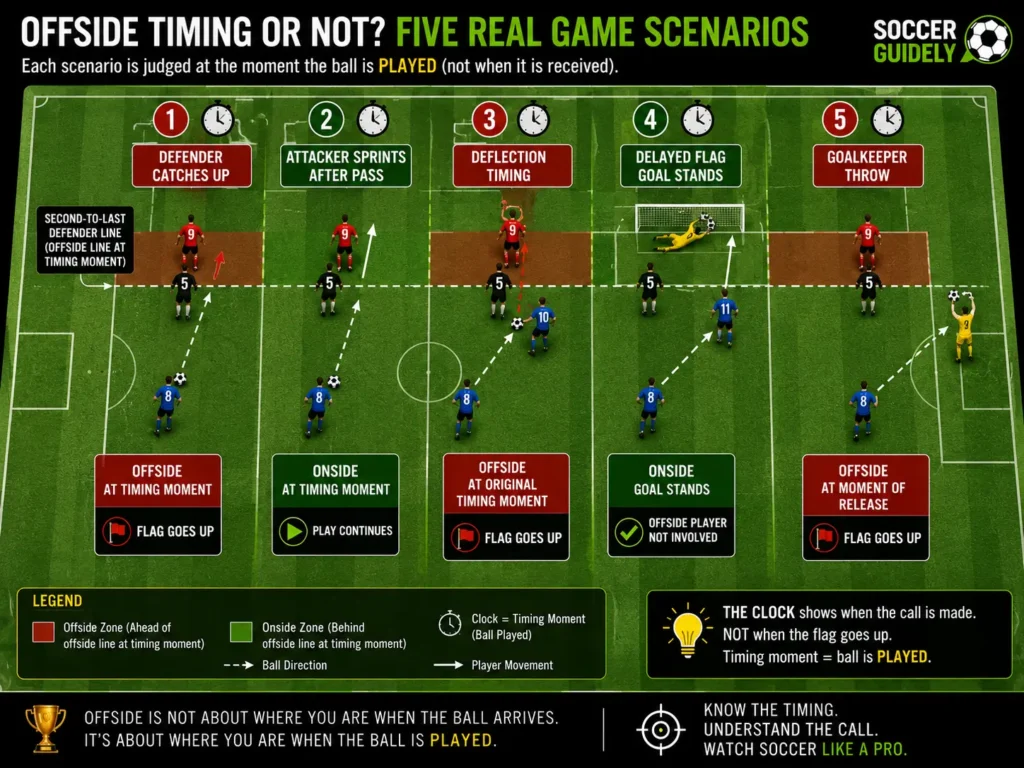
A midfielder plays a through ball over the defense. The striker races a defender to the ball. By the time the striker receives it, the defender is right alongside them. Looks completely onside to everyone in the stadium. Flag goes up anyway.
At the exact moment the midfielder’s foot made contact with the ball, the striker was two full yards past that defender. The defender sprinted to close the gap during the ball’s travel a full second of real time. By the time the ball arrived, the gap was gone. But the timing moment already happened. Already frozen. Already measured. Defender closing the gap afterward changes absolutely nothing.
Scenario 2: Attacker Sprints Into Offside Territory After the Pass Is Played
A forward pass goes into the attacking third. At the moment it is played, the striker is clearly onside two defenders are still ahead of them. The striker then sprints hard during the ball’s travel, is clearly past the last defender by the time they receive it, looks completely offside when the ball arrives. No flag.
Onside at the moment of the pass. End of story. It does not matter where they ended up afterward. They earned that run by timing it correctly. That is the skill being rewarded.
Scenario 3: The Deflection Timing Problem
A striker shoots from a clearly onside position. The ball clips a defender and deflects into the path of a second striker who was in an offside position when the original shot was taken. Second striker scores from the deflection.
Offside. The timing moment goes back to when the original shot was played. At that moment the second striker was illegally positioned. They gained an advantage from that illegal position by being in the right spot for the deflection.
Here is the important nuance most fans miss. If the defender had DELIBERATELY played the ball rather than it deflecting accidentally off them, the offside call would be canceled. A deliberate touch by a defender resets the situation the attacker is no longer considered to have gained an unfair advantage. But a ricochet, a block the defender did not control, a ball clipping off a knee unexpectedly those do not count as deliberate play. The original timing moment stands. This distinction causes genuine match controversy because “deliberate” versus “uncontrolled deflection” is itself a judgment call that officials have to make in real time.
Scenario 4: The Delayed Flag Goal That Stands
A striker is in an offside position when the pass is played. The assistant referee sees it and keeps the flag down following delayed flag protocol exactly. The offside striker never touches the ball at any point. A different onside teammate receives the pass and scores.
Goal stands. The timing determination confirmed offside position at the moment of the pass. But the offside player never got involved in any way. No offense occurred. No flag needed. Clean goal. Delayed flag protocol worked exactly as it was designed to work.
Scenario 5: The Goalkeeper Throw Timing Catch
The goalkeeper makes a long throw upfield. A striker receiving it is well past the last defender when the ball arrives. Flag goes up. The striker looks confused. Most fans in the stadium are confused alongside them.
Unlike a goal kick which is fully exempt from offside a goalkeeper throw follows standard timing rules. At the moment the ball left the goalkeeper’s hand, the striker was already past the second-to-last defender. Offside position at the moment of release means offside offense when they receive it. Most people watching assumed it was treated like a goal kick. It was not. And now you know exactly why.
How Can You Actually Track Offside Timing Yourself While Watching?
Here is a practical tip that genuinely changes how you watch every match from now on. Simple but effective.
Stop Watching the Ball Watch the Line Instead
When a forward pass goes into the attacking third, do not follow the ball. Watch the defensive line instead. The instant the passer’s foot makes contact that is your timing moment. At that exact instant, look at where the last outfield defender is standing. Any part of the attacker’s body past that defender? Flag should go up.
Counterintuitive. Every instinct says follow the ball. But the assistant referee on the sideline is not following the ball at that moment. They are watching the line. The timing moment. You can do exactly the same from the stands.
I have tried explaining the timing rule to friends at watch parties more times than I can count. Every time I described the frozen millisecond and the freeze frame concept eyes glazed over. The moment I said “stop watching the ball and watch the defensive line instead” that was the moment it clicked for every single one of them. One sentence. Whole rule unlocked. Try it once. It works every time.
How to Read the Timing Call Before the Flag Even Goes Up
According to MLS match data from the 2023 season, the average MLS match produced 6.2 offside decisions per game. That is a timing determination being made roughly every 15 minutes of play. Six moments per match where knowing this rule makes the difference between understanding what just happened and staring at the screen completely lost.
Practice watching the defensive line for one full match. By halftime you will start reading timing calls before the flag goes up. You will see the pass played, check the defensive line at that exact instant, and know. Onside or not. Before any official signals anything. That is how experienced fans watch soccer. Show up to a 2026 World Cup match with that skill and the whole experience becomes something completely different.
Why Do Elite Strikers Obsess Over Run Timing?
Understanding timing as a fan is useful. Understanding why professional strikers obsess over it reveals an entirely different layer of the game.
Being Onside at the Right Moment vs Being in the Right Position
The entire craft of elite forward play comes down to one brutally difficult skill. You need to be onside at the timing moment when the ball is played while simultaneously being in the best possible position to receive and finish when the ball actually arrives. Two different moments. Separated by a full second or more of real time. You need to get both right at the same time.
A striker who is offside at the timing moment but looks onside when receiving the ball did not do anything skillful. They just got away with bad positioning. A striker who is perfectly onside at the timing moment and then uses the ball’s travel time to sprint into the best finishing position that is the craft. That is what separates the elite from everyone else.
What Separates a World Class Run From an Offside Call
What most American fans do not realize is that elite strikers are not running on pure instinct. They are reading their teammates constantly watching body position, weight shift, eye direction predicting exactly when the pass will come. Then timing their acceleration to start at the precise moment just before the ball is played.
Watch USMNT forward Christian Pulisic in the attacking third next time you catch a match. He does not sprint the instant the ball goes wide to a teammate. He takes two or three stutter steps almost jogging in place while the teammate sets up. Then the instant that teammate’s body shifts into a passing position, Pulisic accelerates. By the time the pass is played, he is already at full speed. And because he timed the acceleration to start just before the ball left his teammate’s foot, he is onside at the timing moment while being in a full sprint by the time the ball arrives. Not an accident. A skill that takes years to develop.
Here Is Something Coaches Know That Most Fans Do Not: The Pass Has to Be Deliberately Played for Standard Timing Rules to Apply
Most fans assume the offside timing rule activates on every single touch a teammate makes. It does not. The key word buried in Law 11 is “played.” The ball has to be deliberately played not accidentally contacted, not deflected unintentionally.
If a teammate’s shot is blocked and deflects accidentally to an attacker, no deliberate “play” occurred in the standard sense. Smart attackers who understand this rule position themselves to exploit accidental touches completely legally. What most fans do not realize is that this is one of the most genuinely contested gray areas in modern soccer officiating. Referees and VAR officials make a split-second judgment was that touch deliberate or accidental? That one judgment determines whether the timing rule applies at all. Two identical-looking situations can get completely different calls based solely on how the official reads the intent behind the touch.
What Offside Timing Myths Do Most American Fans Still Believe?
These myths are everywhere. Even fans who have been watching soccer for years repeat them without thinking about whether they are actually true.
Myth 1: “If You Are Onside When You Receive It, You Cannot Be Offside”
Most common myth by a significant margin. Sounds completely logical on the surface. But the call is based on the timing moment of the pass not the moment of reception. You can look perfectly onside when the ball arrives and still be offside because of where you were a full second earlier when it was played. Different moments. Different rules. Not connected.
Myth 2: “The Flag Going Up Means the Ref Saw It at That Moment”
Nope. The delayed flag system means the flag timing and offside timing are completely separate events. The assistant referee made the timing determination earlier at the moment the ball was played. The flag went up later, after they confirmed the offside player got involved. The flag moment is not the offside moment. Never has been.
Myth 3: “If the Defender Catches Up, the Offside Is Canceled”
A defender sprinting back to close the gap after the pass is played has zero effect on the call. The timing moment already happened. The freeze frame already showed the attacker past the defender. Nothing that happens after that frozen moment can change what the frozen moment showed. Zero effect. None.
Myth 4: “You Cannot Be Offside From a Goalkeeper Throw”
Probably exists because goal kicks are exempt and fans naturally group those two situations together. Goal kick and goalkeeper throw are completely different restarts with completely different rules. A goalkeeper throw follows standard offside timing rules. No exemption. Moment of release is the timing moment. Full stop.
Myth 5: “VAR Can Choose a Different Timing Moment”
VAR does not get to shop around for a more convenient frame. The timing moment is always and only the exact frame when the ball left the passer’s foot or body. VAR reviews that same moment with greater accuracy than any human could achieve in real time. Same rule. Better measurement. For a full breakdown of every offside myth including all the timing-related ones, our offside myths guide covers every misconception in detail.
Frequently Asked Questions About Offside Timing in Soccer
Q:1 When exactly is offside judged in soccer?
Offside is judged at the exact moment the ball leaves a teammate’s foot, head, or body when playing a pass. The attacker’s position at that precise millisecond is the only thing that matters. Under Law 11 of the Laws of the Game, position at the moment the ball is received is completely irrelevant to the call.
Q:2 Why do referees sometimes wait before raising the offside flag?
Referees use the delayed flag system to avoid stopping potentially legal attacks prematurely. The assistant referee waits to confirm the offside player actually becomes involved in play before raising the flag. In VAR competitions, refs keep the flag down and let attacking sequences finish so VAR can make the most accurate determination possible.
Q:3 Can a player become offside after the ball is played?
No. A player cannot become offside after the moment the ball is played. If they were onside at the timing moment of the pass, they remain onside regardless of where they sprint afterward even if they are clearly past every defender when they receive the ball. Onside at the moment the ball is played means onside. Period.
Q:4 Is a goalkeeper throw judged the same way as a regular pass for offside?
Yes. A goalkeeper throw follows the same offside timing rules as any other pass. Offside is judged at the moment the ball leaves the goalkeeper’s hand. This is completely different from a goal kick, which is fully exempt from the offside rule under Law 11 of the Laws of the Game.
Q:5 How does VAR determine the exact timing moment for offside?
VAR freezes footage at the exact frame when the ball leaves the passer’s body. At the 2026 World Cup, Semi-Automated Offside Technology uses sensors inside the match ball detecting contact 500 times per second, combined with AI limb-tracking cameras measuring every player’s position at that exact frozen moment with centimeter-level accuracy.
Want to Keep Learning?
The timing rule is the foundation of understanding every offside call you will ever see. But the offside rule has more layers worth knowing before you sit down for a 2026 World Cup match in a US stadium.
If the delayed flag and active involvement concept still has you thinking, our guide on active vs passive offside breaks down exactly when an offside position becomes an actual offense. If you want the full picture of how the entire rule works together in one place, start with the complete offside rule guide. And if you are curious about all the situations where the offside rule flat-out does not apply, the offside exceptions guide covers every single one of them.
The offside timing rule is just one piece. Here is where to go next depending on what still has you thinking:
- Offside Position in Soccer Complete Guide
- What Is Offside in Soccer The Complete Rule Guide
- Active vs Passive Offside What Is the Real Difference?
- Offside Exceptions When the Rule Does Not Apply
- VAR Offside Decisions How Technology Makes the Call
- The Offside Trap How Teams Use This Rule as a Weapon
- History of the Offside Rule
- FIFA Law 11 Full Offside Law Explained
- Offside Myths Busted
Have a question about something we did not cover? Drop it in the comments below. We update these guides regularly based on what American fans are actually asking and your question might make it into the next version of this article.
About This Article
Written by the SoccerGuidely Editorial Team soccer analysts and MLS fans covering the sport for American audiences since 2019. Our mission: make soccer make sense for Americans, especially before the biggest World Cup in history arrives on US soil.
All rule references verified against IFAB’s 2025-26 Laws of the Game. Statistics sourced from FIFA’s official 2022 World Cup Technology Report, FIFA VAR protocol documentation, UEFA Champions League VAR analysis 2022-23, and MLS 2023 competition data. Reviewed for accuracy before every publication.