Last updated: May 2026 | Verified against IFAB 2025-26 Laws of the Game
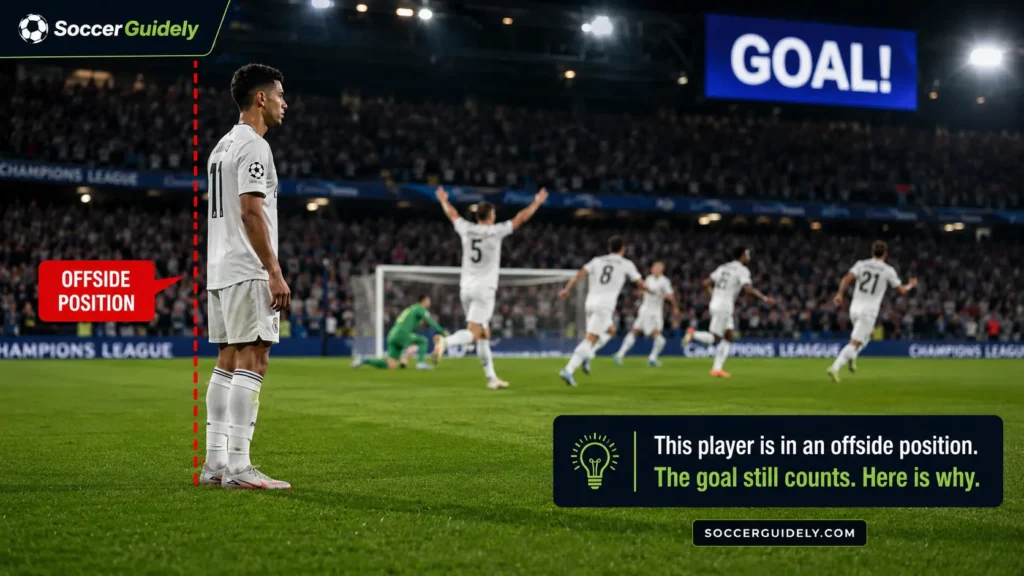
Quick Answer: You are in an offside position in soccer when your head, body, or feet are further up the field than both the ball and the last outfield defender at the exact moment your teammate plays it. Arms do not count. Ever. And just being in that position is not actually a foul. You have to get involved in the play first.
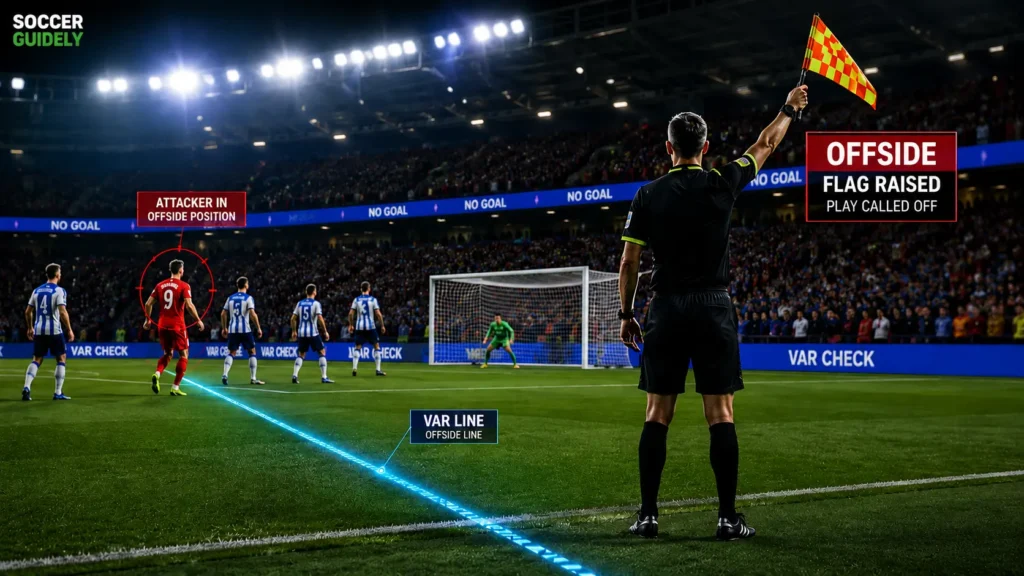
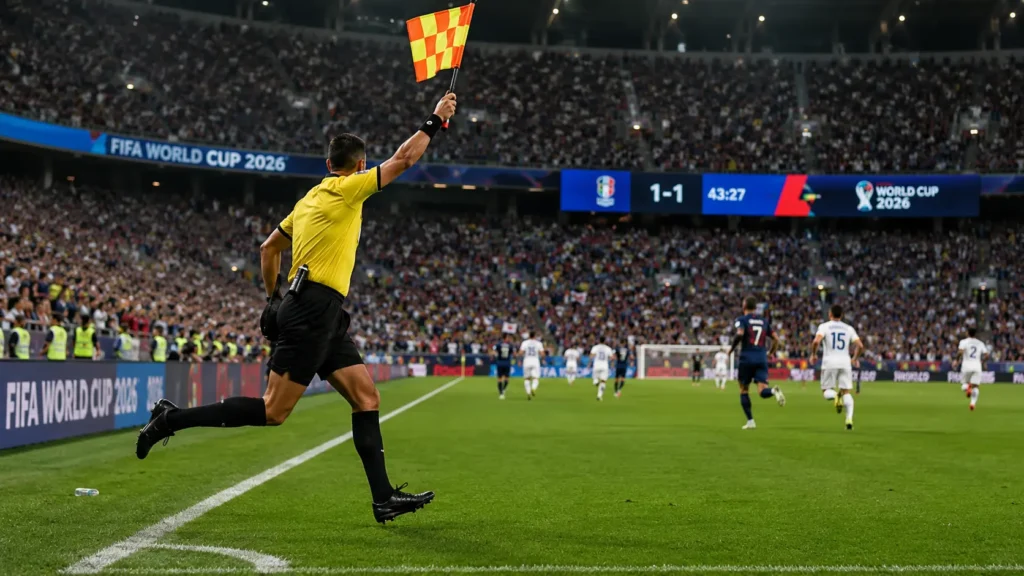
The striker breaks free. Ball hits the net. Eighty thousand people completely lose their minds, then nothing. Dead silence. Flag is up on the sideline. Some thin blue digital line shows up on the screen and suddenly the goal that just happened did not happen. Offside position. Two words. Greatest moment of the game, gone.
You have seen it happen. You just never knew exactly why.
I have watched this exact moment happen to new soccer fans more times than I can count. Someone watches their first match, a goal gets disallowed for offside, and they spend the next ten minutes being explained something that nobody can explain clearly in ten minutes. Not because the rule is that hard. Because nobody ever breaks it down the right way.
Until now.
With the 2026 World Cup arriving in US cities this summer, including MetLife Stadium in New Jersey, SoFi Stadium in LA, AT&T Stadium in Dallas, and Levi’s Stadium in San Francisco, millions of Americans are going to sit in those seats and watch this rule get called live. Probably multiple times per match. Probably on a goal that seemed absolutely certain. This is the guide that makes sure you are not the person in the stadium asking “wait, what just happened?”
What Is the Offside Position in Soccer?
Real talk. The official definition reads like a terms and conditions page. Under Law 11 of the Laws of the Game, written and maintained by IFAB, the International Football Association Board and the body that has governed soccer rules since 1886, a player is offside if any part of their head, body, or feet is past the second-to-last defender when their teammate plays the ball forward. That is the core of it. Everything else is details layered on top.
Three things inside that definition do all the work. Understand each one separately and the whole rule just clicks.
The Three Words That Actually Matter: “Second-to-Last Defender”
“Second-to-last defender” sounds like something a lawyer made up. It is not complicated though. The goalkeeper is last, they are always deepest. So second-to-last just means the final outfield player. The last actual field player standing between the striker and a wide open run at goal. That is the person who draws the invisible line.
One knee past that player when the ball is played? Offside position. Does not have to be dramatic. Does not have to be obvious. One knee is enough.
Why “At the Moment the Ball Is Played” Changes Everything
This one gets people every single time. Seriously, every time. It does not matter where the attacker ends up when they catch the ball. What matters is where they were standing the moment their teammate’s foot made contact. That instant. Not a second later. Not when the ball arrives. That one frozen moment is literally the only thing being judged.
So a striker can be offside, sprint forward, get the ball in what looks like a totally onside position, and still get flagged. Because the call was already made back when the pass happened.
How Does the Offside Position Actually Work on a Real Field?
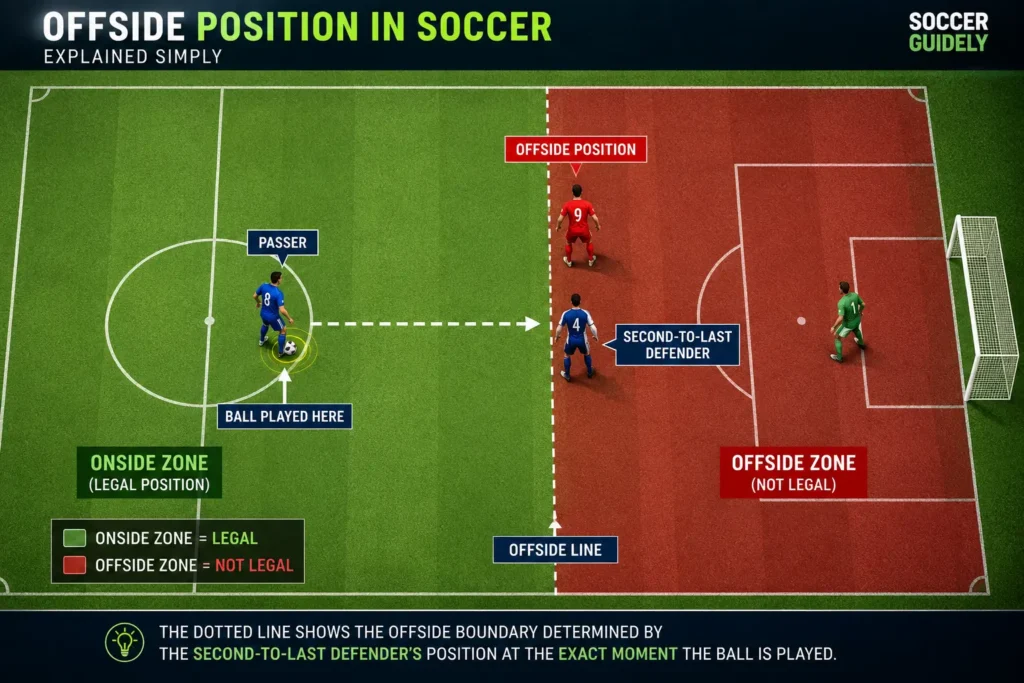
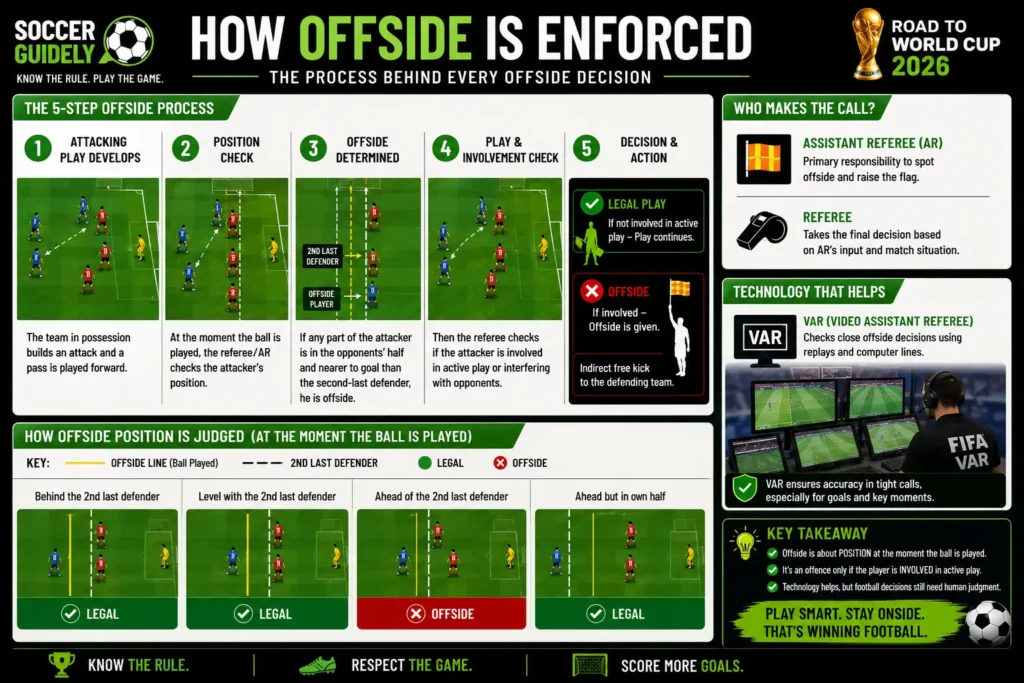
Picture a freeze frame. Your team’s midfielder is about to play a through ball. The exact millisecond that ball leaves their foot, an imaginary horizontal line gets drawn across the field through the second-to-last defender. That invisible line is the offside boundary. Any goalscoring body part past it? Offside position.
What most American fans do not realize is that this boundary is not fixed like a yard line in football. It moves constantly. Every time the defensive line pushes up to pressure, the offside line moves with them, closer to midfield. Every time they drop back, the line drops too. It is a living, shifting boundary that defenders use as a weapon, and smart attackers spend 90 minutes trying to time their runs around it.
According to IFAB’s annual football report, offside is consistently the most reviewed decision in VAR-enabled competitions worldwide, accounting for over 35% of all VAR interventions across top-tier leagues globally. More than fouls, handballs, and any other call in the game.
Think of It Like an NFL Forward Pass Seriously
NFL analogy incoming, and it actually works here. When the quarterback snaps the ball, wide receivers cannot already be past the line of scrimmage. Does not matter how fast they run after that. If they were ahead of the line when the play started, it is illegal. Whole thing gets called back. Soccer is the same deal, just without the painted line on the grass that everyone can actually see.
The difference? Football has a literal painted line. In soccer, that line is invisible, constantly moving, and being tracked by a human assistant referee standing on the sideline from 50 yards away in real time at full match speed. That is why offside is one of the most controversial calls in all of sports, and why VAR changed everything.
Why That Line Keeps Moving (And Why That Makes It So Hard to Call)
Defenders are not just standing there waiting to get beat. They are actively managing that offside line as a tactical tool, stepping up together in a coordinated wave to push the boundary toward midfield and shrink the space attackers can operate in. This is intentional. Strategic. It is called the offside trap, and entire defensive systems have been built around it.
The line moves because the players move. Following it in real time, with human eyes, at full match speed is genuinely one of the hardest jobs in officiating. And before VAR, they got it wrong a lot.
Is Being in an Offside Position Actually Illegal?
Short answer: no. Longer answer: still no, but here is why it matters.
Standing past the last defender is not against the rules on its own. Nothing gets called. No flag, no whistle, game keeps moving. People think just being in that spot is the crime. It is not. The crime is what you do from there.
You only commit an actual offside offense when two things are true at the same time. You are in an offside position AND you are actively involved in the play. Both conditions at the same time. Miss one? No call.
What Does “Actively Involved in Play” Actually Mean?
FIFA breaks “actively involved” into three specific situations. First, you touch or play the ball your teammate passed. Second, you interfere with an opponent, meaning you block their line of sight to the ball or get in the way of their movement even without touching the ball. Third, and this one catches people off guard, you gain an advantage from your offside position. The ball deflects off the post or a defender and comes back to you because you were already illegally positioned there.
You do not have to receive the original pass to get caught. If you were in an offside position when the ball was played and you pick up the rebound, that is the offense. Wrong place, got the ball, flag goes up.
When an offside offense IS called, the defending team gets what is called an indirect free kick from the spot where the offside player got involved. “Indirect” means the ball has to touch at least one other player before it can go into the goal. Think of it like a reset possession play rather than a direct scoring chance. A punishment, but not catastrophic. More like losing a down in football than getting hit with a penalty kick.
The NBA Restricted Area Rule That Explains This Perfectly
Think of the restricted area circle under the basket in the NBA. A defender standing inside it is not automatically charged with a foul. Nothing happens just from being there. The call only comes when there is active contact and the right conditions are met. Soccer’s offside position works the same way. Just being in the wrong place is not the crime. Getting involved in the play FROM that wrong place is the crime.
Which Body Parts Count for Offside? (Yes, It Gets Weird)
Okay so this is where it gets a little unhinged. The rule makes logical sense in theory. Any body part you can actually score with counts toward offside. Head, chest, torso, legs, feet. All of it. Arms though? From the armpit down to your fingertips, none of it counts. Zero.
The reasoning is fine. You cannot score with your arm on purpose, so why should it be able to make you offside? Makes sense on paper. Until VAR zooms in on somebody’s armpit on a jumbotron in front of 70,000 people. Then it stops making sense real fast.
Why the Armpit Became the Most Controversial Inch in Soccer
Here is where things get genuinely absurd. With VAR technology drawing digital lines across freeze-frame footage, referees are now measuring human body parts to the centimeter. Goals have been disallowed because a player’s shoulder, not their foot, not their head, their SHOULDER, was two centimeters past the defender at the moment of the pass.
According to FIFA’s official 2022 World Cup Technology Report, the upper boundary of the arm is defined as being in line with the bottom of the armpit. So the armpit itself is the dividing line. Fans worldwide started calling it the “armpit rule.” Not affectionately.
Here Is Something Coaches Know That Most Fans Do Not: Strikers Are Trained to Use Their Arms to Stay Onside
Here is an aha moment that reframes everything you just learned about arms not counting.
If arms do not create offside positions, then a smart striker can use their arms to stay onside while their goalscoring body parts push ahead. Think about that for a second. A striker running toward goal can pin their arms deliberately behind their body, pulling their total physical footprint backward, while their torso and feet push forward toward goal. The measured body parts stay level with or behind the defender. The arms hanging back? Pure legal bonus.
Elite strikers are actually coached on arm positioning for exactly this reason. Keeping arms tucked or pulled back can legally gain inches of advantage on a defensive line without creating an offside position. At the World Cup level, where the difference between onside and offside is sometimes a single centimeter, those inches matter enormously.
Next time you watch a striker make a run in behind the defense, take a second to look at where their arms are. You will start seeing it everywhere.
The Logic Behind the Arms Rule Actually Makes Sense
Strip away the controversy and the logic holds up. A shoulder being two inches past a defender does not help you score. Your chest, your head, your feet do. So those are the only things measured. The underlying principle is fair. The execution, via millimeter-level armpit analysis on a stadium jumbotron, is where it gets a little existential.
What Are the Three Conditions That Must ALL Be True for Offside to Be Called?
Three things. All three have to be happening at once. Miss any single one and there is no call, play on.
Condition 1: You Must Be in the Opponent’s Half
First one is the easiest. You have to actually be in the opponent’s half of the field. Your own half? Safe. Always. A player standing on their side of the halfway line cannot be called offside under any circumstances, no matter where everyone else is positioned. The halfway line itself counts as onside territory.
Condition 2: You Must Be Past the Second-to-Last Defender AND the Ball
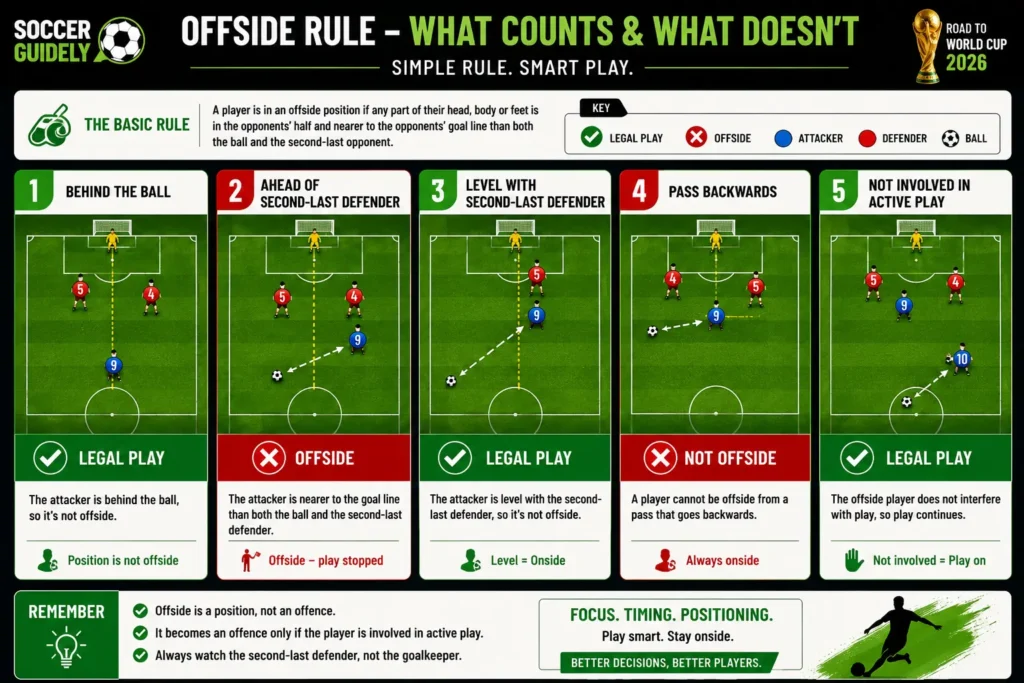
This one trips people up more than it should. You have to be past both the second-to-last defender AND the ball, not just one of them. If the ball is further up the field than you are, there is no offside. If even one outfield defender is still level with you or ahead of you, there is no offside. Both have to be behind you toward their own goal at the same time.
Condition 3: You Must Be Actively Involved in Play
And if that is not enough, you also have to actually do something. Touch the ball, block a defender’s line of sight, or pick up a rebound after being illegally positioned. Any of those three triggers the call. But standing completely still and doing nothing while play continues around you? Totally legal. We broke this down in full detail in the “actively involved” section above.
Is Being Level With the Last Defender Offside?
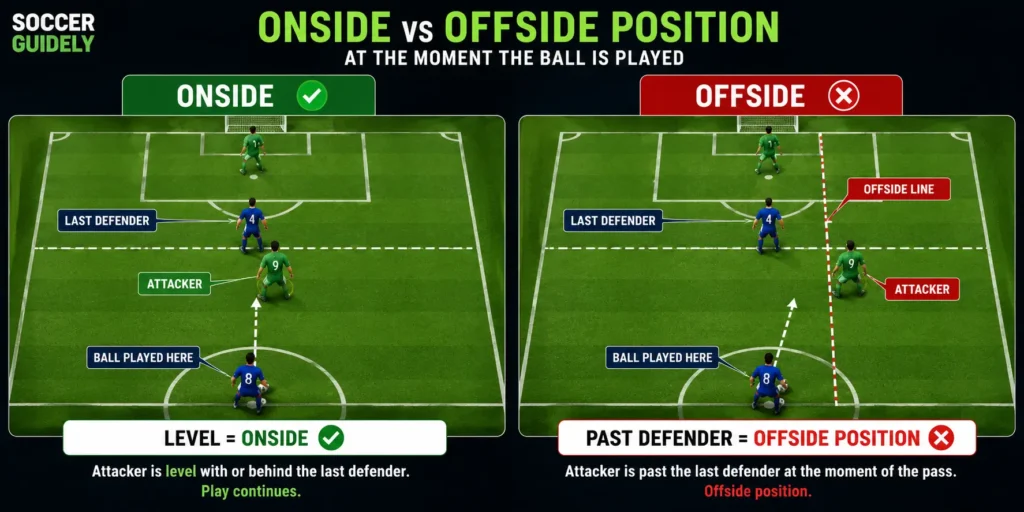
Nope. This trips people up constantly and has been causing arguments at watch parties for decades. Being level with the second-to-last defender means you are onside. You have to be clearly and measurably AHEAD of them, not alongside them, not at the same line, actually past them, to be in an offside position.
Why Ties Always Go to the Attacker
The rule is intentionally tilted toward the attacker when it is close. If any part of the attacker is level with the last defender, not past them, exactly level, they are onside and play stands. FIFA built this in deliberately to encourage attacking play. In the pre-VAR era it meant close calls went to the attacker by default. In the VAR era there is almost no such thing as too close to call anymore. But the principle stays: level is always legal.
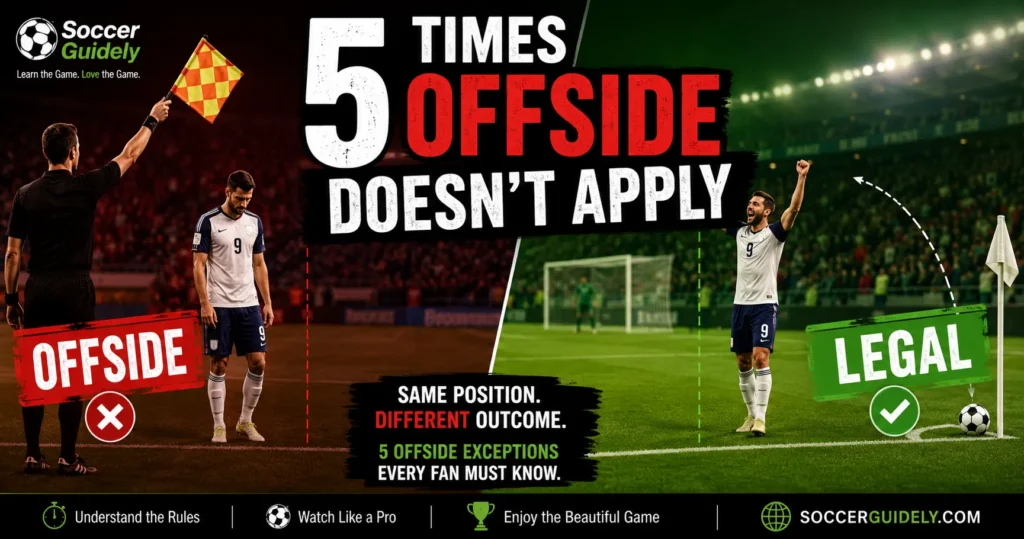
Offside or Not? Five Real Game Situations Every Fan Should Know
Let us walk through five situations you are going to see at the 2026 World Cup. Real moments. Real outcomes. The play unfolding the way it actually does on the field.
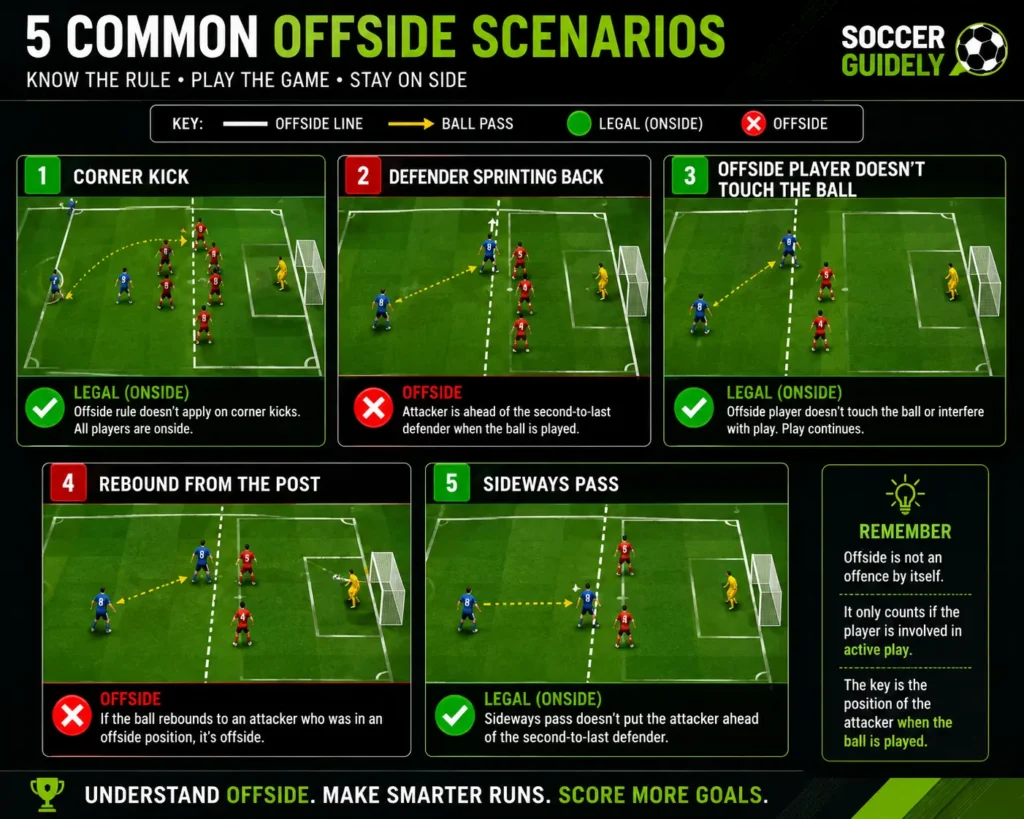
Situation 1: Striker Scores Directly From a Corner Kick
The corner comes in. The striker rises above everyone at the back post and heads it into the net, despite standing clearly past the last defender. No flag. Goal stands. You cannot be offside directly from a corner kick, a goal kick, or a throw-in. Does not matter where any attacker is standing. These three restarts are fully exempt under Law 11, no exceptions to the exception.
Situation 2: Defender Sprints Back After the Pass Is Played
A midfielder slides a through ball over the top. At the exact moment it leaves their foot, the striker is two yards past the last defender. A defender sprints back and actually catches up to the striker just as they bring the ball down. Still offside. The only frame that matters is when the ball was played. A defender catching up afterward changes absolutely nothing.
Situation 3: An Offside Player Stays Completely Out of the Play
A striker is clearly in an offside position, past the last defender, in the opponent’s half. Their teammate plays the ball to a completely different player who is onside. The offside striker freezes. Does not move toward the ball. Does not get near any defender. Plays zero part in what follows. No flag. This is passive offside and it is completely legal. Smart players do this deliberately. They know they are offside, so they make a point of not moving and not interfering, letting onside teammates continue the attack without penalty.
Situation 4: The Ball Rebounds Off the Post to an Offside Player
A striker shoots from an onside position. The ball smashes off the post. A second striker, who was in an offside position when the shot was taken, reacts fastest and scores from the rebound. Offside. Goal disallowed. This is the “gaining an advantage” rule. The second striker was illegally positioned when the ball was originally played. They benefited from that position by being in the right spot for the rebound. The original pass did not go to them. Did not matter. Wrong place, got the ball, flag goes up.
Situation 5: The Ball Is Played Sideways, Not Forward
A striker is ahead of the last defender, clearly in what would be an offside position if a forward pass came their way. Their teammate instead slides the ball square across the field to them. No offside. The rule only applies when the ball travels forward. Sideways and backward passes carry zero offside risk regardless of where the receiving player is standing. This is exactly why you will see teams recycle the ball laterally to reset the attack without any offside danger.
How Do You Actually Spot Offside Yourself While Watching?
Here is something nobody tells new fans, and it is genuinely useful.
Do not watch the ball when a through pass goes forward. Watch the defensive line instead. The moment the ball leaves the passer’s foot, glance at where the last outfield defender is standing. If the striker’s body is past that line, even slightly, the flag should go up. That is the whole read right there.
It sounds completely counterintuitive because every instinct tells you to follow the ball. But that is exactly what the assistant referee on the sideline is doing at that moment. They are not watching the ball. They are watching the line. Now you can do the same thing from the stands. Try it during the next match you watch. It genuinely changes how you see the game.
Why Does Soccer Even Have an Offside Rule?
Look. It is a fair question. The rule is complicated. So why have it at all?
Picture soccer without it. Every team immediately stations one or two strikers permanently in front of the opponent’s goalkeeper. Every game. The entire tactical conversation collapses into: get the ball forward, boot it long, hope your guy gets there first, movement, No build-up and No chess match. Just a very boring, very ugly version of what is supposed to be the beautiful game.
What the Game Would Look Like Without It
The offside rule forces attackers to earn their positions. It rewards timing, intelligence, and communication with teammates over just standing in a good spot and waiting. It is the reason you get those electric moments when a striker makes a perfectly weighted diagonal run, beats the defensive line by a fraction of a second, stays onside by the skin of their teeth, then finishes one-on-one with the goalkeeper. That moment only exists because the offside rule makes it genuinely dangerous to attempt. Remove the rule and that entire thrill disappears with it.
Here Is Something Coaches Know That Most Fans Do Not: Defenders Deliberately Manufacture Offside Calls
Most fans watch the offside rule as something that happens TO a team. A striker runs too early, gets caught, flag goes up. Passive. Accidental. Bad timing by the attacker.
Coaches see it completely differently.
The best defensive units in the world do not wait to catch attackers offside. They actively CREATE offside situations, engineering them in real time by stepping forward as a coordinated unit at the exact moment the ball is played. The whole defensive line moves together like a single organism, pushing up two or three yards in one synchronized step. If the striker does not read it in time? Caught. Flag. Turnover.
What most fans do not realize is that this is one of the most rehearsed actions in professional soccer. Teams spend hours on the training ground drilling defensive line movement, specifically timed to the moment of the pass, not a second before or after. Too early and the attacker stays onside. Too late and they are already past you. The timing window is measured in fractions of a second.
The tactical reason behind it goes deeper too. A defense that steps up together does not just catch attackers offside. It compresses the entire field. Every time that line moves forward, the space between defense and midfield shrinks. Attackers have less room to receive the ball, less time to turn, less field to operate in. The offside trap is not just about getting the flag. It is about making the entire pitch feel smaller for the other team.
How the Offside Rule Created the Most Clever Tactic in Soccer
The offside rule accidentally created one of soccer’s most brilliant tactical inventions. Teams figured out they could weaponize the rule by stepping forward in a coordinated defensive line to catch attackers in illegal positions rather than defending normally. Arsenal under Arsene Wenger became legendary for executing it with almost surgical precision, sometimes catching entire attacking lines in a single coordinated step. Want to see how teams turn a rule into a weapon? Our full breakdown of the offside trap is genuinely worth your time.
How Did VAR Change the Offside Rule Forever?
Before VAR existed, the assistant referee on the sideline was doing something genuinely impossible. Tracking the ball, the last defender, and the attacking player, all at the same time, from halfway across the field, while the game is running at full speed. With their eyes. Unsurprisingly, they got it wrong a lot. Goals that should not have stood. Goals wiped for no good reason. Controversial every single week.
VAR fixed the accuracy problem. Every goal now gets reviewed using multiple camera angles, slow-motion replay, and digital line technology. Calls that took minutes of heated argument now resolve in seconds.
What Is Semi-Automated Offside Technology (SAOT)?
At major FIFA tournaments, VAR is backed by Semi-Automated Offside Technology, a system using 12 dedicated tracking cameras installed around each stadium, advanced limb-tracking software, and AI that calculates player positions to centimeter-level accuracy. According to FIFA’s official 2022 World Cup Technology Report, SAOT reduced the average offside review time from approximately 70 seconds down to under 25 seconds, a near three-fold improvement in both speed and consistency.
Why Fans Love and Hate VAR at the Same Time
Here is the uncomfortable truth. VAR is objectively more accurate than the human eye ever was. It has made the game fairer. It has also produced some of the most agonizing moments in modern soccer history. Crowds standing in confused silence for 90 seconds while replays roll, watching a goal get wiped out because a player’s shoulder blade was 1.2 centimeters past a defender’s hip.
Both things are true. The accuracy is real. The drama it kills is also real. Soccer is still figuring out how to feel about it, and honestly so am I. For a complete breakdown of how VAR actually processes offside decisions, our guide on VAR offside decisions has everything you need.
When Exactly Is Offside Judged? The Timing Rule That Confuses Everyone
“But he was onside when he got the ball. I saw it!”
You will hear this at every match. And almost every time, the person saying it is thinking about offside backwards.
Why It Does Not Matter Where You Are When You Receive the Ball
Offside is judged at one moment. One. The exact instant the ball leaves the foot, or head, or any body part, of the player making the pass. Everything after that is irrelevant. The attacker can be clearly onside when they actually receive the ball and STILL be called offside, because where they were when the ball was PLAYED is all that matters.
VAR freezes that exact frame. Measures from there. No arguments. For the full deep dive on timing mechanics, our guide on offside timing covers every edge case worth knowing.
What Are the Exceptions to the Offside Rule?
Corner Kicks, Throw-Ins, and Goal Kicks: The Big Three Exceptions
Three restarts in soccer where the offside rule flat-out does not apply. Corner kicks, you can stand directly in front of the goalkeeper and receive the ball, completely legal. Throw-ins, you cannot be offside receiving a ball from a throw-in anywhere on the field. Goal kicks, same exemption applies. All three are written directly into Law 11 as explicit exceptions. For every exception including the edge cases, our guide on offside exceptions covers all of them.
What Happens When a Defender Deliberately Plays the Ball to an Offside Attacker?
Counterintuitive one here. If a defender deliberately plays the ball to an attacker who is in an offside position, the attacker is NOT offside. The defender made a free choice to play that ball, so the attacker did not gain an unfair advantage from their position. The exception to the exception, and yes it has one, is if that deliberate play was actually a save, defined as stopping a ball going into or near the goal. A save does not count as a deliberate play and offside can still be called. This gets broken down fully in our guide on active vs passive offside.
Offside Position vs. Offside Offense: The Comparison Every Fan Needs
Most fans treat these as the same thing. They are not even close.
| Offside Position | Offside Offense | |
|---|---|---|
| What it means | Player is past last defender when ball is played | Player is in offside position AND gets involved in play |
| Is it illegal? | No, completely legal on its own | Yes, play is stopped immediately |
| What happens? | Nothing, play continues | Indirect free kick to defending team |
| Can it happen in own half? | No | No |
| Does arm position matter? | Never | Never |
| Level with defender? | Onside, no position called | Onside, no offense possible |
| VAR involved? | Only if offense follows | Yes, every goal checked |
| Referee action | None | Stops play, signals indirect free kick |
This table is the thing every new soccer fan needs before they sit down for a match. Position and offense sound like the same thing. They are completely different situations with completely different outcomes.
What Offside Myths Do Most American Fans Believe?
The offside rule has collected more myths than almost any other rule in sports. Some are so widespread that people who have watched soccer for years still believe them without question.
“Level With the Defender Means Offside” – Wrong
This one is everywhere. Level is onside. Always has been. You have to be clearly past the second-to-last defender to be in an offside position. Being right alongside them is perfectly legal. The confusion probably comes from the fact that in real time at full speed, “level” and “slightly past” look almost identical to the human eye. But they are completely different calls.
“Your Arm Past the Defender Makes You Offside” – Also Wrong
Arms do not count. Full stop. From the bottom of the armpit to the fingertips, none of it. This myth gets extra traction in the VAR era because camera angles sometimes make a dangling arm that is past a defender look like it should matter. It does not. Only body parts that can legally score a goal are measured. Period.
“You Can Be Offside in Your Own Half” – Nope
Cannot happen. A player can stand two inches past every single defender on the opposing team while in their own half and it is completely legal. The halfway line is a hard boundary. Your own side of it is always safe ground. For a full myth-busting breakdown, our offside myths guide covers every misconception in detail.
How Will Offside Calls Work at the 2026 World Cup?
The 2026 FIFA World Cup is coming to US cities, New York, Los Angeles, Dallas, Miami, Seattle, and more. Millions of Americans are going to experience live soccer at the highest level for the very first time. And they are going to see offside calls. A lot of them.
The Technology FIFA Is Deploying Across All 16 Host Stadiums
FIFA has confirmed Semi-Automated Offside Technology across all 16 host stadiums for 2026, the most comprehensive SAOT deployment in tournament history. According to FIFA, there were over 400 offside-related decisions across just 64 matches at the 2022 World Cup in Qatar. The 2026 tournament runs 104 matches in an expanded 48-team format, meaning fans should expect upward of 600 offside situations across the tournament. Every single one processed by SAOT. Every single one reviewed by VAR. Results on the stadium screen within seconds.
It is not just a World Cup problem either. According to MLS data from the 2023 season, offside was the single most common reason for VAR review across the entire league, flagged on average 6.2 times per match. That is in your own backyard, in American stadiums, in a league built partly to grow the sport for American audiences.
The Tactical Reason the 2026 World Cup Will Produce More Offside Controversies Than Any Tournament in History
The 2026 World Cup is not just bigger than previous tournaments. It is structurally different in a way that directly affects how offside gets called and how often fans are going to be caught in the middle of it.
What most fans do not realize about the expanded 48-team format is that the early group stage now includes more mismatched games. Stronger European and South American teams playing against lower-ranked opposition from smaller federations. In these matchups, stronger teams dominate possession and press extremely high up the field. Their defensive lines push aggressively toward the halfway line, creating a compressed playing field where the offside trap becomes devastating.
According to UEFA analysis of high-possession teams in major tournaments, teams that maintain over 65% possession generate offside calls against opponents at nearly twice the rate of evenly matched games. Mismatches in 2026 means more aggressive defensive lines. More aggressive lines means more offside calls, and offside calls means more VAR reviews. VAR reviews means more of those agonizing silences where 70,000 people stand in an American stadium waiting to find out if a goal counts.
Why American Fans Need to Understand This Rule Before July 2026
Think about it this way. You are in MetLife Stadium. A goal gets waved off. The Brazilian fans two rows back immediately know what happened. The fans from Germany near the aisle know too. They have been watching this rule get called their entire lives.
You have spent the last ten minutes reading about it, and honestly? That is enough. You know what they know now. Maybe more actually, because somebody finally explained the armpit thing.
Go enjoy the game.
Frequently Asked Questions About the Offside Position in Soccer
Q:1 Can You Be Offside in Your Own Half?
No. The offside rule only applies in the opponent’s half of the field. A player standing anywhere in their own half cannot be called offside regardless of where any other player is positioned. The halfway line is a hard boundary under Law 11 of the Laws of the Game.
Q:2 Is Being Level With the Last Defender Offside?
No. Being exactly level with the second-to-last defender means you are onside. Under Law 11, a player must be clearly and measurably ahead of that defender to be in an offside position. When it is close, the rule always favors the attacking player.
Q:3 Can You Be Offside From a Throw-In, Corner Kick, or Goal Kick?
No. All three restarts are explicitly exempt from the offside rule under Law 11 of the Laws of the Game. A player can receive the ball directly from any of these three situations while standing in any position on the field without being called offside.
Q:4 Do Arms Count Toward Offside Position?
No. FIFA’s Laws of the Game state explicitly that the hands and arms of all players, including the goalkeepers, are not considered when determining offside position. Only body parts that can legally score a goal are measured.
Q:5 What Is the Difference Between Offside Position and an Offside Offense?
An offside position is where you are standing when the ball is played. It is not illegal on its own. An offside offense occurs when a player in that position becomes actively involved in play by touching the ball, interfering with an opponent, or gaining an advantage. Both conditions must be true simultaneously for play to stop.
Want to Keep Learning?
This guide covers the offside position from every angle. But the offside rule goes deeper than most fans ever explore, and the articles below are worth your time whether you are watching your first match or your hundredth.
If you want the complete picture beyond just the position itself, start with the complete offside rule guide. If the VAR section had you curious, the VAR offside decisions guide breaks down exactly how the technology makes the call frame by frame. And if the offside trap section caught your attention, the offside trap breakdown shows how the best teams in the world turn this rule into a full defensive system.
The offside position is just the foundation. Here is where to go next:
- What Is Offside in Soccer The Complete Rule Guide
- Offside Timing When Exactly Is the Call Made?
- Active vs Passive Offside What Is the Real Difference?
- Offside Exceptions When the Rule Does Not Apply
- How VAR Makes Offside Decisions
- The Offside Trap How Teams Use This Rule as a Weapon
- History of the Offside Rule
- FIFA Law 11 Full Offside Law Explained
- Offside Myths Busted
Not sure where to start? Drop your question in the comments below. We update these guides regularly based on what American fans are actually asking, and your question might make it into the next version.
About This Article
Written by the SoccerGuidely Editorial Team soccer analysts and MLS fans covering the sport for American audiences since 2019. Our mission is simple: make soccer make sense for Americans, especially before the biggest World Cup in history lands on US soil.
All rule references verified against IFAB’s 2025-26 Laws of the Game, the official governing document for soccer rules worldwide. Statistics sourced from FIFA’s 2022 World Cup Technology Report and official MLS competition data. SoccerGuidely content is reviewed for accuracy against current IFAB and FIFA documentation before every publication. Last updated May 2026.