Written by the SoccerGuidely Editorial Team. Your go-to soccer resource for American fans learning the game ahead of the 2026 World Cup. Last updated: July 2026 · Verified against IFAB’s 2025-26 Laws of the Game.
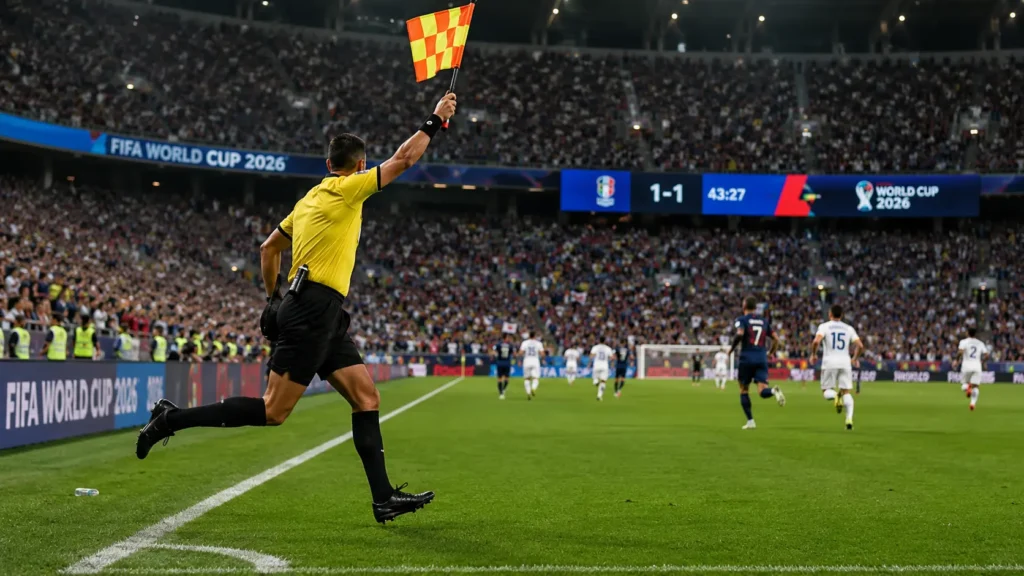
It’s the 78th minute. Your team just scored what looked like the goal of the tournament. You’re on your feet, screaming, high-fiving strangers you met an hour ago at the bar.
Then a flag goes up.
The referee waves it off. The whole room goes dead silent. Someone next to you mutters “offside” like that one word explains everything. It doesn’t. Not yet. But it’s the rule that ruins more American watch parties than any other call in this sport, and by the time you finish reading this, you’ll be the one explaining it to the confused guy next to you.
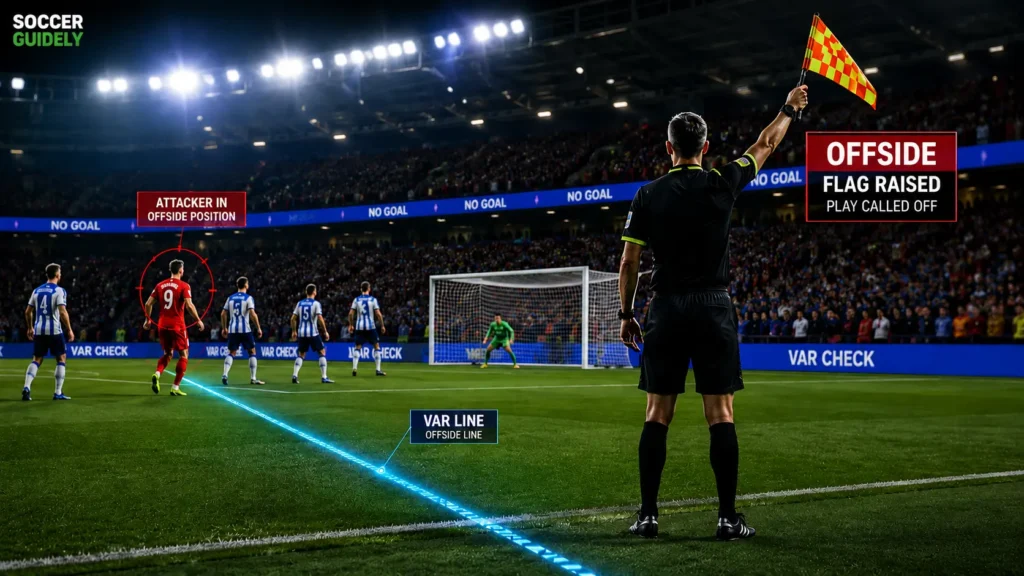
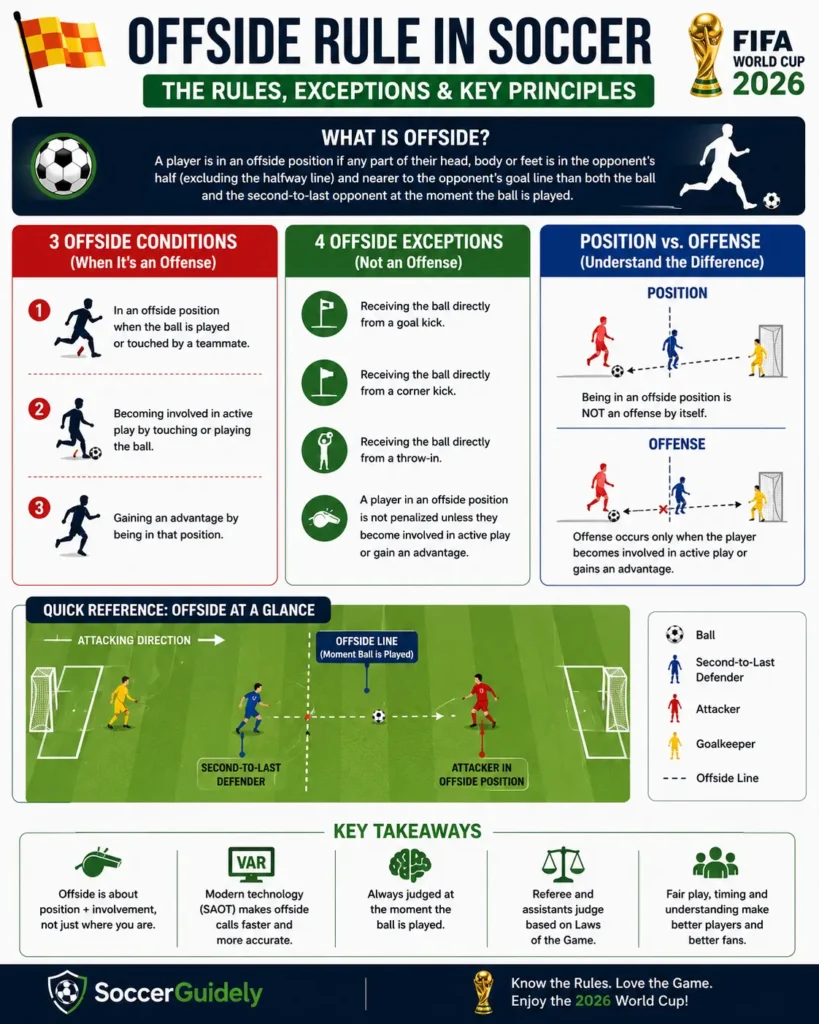
Offside happens the instant a teammate plays the ball forward and an attacker is already ahead of the second-to-last defender, using any body part except the arms. Standing there isn’t a violation by itself. The flag only comes out once that player actually gets involved in the play.
What Exactly Does Offside Mean?
Offside means an attacking player is nearer to the opponents’ goal than both the ball and the second-to-last defender at the exact moment a teammate plays the ball to them. Three things have to line up for it to actually count against you. You’re in the opponents’ half of the field. A body part that could legally score a goal is beyond that second-to-last defender. And a teammate plays the ball to you at that precise instant. Miss any one of those three, and nothing happens. No flag. No whistle. Play just continues like you weren’t even standing there.
Think cherry-picking in basketball. A guy who camps under the opponent’s rim waiting for a long outlet pass isn’t really playing basketball, he’s just standing in the best spot on the floor and hoping. Soccer had that exact problem back in the 1800s. Strikers would plant themselves by the goal for the entire match and wait. Offside fixed it. It’s the whole reason the middle of the field matters at all in this sport.
What’s the Difference Between an Offside Position and an Offside Offense?
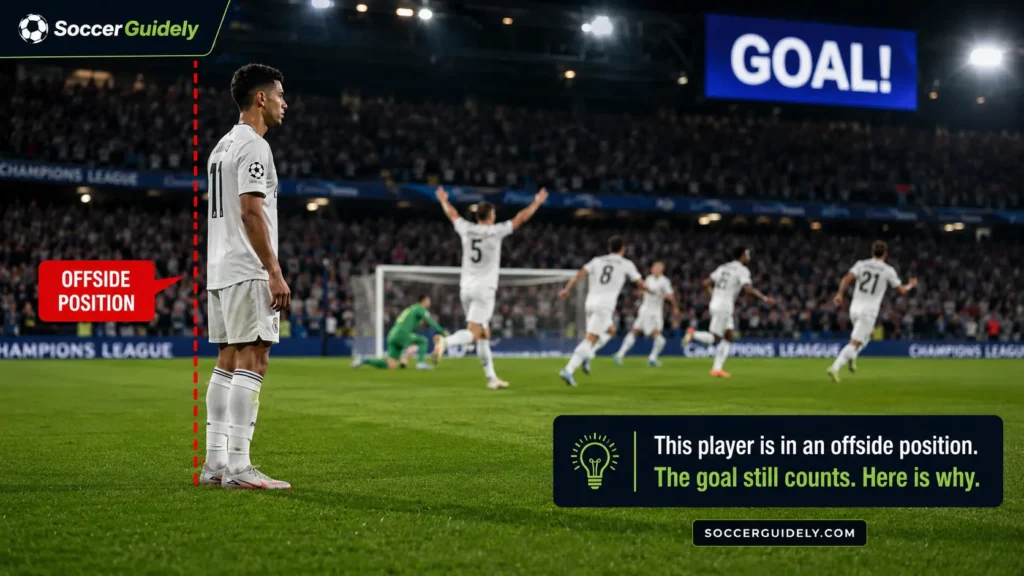
Here’s what trips up almost every new fan, and honestly, it trips up some longtime fans too. Being in an offside position is not the same thing as committing an offside offense. Under Law 11 of the Laws of the Game, it is not an offence to simply be standing in that spot. A player can stand there the entire match with zero penalty, as long as they never get involved in the play.
A striker can be standing five yards past the last defender while a teammate rips a shot from thirty yards out. If that striker never touches the ball and doesn’t affect anyone, the goal counts. Every time. This is the single biggest source of “wait, why wasn’t that called?” moments you’ll have this summer, and our complete guide to offside position walks through exactly where that line gets drawn.
Which Body Parts Actually Count for Offside?
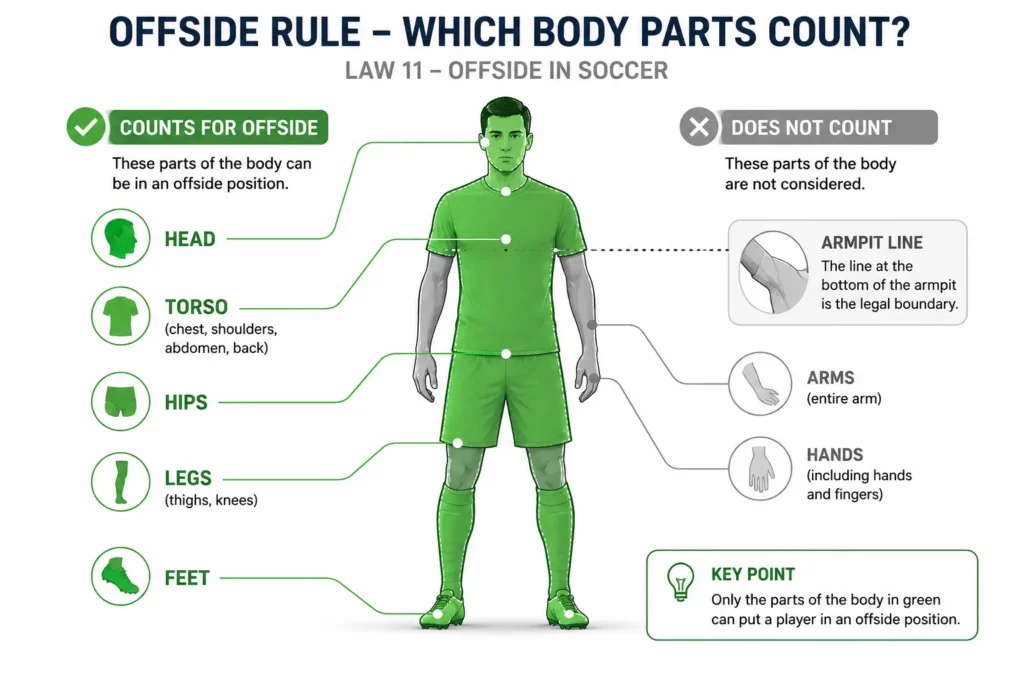
Only the parts that can legally score a goal matter. Head, torso, feet. That’s it. Arms and hands don’t count at all, all the way up to the bottom of the armpit, because you literally cannot score with your arm without it being called for handball.
Here’s what that looks like on TV this summer. A striker’s shoulder can be one single centimeter past a defender’s hip, and that’s a disallowed goal. It happens more than you’d think. But if the attacker is exactly level with the last defender, shoulder to shoulder, no gap at all, they’re onside. Benefit of the doubt always goes to the attacker on that one.
When Is Offside Actually Judged?
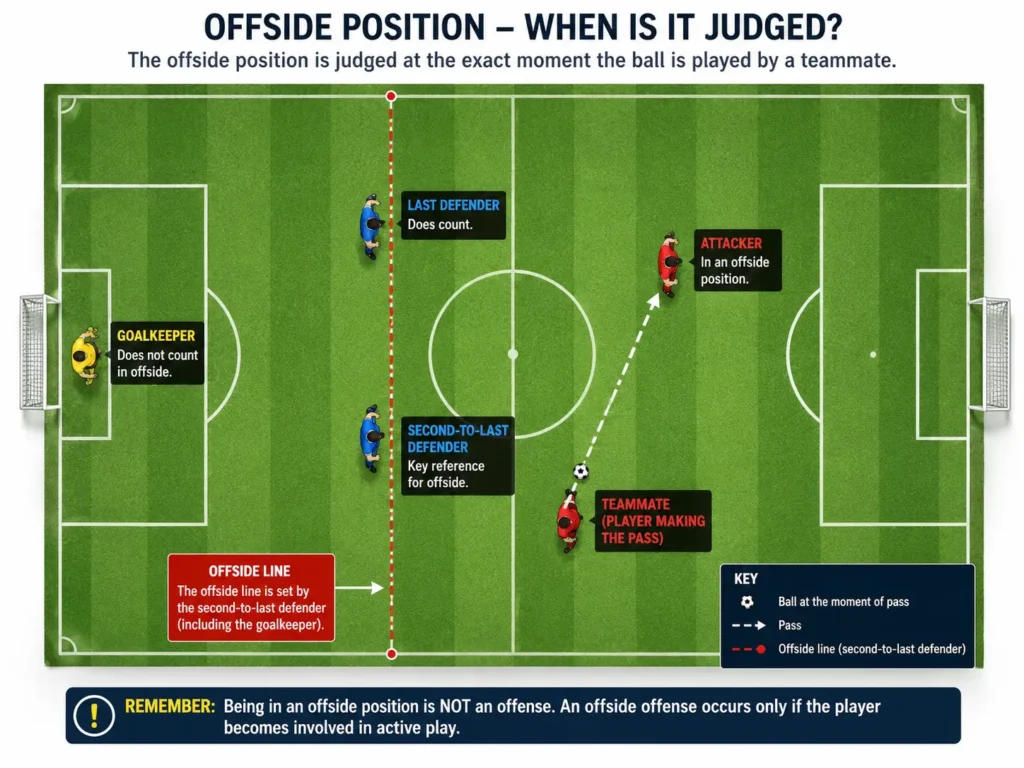
This is the detail that decides most close calls, and nobody explains it well. Offside gets judged at the exact millisecond a teammate’s foot touches the ball. Not when the attacker receives it. An attacker can be dead level with the defense the moment the pass is played, then sprint four yards clear by the time the ball actually gets there, and it’s still completely legal.
The checkpoint is the kick. Not the catch.
What most American fans don’t realize is that this timing rule is exactly why a fast counter-attack can look blatantly offside and not be. A player who was onside the second the ball left their teammate’s foot stays onside no matter how far ahead they end up running. For a deeper dive into why this exact moment matters more than anything else in the rule, our offside timing guide covers it in full.
When Is Offside Not Called? The Exceptions Everyone Forgets
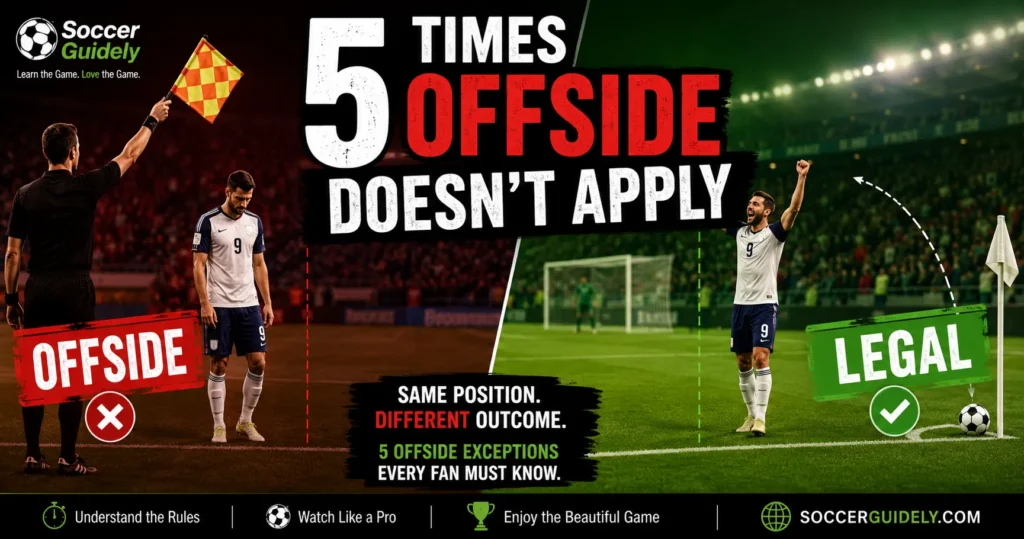
Sometimes a player looks blatantly offside, standing right on top of the goalkeeper, and the game just keeps rolling. New fans assume the ref blew the call. Nope. Goal kicks, throw-ins, and corner kicks are all completely exempt from offside under Law 11.
There’s a fourth exception almost nobody learns, too. You can never be offside while you’re still in your own half, no matter how far ahead of the play you look. Our complete offside exceptions guide has every one of these with real match examples.
Can a Goalkeeper Be Offside?
Yes. A goalkeeper can absolutely be offside, same as any outfield player. Law 11 doesn’t carve out a special exception for them. The only goalkeeper-specific rule is that their hands and arms don’t count toward their position, same as everyone else.
Picture a team down a goal in stoppage time, sending the keeper forward for one desperate corner kick. If that goalkeeper drifts offside and gets involved in the play, the flag goes up on them too. Doesn’t matter who’s wearing the gloves.
Is Offside a Foul?
No, and this one genuinely surprises people. Offside lives under its own law, Law 11, completely separate from fouls and misconduct under Law 12. That means it never earns a yellow card or a red card on its own. Not once.
Here’s the funny part for American viewers. Offside in football, the actual American kind, is literally classified as a foul with a five-yard penalty attached. In soccer? Just an infringement. Indirect free kick, nothing more.
Why Is It Called “Offside” in the First Place?
The word comes from a military term for a soldier trapped behind enemy lines, cut off from his unit, described as being “off the strength of his side.” Soccer borrowed it because an attacker standing alone near the goal, with nobody around them, is basically stranded from the normal flow of play. Same idea. Different battlefield.
What Happens on the Field the Moment Offside Gets Called?
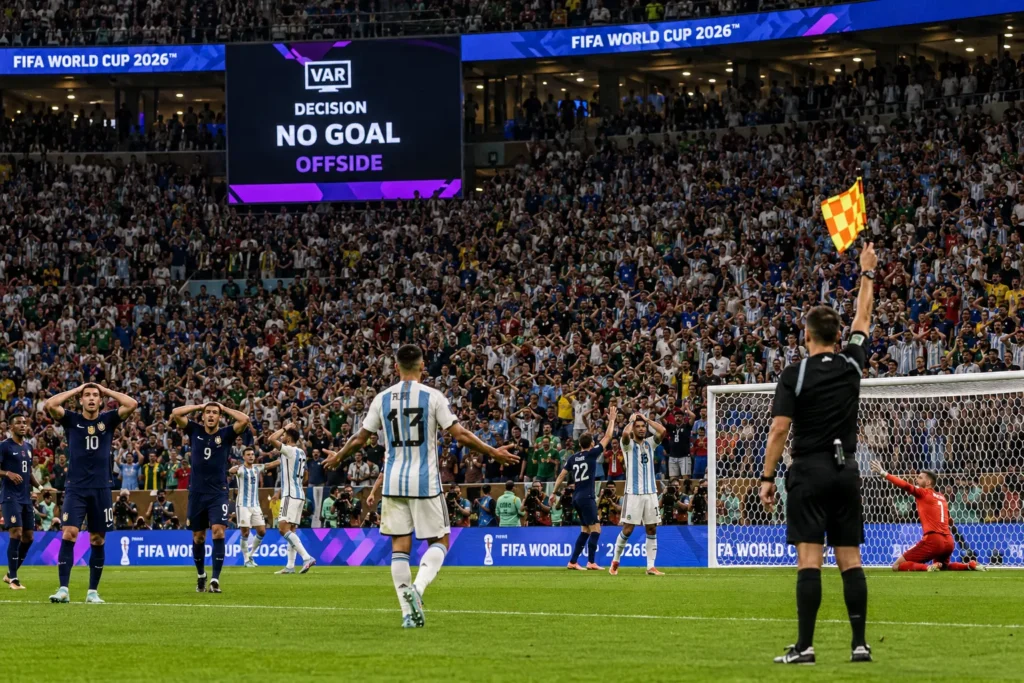
The assistant referee raises the flag first, but the referee doesn’t always stop play immediately. Modern officiating often lets the phase of play finish out, just in case the defending team still has an advantage worth protecting. Once play does stop, the defending team gets an indirect free kick from wherever the offside player got involved, not from wherever the ball was originally. Opponents have to stay ten yards back, and here’s the part people forget: that free kick can’t go straight into the net. Someone else has to touch the ball first, or the goal gets wiped and the other team just gets a goal kick instead. No card, ever, for offside alone.
Here’s how this actually plays out. An American midfielder threads a gorgeous pass to a streaking forward. The crowd starts to erupt as the ball hits the net. Then everyone goes quiet at once. On the giant screen, a 3D graphic pops up showing the exact moment the pass was released, with a thin red line marking a shoulder that was just barely ahead of the last defender. Goal comes off the board. The broadcast cuts to a slow-motion replay nobody in the stands can quite believe. That’s offside doing exactly what it’s built to do, even when it stings.
Soccer’s Offside Compared to Other Sports
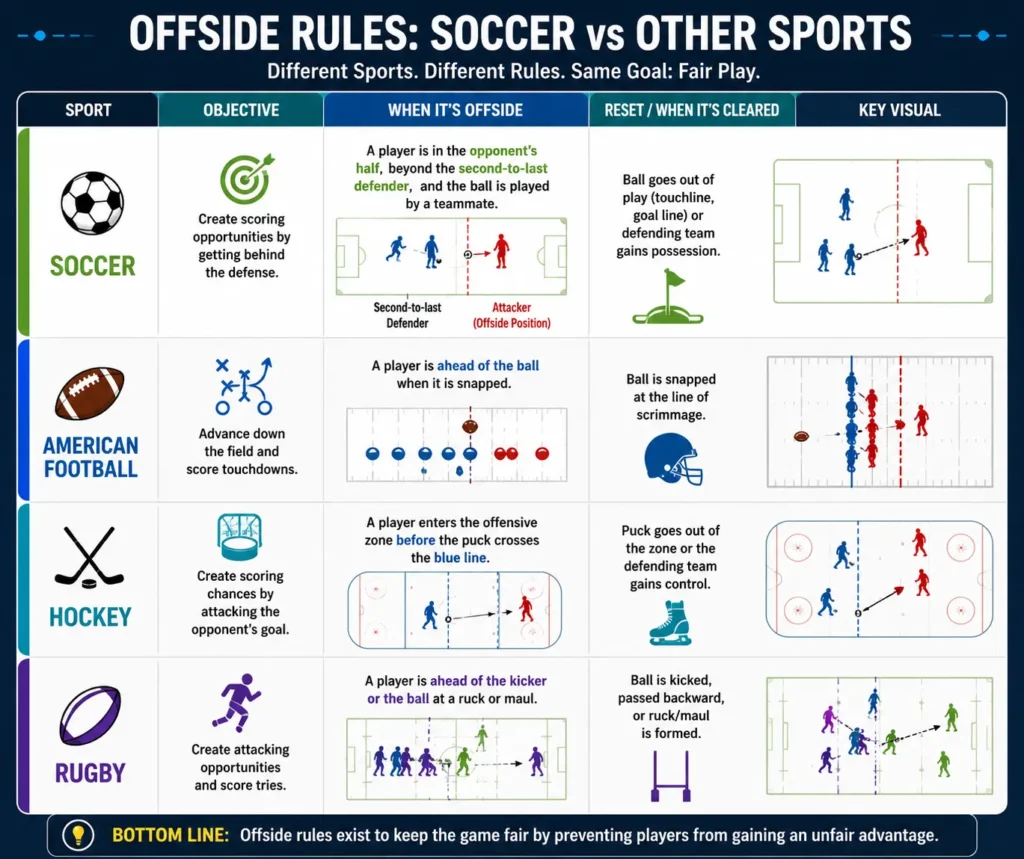
Soccer isn’t the only sport with something like offside, and seeing how the others handle it makes soccer’s version click a lot faster for American fans.
| Sport | Who Gets Penalized | Reference Point | Fixed or Moving Line |
|---|---|---|---|
| Soccer | The attacking team | Second-to-last defender | Moving, tied to the defense |
| American Football | The defense (usually) | Line of scrimmage at the snap | Fixed for that play |
| Ice Hockey | The attacking team | The blue line | Fixed on the ice |
| Rugby | Any player ahead of the ball carrier | The ball itself | Constantly moving with the ball |
Football’s offside and soccer’s offside actually punish opposite teams, which sounds backwards until you sit with it for a second. In the NFL, offside is a defensive penalty. A defender jumps the line of scrimmage before the snap, and the offense gets five free yards. In soccer, it’s the attacking team that gets penalized, since a forward gets ahead of the defense before the pass is played. Same word. Completely opposite logic.
Hockey and rugby round out the picture. Hockey’s blue line never moves, so attackers just have to let the puck cross first. Rugby skips the counting entirely. Anyone standing ahead of whoever’s carrying the ball is offside. Full stop.
What’s the Difference Between Offside and Onside?
Offside and onside are opposite terms describing where a player legally stands. You’re offside if you’re closer to the opponent’s goal than both the ball and the second-to-last defender when a teammate plays it. You’re onside if you’re level with or behind that defender, or behind the ball itself. Onside is always legal. Offside can lead to a penalty, but only if you actually get involved in the play. Our full offside vs. onside comparison breaks down every edge case side by side.
What’s the Difference Between Active and Passive Offside?
Active and passive offside describe whether a player in that offside position is actually doing anything. Active means they touched the ball, blocked someone’s view, or gained an advantage off a rebound while standing there. Passive means they’re just standing around, doing absolutely nothing.
Passive offside is completely legal. That’s why you’ll sometimes see a player standing in an obviously offside spot while a goal gets scored somewhere else entirely, and nothing happens to them. Our active vs. passive offside guide covers the trickier real cases referees actually deal with.
What Is the Offside Trap, and Why Do Defenses Love It?
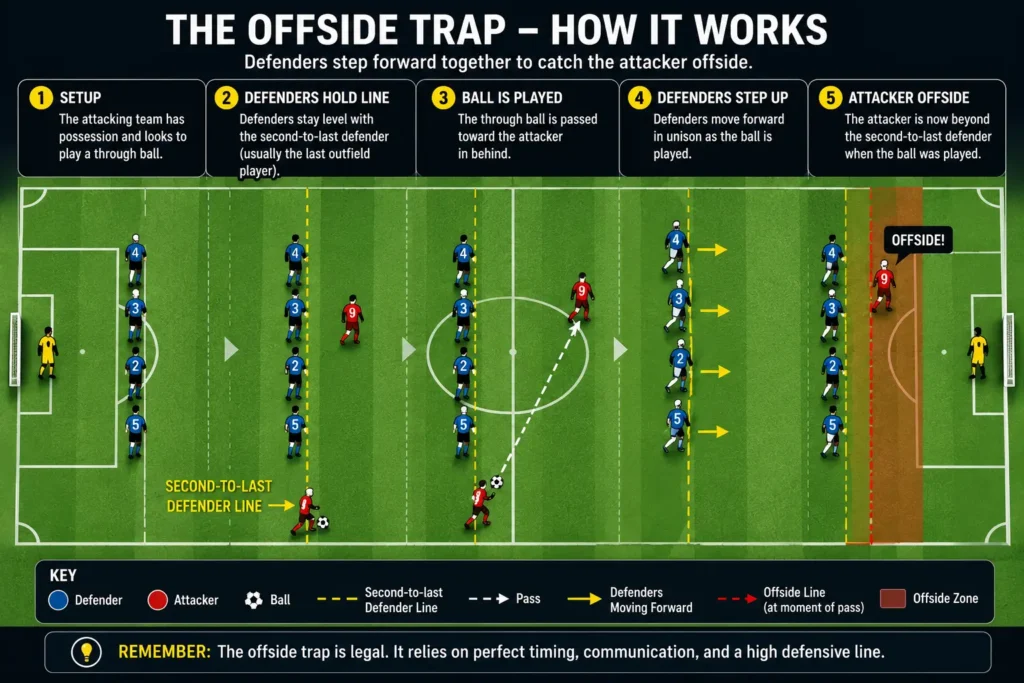
The offside trap is a defensive tactic where the back line steps forward together, right as an opponent plays a forward pass, hoping to catch an attacker offside. It’s totally legal under Law 11. Timing is everything here. Step too early, and the attacker who was offside a second ago is suddenly onside, with the whole defense caught flat-footed and out of position.
It’s basically a cornerback jumping a route right at the snap. Read it right, you kill the play before it even starts. Read it wrong, the attacker’s in alone against the keeper. Our offside trap guide breaks down the mechanics, the risk, and how attackers learn to beat it.
Why Is Offside One of the Hardest Calls in Sports to Get Right?
Most fans assume a bad offside call just comes down to a tired linesman blinking at the wrong moment. It’s actually more interesting than that. There are two separate optical tricks working against the assistant referee at the same time, and they’re not the same problem.
The first is called foreshortening. If the assistant referee isn’t standing in perfect line with both the attacker and the last defender, distance itself starts to look wrong, even to a trained eye. The second is called the flash-lag effect, and this one’s backed by peer-reviewed research on how the human brain processes motion. The brain naturally perceives a moving object as being further ahead than it actually is compared to something standing still. That means a sprinting attacker can visually appear ahead of a stationary defender even when they’re not, purely because of how human vision works.
Put those two effects together, and you get why even world-class assistant referees miss centimeter-level calls that SAOT now catches instantly. It’s not incompetence. It’s physics working against the human eye. Once the flag does go up, the mechanics are simple. Straight up means stop play. The angle afterward, 45 degrees down, flat, or 45 degrees up, tells the referee which third of the field the offense happened in.
How Does VAR Handle Offside Calls?
VAR checks offside on nearly every goal automatically, using tracking tech to pinpoint a player’s exact position the instant the ball’s played. No coach’s challenge involved, unlike the NFL. No time limit either. The VAR team reviews in the background on basically every goal scored, and the on-field ref only steps in personally when something’s genuinely close. Our complete VAR offside breakdown walks through the whole process.
What Is Semi-Automated Offside Technology (SAOT)?
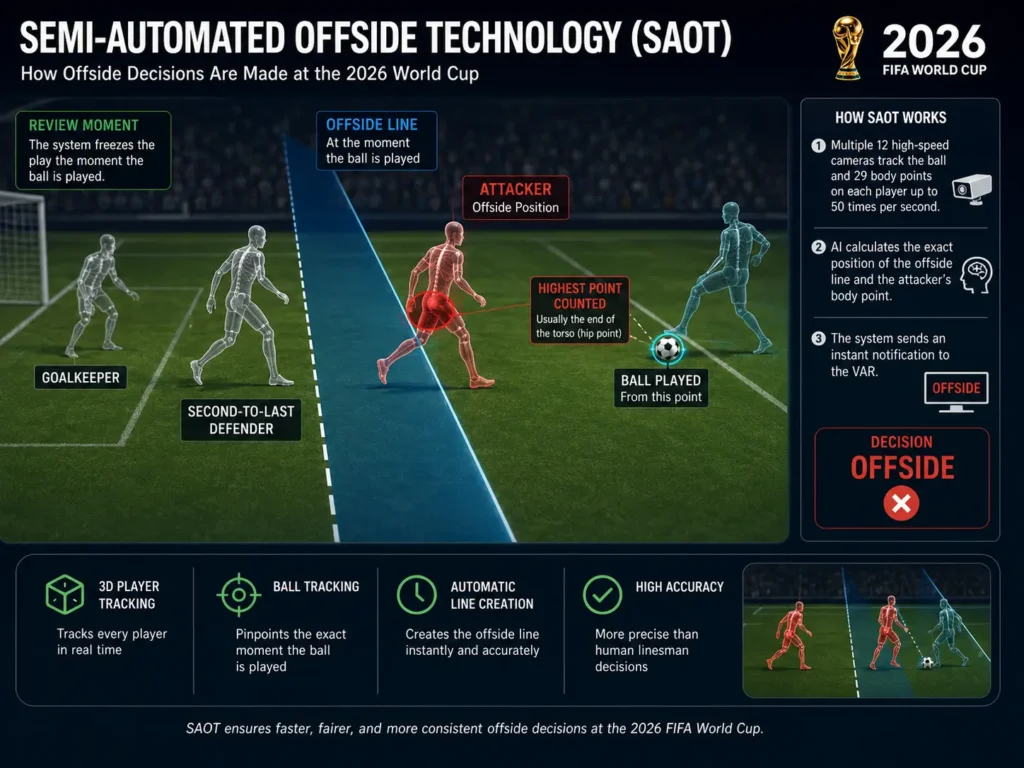
SAOT uses tracking cameras and AI to instantly calculate a player’s position and spit out a 3D offside line, cutting reviews that used to take over a minute down to seconds. It’s “semi” automated because a human VAR official still confirms every call. The tech can’t judge whether a player’s presence actually messed with an opponent’s ability to play the ball. That’s still a human call. That 3D animation you’ll see this summer, skeletal outlines and all, is SAOT.
Before this technology, a high defensive line was a genuine gamble. If the assistant referee missed a tight call, a defense playing an aggressive offside trap could get exposed for an entire half before anyone corrected it. At the 2026 World Cup, that risk has shrunk dramatically. Defenses at this tournament have been willing to push their back line higher than you’d see in a typical league season, precisely because they trust the technology to sort out the close ones fast and correctly.
Why Is Offside So Confusing for American Fans?
Because no major US sport has anything quite like it. Football, basketball, hockey, they all give you a clear stoppage point before the action resets. A down. A shot clock. A faceoff. Soccer’s offside gets judged in one moving instant with zero pause, based on exactly where a player’s body was the second the ball was passed. Nothing in American sports trains your brain to watch for that. Our full breakdown of why this rule is uniquely hard for Americans gets into the psychology of it.
Does a Deliberate Handball Reset an Offside Call?
Yes, and this catches almost everyone off guard. A deliberate handball by a defender counts as deliberate play, same as a deliberate kick or header would. So if a defender intentionally handles the ball and it reaches an attacker who was offside, that attacker isn’t penalized, though the ref will deal with the handball separately. People online get this wrong constantly, even some homework-help sites. But Law 11 flat out includes deliberate handball under “deliberate play.”
Can a Backward Pass Still Be Offside?
Yes. This is one of the most common myths going around. A backward pass does not automatically protect you from being called offside. Direction has never mattered under Law 11, not once. What matters is where you were standing the moment the ball was played, not which way it traveled. You can get flagged offside off a pass that came from behind you just as easily as one from in front.
Offside Myths That Just Won’t Die
There’s a lot of bad offside information floating around watch parties and comment sections, and it spreads fast because it sounds confident. The biggest one, and honestly the one that causes the most arguments, is that you’re automatically offside the second you’re past the last defender. Wrong. You also have to be in the opponents’ half, and you have to actually get involved in the play. A striker can stand five yards past everyone while a teammate scores from way out, and as long as that striker never touches anything, the goal counts clean.
Another one that just won’t go away is the idea that you have to touch the ball to be called offside. According to ESPN’s breakdown of the rule, interfering with an opponent’s line of sight is enough by itself, zero contact required. And the backward-pass myth gets somebody at almost every watch party. Position at the moment of the pass is the only thing that counts. That’s it, no exceptions.
How Many Goals Actually Get Disallowed for Offside?
Going back to 2020-21, the Premier League has disallowed 30-plus offside goals every single season since, according to ESPN’s year-by-year VAR tracking, 32 that year, 35 in 2022-23, and 32 again in 2023-24. That kind of consistency tells you offside isn’t some rare fluke call, it’s a constant presence in the modern game. Some teams lean into getting caught offside more than others. According to StatMuse’s Premier League data, Liverpool got caught offside 76 times during the 2025-26 season, the most of any club, with Arsenal not far behind at 61.
Nobody touches former striker Emmanuel Adebayor’s all-time Premier League record of 327 career offsides. What most American fans don’t realize is that a high offside count is usually a sign of a dangerous striker, not a bad one. Adebayor’s number is built on the exact same pace and directness that made defenders afraid of him in the first place. Compare that to a striker like Erling Haaland, who in one recent Premier League season was caught offside only once all year, a completely different style built on timing runs from deeper. Neither approach is wrong. They’re just different bets on where the risk pays off.
Does Every Level of Soccer Use the Offside Rule?
Nope. Futsal, five-a-side, and beach soccer all skip it completely, since the smaller field already keeps everybody bunched up close, and the rule would just slow everything down for no reason. Youth soccer skips it too at younger age groups, with some US leagues using a “build-out line” instead. One thing that never changes anywhere on earth: the rule is identical for men’s and women’s soccer. No difference at all.
How Is Offside Being Called at the 2026 World Cup?
Offside has been one of the most debated calls of the entire 2026 World Cup here in North America. The tournament rolled out an advanced version of Semi-Automated Offside Technology paired with a sensor-equipped match ball, giving officials faster reads on tight calls than what was used back at the 2022 Qatar World Cup. A few high-profile disallowed goals kept the debate alive deep into the tournament, including two separate offside calls against the USA in their group-stage win over Bosnia and Herzegovina, and a stoppage-time equalizer wiped off the board for Croatia in a heartbreaking loss to Portugal.
Neither of those was a dragged-out controversy. Both were confirmed in seconds, on-screen, for the whole stadium to see. With World Cup 2026 bringing millions of brand new fans into this sport across the country, getting confused by an offside call has basically become a rite of passage this summer. If it happened to you, relax. You’re in extremely good company. Longtime fans argue about the tight ones too.
Frequently Asked Questions
Q1: What is offside in soccer?
A: Offside happens when an attacking player is in the opponents’ half, a body part that can legally score is beyond the second-to-last defender, and a teammate plays the ball to them at that exact moment. Standing in that position isn’t a penalty by itself; the player has to get involved in the play.
Q2: What does offside mean in soccer?
A: Offside means an attacking player has gone ahead of the last line of defense before the ball was played to them. It only becomes an offense if that player then touches the ball, blocks an opponent, or otherwise affects the play from that position.
Q3: Can you be offside from a corner kick?
A: No. Corner kicks, throw-ins, and goal kicks are all exempt from offside under Law 11. A player can stand directly in front of the goalkeeper during any of these restarts without being flagged.
Q4: Do arms count for offside?
A: No. Only the head, torso, and feet count toward an offside position, since those are the parts a player could legally use to score. Arms and hands are excluded entirely, up to the bottom of the armpit.
Q5: What is the penalty for offside in soccer?
A: The defending team is awarded an indirect free kick from the spot where the offside player became involved in play. No yellow card or red card is ever issued for offside alone under the Laws of the Game.
Q6: Who invented the offside rule?
A: Nobody in particular. It was drafted collectively by the Football Association’s founding member clubs back in 1863, at the same London meeting where soccer’s first official rules got hammered out.
Q7: Will the offside rule change for the 2026 World Cup?
A: No. The core rule stays exactly the same. What’s actually new is the officiating technology. SAOT just makes the calls faster and clearer, it doesn’t change what counts as offside.
More on the Offside Rule
- Offside Position Explained
- Offside Timing: The Exact Moment It’s Judged
- All 5 Offside Exceptions
- Active vs. Passive Offside
- How VAR Handles Offside
- The Offside Trap
- Offside vs. Onside
- Common Offside Myths, Debunked
About This Article
This guide was checked against the IFAB Laws of the Game, Law 11, current VAR reporting from ESPN, and Premier League tracking data from StatMuse. We update this page as the rule, technology, or World Cup context changes.
Want the rules explained before every big match this summer? Our newsletter breaks down one soccer rule a week, written for American fans following the 2026 World Cup. No spam, just soccer explained the way it should be. Or keep exploring with our full soccer rules guide.