Written by the SoccerGuidely Editorial Team. Covering soccer rules and history for American fans ahead of the 2026 World Cup. Last updated: July 2026. Verified against IFAB’s historical archive and Laws of the Game.
Offside tactics refer to how teams deliberately use the offside rule to their advantage on both sides of the ball. Defensively, teams use the offside trap, stepping the back line forward together to catch attackers offside. Offensively, attackers time their runs to stay legally onside while getting behind the defense as late as possible. Both are coached, drilled tactics, not accidents.

Watch closely right before a team plays a long pass forward, and you’ll see it. Four defenders, moving as one, stepping up together like they rehearsed it. Because they did.
That’s offside tactics in action. Teams using the rule on purpose instead of just getting caught by it. Once you notice it, you’ll see it happening constantly, on both ends of the field.
How Do Defenses Use Offside as a Weapon?
Defenses use the offside trap, stepping the back line forward together at the exact moment a pass is played, to place an attacker in an offside position without ever making a tackle.
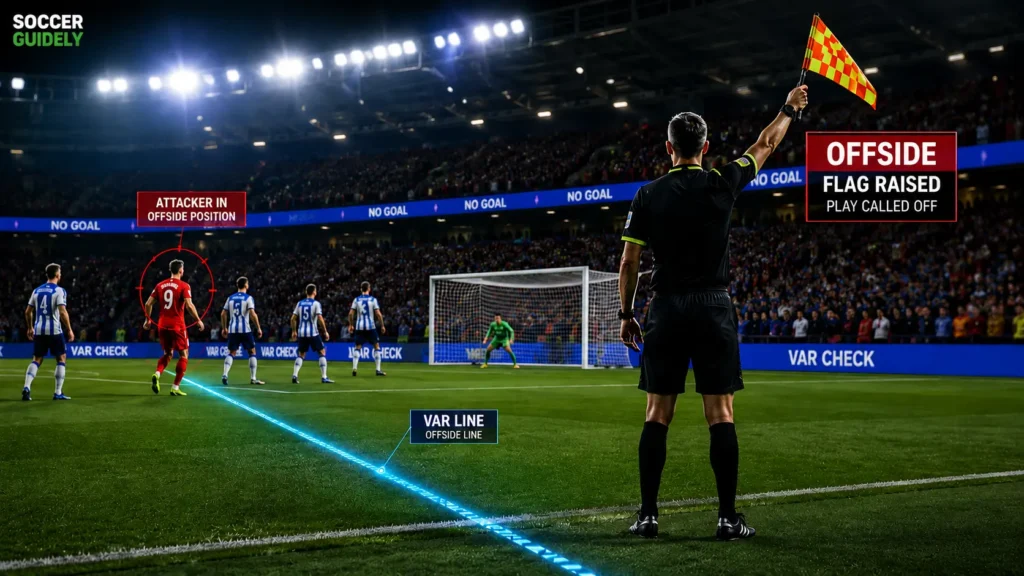
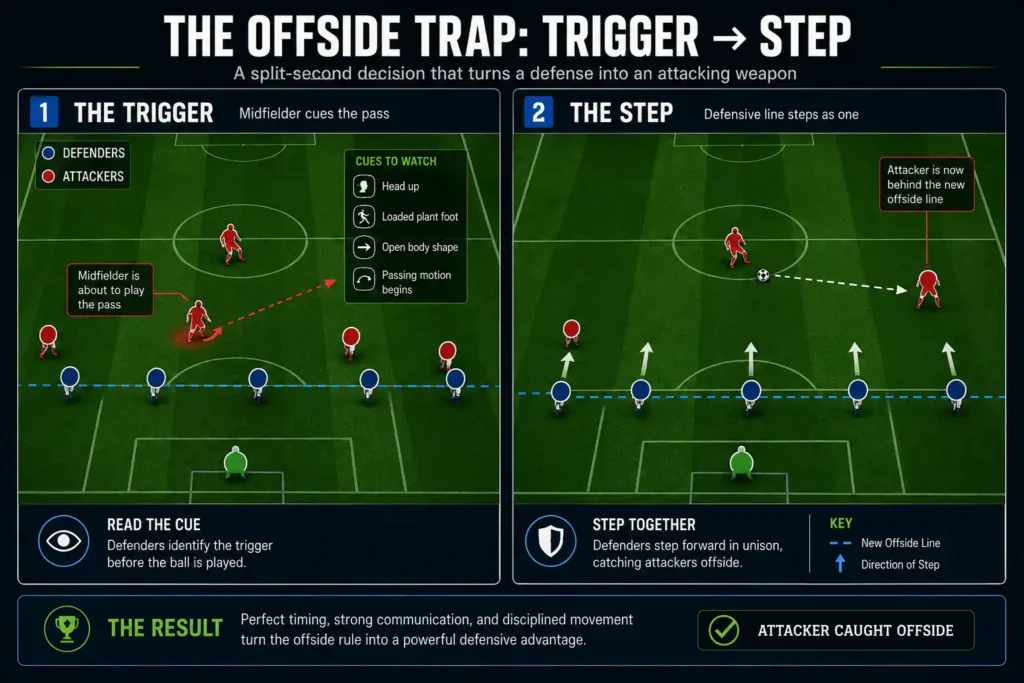
The most famous offside tactic is the offside trap. A defensive back line steps forward together, in unison, at the exact moment the opposing team plays a pass forward. If it works, the attacker who was about to receive that pass is now standing offside, and the flag goes up.
This isn’t just about catching one player napping. A well-drilled trap squeezes the entire field. Think of it like an NBA team running a full-court press for 90 straight minutes. You’re not just trying to force one turnover. You’re making the whole game miserable for the other team, possession after possession, by shrinking the space they have to work with.
Here’s the part that makes it actually coachable rather than lucky. Defenders aren’t reacting to the pass itself, they’re reacting to a trigger, usually the passer lifting his head or loading up his kicking foot, a fraction of a second before the ball actually leaves the ground. React to the pass and you’re already too late. React to the trigger and the whole line moves together in time.
The risk is real, though, and it’s bigger than just getting beaten physically. Even when the trap works perfectly, defenders can’t assume the flag goes up right away. Officials are trained to delay the flag on purpose to let a play develop, so a defender has to keep playing, keep recovering, right up until the whistle actually blows. If even one defender hesitates or steps late, the whole trap collapses, and the attacker who should’ve been offside is suddenly running at the goalkeeper alone.
This isn’t a new or gimmicky idea either. Arsenal’s back four under George Graham in the 1990s built its entire defensive identity around this exact tactic, stepping up together so consistently that it became one of the most recognized defensive systems in the sport’s history. For the full breakdown of how this specific tactic works, formations, common mistakes, all of it, check out our deep dive on the offside trap.
Here’s a real scenario to picture. A center back sees the opposing midfielder load up for a long ball forward. He shouts “step,” and the entire back line surges forward two yards in a single motion. The striker who was standing level a half-second earlier is now caught behind the new line when the pass arrives. Flag goes up. No tackle needed, no risk of a foul, the trap did all the work. That’s the tactic executing exactly as coached.
Here’s something coaches know that fans don’t. The offside trap isn’t just a standalone defensive tool, it’s most dangerous and most effective in the seconds immediately after a team loses possession, before their attacking shape has reorganized. In that split second, the opposing forwards are often still positioned for their own attack, not yet reset for a defensive transition, which means a sudden step forward by the back line catches them out of position before they’ve even realized possession changed.
This is why you’ll see teams that press aggressively also tend to spring the trap most often in these exact transition moments, rather than during settled, patient defending. The tactic isn’t random timing, it’s specifically weaponized against the brief window of confusion that happens the instant the ball changes hands. Teams that drill this transition-specific trigger get significantly more value out of the trap than teams that only think of it as a generic defensive tool to use whenever.
How Do Attackers Time Their Runs to Beat the Offside Trap Legally?
Attackers train to stay level with the last defender, not ahead of them, then explode into the space the instant the ball is played, since offside is only judged at that one frozen moment.
Here’s the part most explainers skip. Attackers have their own offside tactics too, and elite strikers train this constantly. Instead of trying to sprint past the defense as early as possible, smart forwards deliberately stay level with the last defender, not ahead, right up until the ball is played.
This is a real skill, not luck. A striker who breaks too early gets caught offside constantly. A striker who times his run to start the exact moment the ball is played can blow past the defense completely legally, since under Law 11 of the Laws of the Game, offside is judged only at that one frozen instant, not continuously.
Think of it like a wide receiver running a well-timed slant route against press coverage. The timing of the release matters just as much as the speed. A receiver who breaks too early gets jammed at the line. A receiver who reads the exact right moment gets separation nobody can recover from.
What Are Decoy Runs and How Do They Bait the Trap?
A decoy run is a deliberate movement designed to draw the defensive line’s attention away from the attacker who’s actually about to receive the ball, disrupting the trap’s timing on purpose.
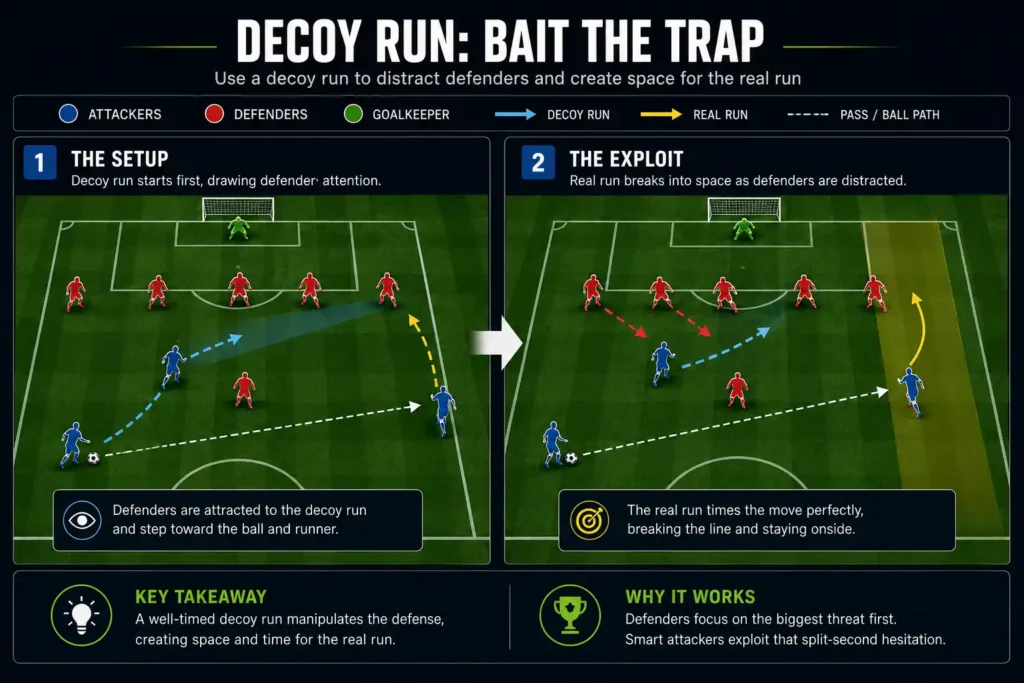
Some of the smartest attacking teams don’t just time individual runs. They use decoy movement to break the defensive line’s coordination on purpose. A forward makes a run that looks like the real attacking threat, drawing the defensive line’s attention, while a different teammate makes the actual run that matters a half-second later.
This confuses the trap’s timing specifically. If the defense steps up to catch the decoy runner offside, but a second attacker is already breaking from a slightly different angle, the defensive line can get caught moving the wrong way at the wrong time. It’s the soccer equivalent of a play-action fake in football, the defense reacts to the fake threat, and that split-second reaction is exactly what opens up the real play behind it.
We’ve watched this exact sequence fool an entire back line on live TV more than once, a decoy run draws three defenders’ eyes, and the actual scoring run happens practically unmarked because nobody was watching for it. It’s a genuinely clever piece of teamwork that most casual fans never notice happening.
A common mistake fans make watching this exact situation is assuming the attacker who gets the assist or scores the goal is the only one who mattered on the play. Often the real hero is the decoy runner who occupied the defensive line’s attention just long enough to break their timing, even though he never touched the ball.
Why Do Formations Matter for Offside Tactics?
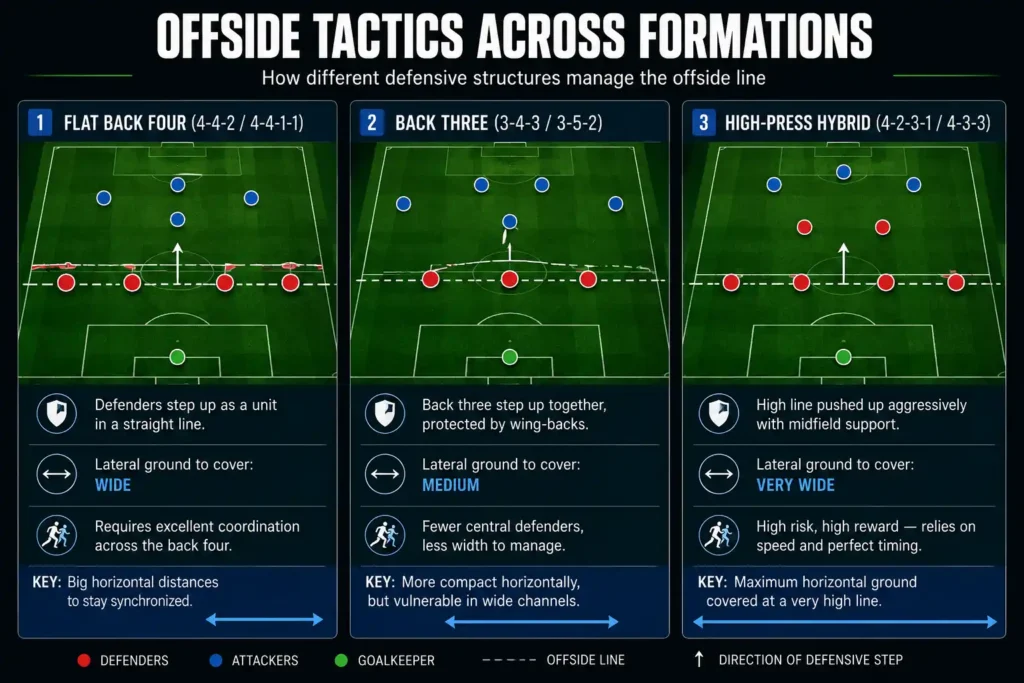
A flat back four with disciplined spacing executes the offside trap far more reliably than formations with wider defensive spacing, because there’s less physical distance for defenders to cover to move in perfect sync.
Not every team can run an aggressive offside trap. It requires a flat, disciplined back line and defenders who trust each other completely. Teams playing a back four in a compact shape tend to use it most effectively, since there’s less lateral ground for defenders to cover to stay in sync.
Teams playing with three center backs face a tougher challenge. The wider defenders have more ground to cover to stay level with everyone else, and that extra half-step of travel time is exactly the seam attackers are trained to look for and attack. Doesn’t mean it can’t work. Just means the margin for error shrinks even further.
Quick side-by-side of how different formations handle this tactic:
| Formation | Trap Suitability | Why |
|---|---|---|
| Flat back four | High | Compact, less ground to cover, easier synchronization |
| Back three | Moderate | Wider spacing makes unison stepping harder |
| High-pressing hybrid | Moderate to High | Works with aggressive midfield press but exhausting to sustain |
What most American fans don’t realize is that when an offside trap gets beaten, the goalkeeper’s positioning in that exact moment matters just as much as the defensive line’s mistake. A goalkeeper who’s playing deep, glued to the goal line, gives a striker who’s broken through the trap a clean one-on-one with tons of room to work. A goalkeeper who’s positioned aggressively, further off the line, ready to sweep up behind a broken trap, can shrink that space dramatically and sometimes even intercept the ball before the striker gets a clean shot off.
This is exactly why modern coaches value what’s often called a sweeper-keeper style goalkeeper so highly for teams that rely heavily on a high line and an aggressive trap. It’s not just about shot-stopping ability anymore. It’s a direct tactical insurance policy against the trap’s biggest risk, and teams that pair an aggressive trap with a passive, goal-line goalkeeper are playing with much less of a safety net than teams that coordinate both roles together.
How Is 2026 World Cup Technology Changing the Risk of the Trap?
Modern semi-automated offside technology has made the trap a much higher-stakes gamble than it used to be. A decade ago, a human linesman might miss a defender who stepped a fraction late, giving the defense the benefit of the doubt. That doesn’t happen anymore.
According to FIFA, the semi-automated offside technology used at this tournament tracks 29 data points per player at 50 times per second, catching positioning errors no previous tournament technology could detect. That means a perfectly executed trap gets rewarded completely, but a single defender who’s even a few inches out of sync gets punished with total certainty. Coaches have had to recalibrate how often they’re willing to gamble on the trap because of exactly this shift.
What most American fans don’t realize is that this precision cuts both ways tactically. A striker whose perfectly timed run would’ve been debated, argued about, and maybe even wrongly flagged by a human eye a decade ago now gets confirmed as legal almost instantly by the same tracking system. That’s a real competitive edge for a well-drilled attacker, since precise, disciplined timing now gets rewarded with certainty instead of left to a linesman’s judgment call. According to reporting on the tournament’s officiating setup, the system’s alert threshold was narrowed to 10 centimeters for 2026, which means attackers timing their runs have to be just as precise as the defenders trying to catch them. The margin for error shrunk for both sides of this tactical battle, not just one.
Here’s the part almost nobody’s connecting for American fans heading into this tournament. As semi-automated offside technology has made the margin for error in the trap essentially zero, national team coaches preparing for 2026 have shifted what they actually prioritize when selecting defenders for a high-line system. Raw recovery speed, historically the top trait teams wanted in case the trap failed, has become slightly less important than a defender’s communication reliability and decision-making speed in the split second the trigger happens.
The logic makes sense once you think it through. A fast defender who steps late still gets caught by millimeter-precise tracking just as easily as a slow one. What actually prevents the trap from failing in the first place is a defender who reacts to the trigger instantly and communicates clearly with his teammates, not one who can simply outrun his own mistake afterward. For American fans used to sports where pure athleticism often gets prioritized above all else, this is a genuinely different way of thinking about what makes a defender valuable, soccer’s precision-officiated era is rewarding coordination and communication over raw physical tools in a way that’s honestly a little countercultural compared to how a lot of American sports scout talent.
Why Does Understanding Offside Tactics Change How You Watch a Match?
Recognizing the trap being set, or a striker deliberately baiting it, turns a confusing flag into one of the most genuinely interesting tactical battles happening on the field.
Understanding offside tactics changes how you watch a match completely. Instead of just seeing a flag go up and feeling confused, you start noticing the defensive line stepping up together before the pass even happens, or a striker deliberately holding his run a half-second longer than you’d expect. That’s not random. That’s coached, drilled strategy playing out in real time, and recognizing it is what actually makes soccer fun to watch tactically instead of just emotionally.
With World Cup 2026 bringing this exact tactical battle to American screens constantly this summer, being able to spot the trap being set, or spot a striker deliberately baiting it, turns a confusing flag into one of the most interesting parts of the match to watch. And it’s not just a tournament thing either, this same tactical chess match plays out every single weekend in MLS and NWSL matches too, so once you can spot it, you’ll be spotting it for the rest of the season. Honestly, once you see it once, you can’t unsee it.
What’s the Bottom Line on Offside Tactics?
Offside tactics work on both sides of the ball. Defenses use the trap to compress space and force turnovers without a tackle. Attackers use precise timing and decoy movement to beat it legally.
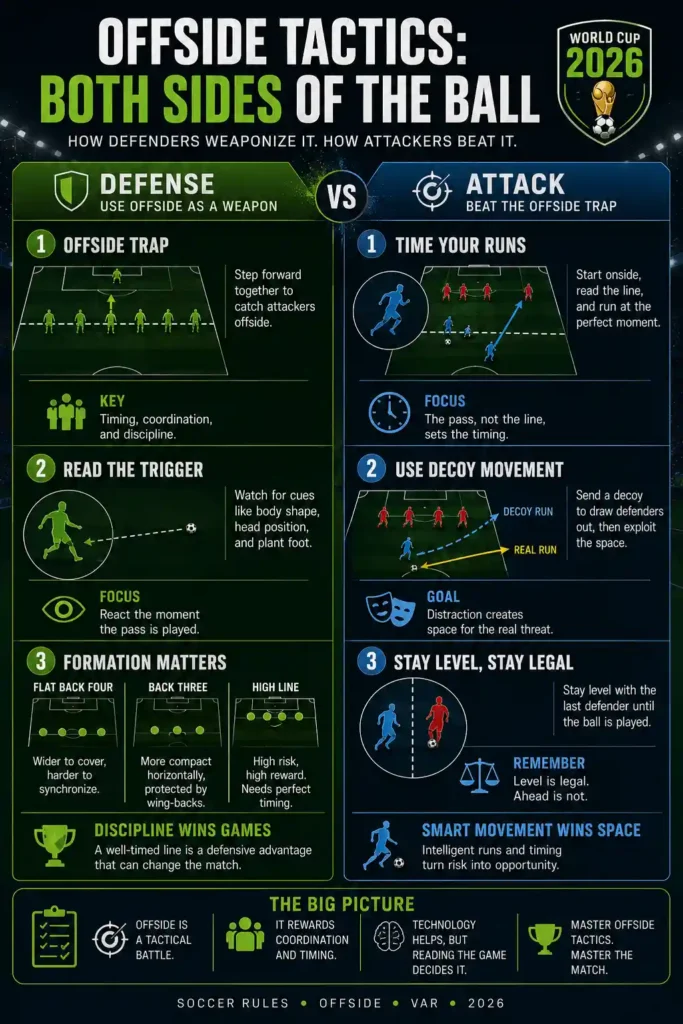
Both require genuine skill and coordination. And once you start noticing them, you’ll never watch an offside call the same way again. For the full breakdown of the rule from the ground up, start with our complete offside rule guide.
Frequently Asked Questions About Offside Tactics
Q1: What is the offside trap in soccer?
A: The offside trap is a defensive tactic where the back line steps forward together at the exact moment an opponent plays a pass, placing an attacking player in an offside position without a physical challenge. It requires perfect timing and communication across the entire defensive unit.
Q2: How do attackers beat the offside trap?
A: Attackers beat the offside trap by staying level with the last defender, not ahead of them, and timing their run to start the instant the ball is played. Since offside is judged only at that exact moment, a well-timed run can legally get behind the defense.
Q3: What triggers defenders to start the offside trap?
A: Defenders react to a visual trigger, typically the passer lifting their head or loading their kicking foot, rather than the pass itself. Reacting to the trigger early enough allows the entire back line to step forward in a single, synchronized motion.
Q4: What is a decoy run in soccer tactics?
A: A decoy run is a deliberate movement by one attacker designed to draw the defensive line’s attention away from a teammate who is actually about to receive the ball. It disrupts the timing of a defensive trap without the decoy runner ever touching the ball.
Q5: How has technology changed offside tactics at the 2026 World Cup?
A: Semi-automated offside technology at the 2026 World Cup tracks player positioning with far greater precision than previous tournaments, leaving almost no margin for error. This has made the offside trap a higher-risk tactic for defenses while rewarding attackers who time their runs with equal precision.
More on the Offside Rule
- The Offside Trap Explained
- Active vs. Passive Offside Explained
- VAR Offside Decisions at the 2026 World Cup
- Offside in Real Match Scenarios
- What Is Offside in Soccer, The Complete Rule Guide
Want to catch every one of these moments as they happen this summer? Our newsletter breaks down the rules and history behind the biggest plays at World Cup 2026, written for fans who are still learning the game. And if you want to keep going deeper into how offside actually works, start with our full soccer rules hub.
About This Article
All rule references verified against IFAB’s official historical archive and the current Laws of the Game, Law 11. The historical reference to Arsenal’s back four under George Graham reflects widely documented soccer history from the 1990s. World Cup 2026 semi-automated offside technology details, including tracking precision and alert threshold figures, verified against FIFA-adjacent reporting current as of July 2026. Reviewed for accuracy before publication by the SoccerGuidely Editorial Team.