
Written by the SoccerGuidely Editorial Team | Last updated: June 2026 | Verified against IFAB 2025-26 Laws of the Game
Quick Answer: Active offside in soccer means a player in an offside position touches the ball, blocks an opponent’s view, or benefits from a rebound while illegally positioned. Passive offside means the player is in an offside position but has zero involvement in the play. Only active offside gets penalized under Law 11 of the Laws of the Game.
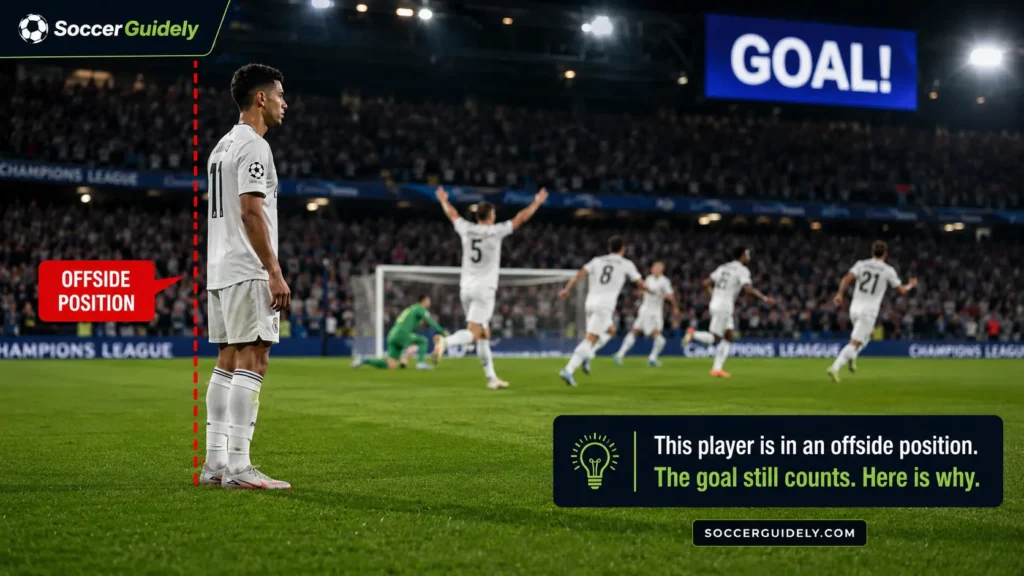
The striker is clearly past the last defender. Everyone in the stadium can see it. The ball gets played, a different teammate scores, and absolutely nothing happens. No flag. Goal stands. You just watched active vs passive offside play out in real time and had no idea what you were looking at.
Now you will.
With the 2026 World Cup coming to US stadiums this summer, you are going to see active vs passive situations play out live, in front of 70,000 people who mostly already understand what just happened. Now you will too.
What Is the Difference Between Active and Passive Offside?
Okay. Here is the thing that changes how you watch soccer forever.
I have seen this exact confusion play out at MLS watch parties more times than I can count. Someone watches a player stand clearly offside for ten seconds while a goal gets scored, and they cannot understand why the flag never went up. Once I explain active versus passive, the light bulb goes on every single time. It is one of those rules that sounds complicated until someone explains it the right way.
Being in an offside position is not automatically against the rules. Under Law 11 of the Laws of the Game, written and maintained by IFAB, the International Football Association Board, a player in an offside position only commits an offense when they become actively involved in the play. Stay completely out of it? No foul. No flag. Play goes on. Goals can stand.
The whole distinction exists so attacking play can flow naturally without penalizing players for being in a position that could have caused a problem but actually caused none. Makes sense once you hear it explained right.
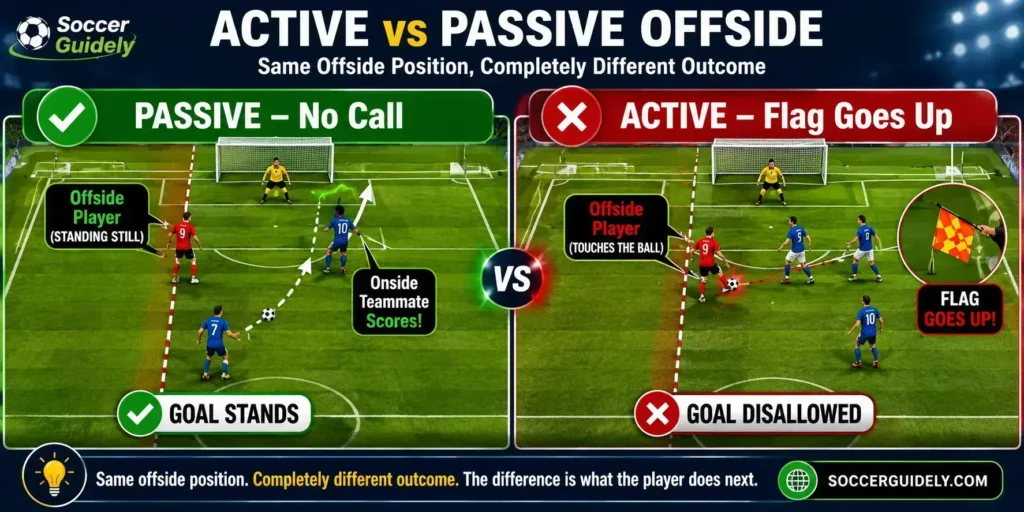
Active Offside, When Being in the Wrong Spot Becomes a Foul
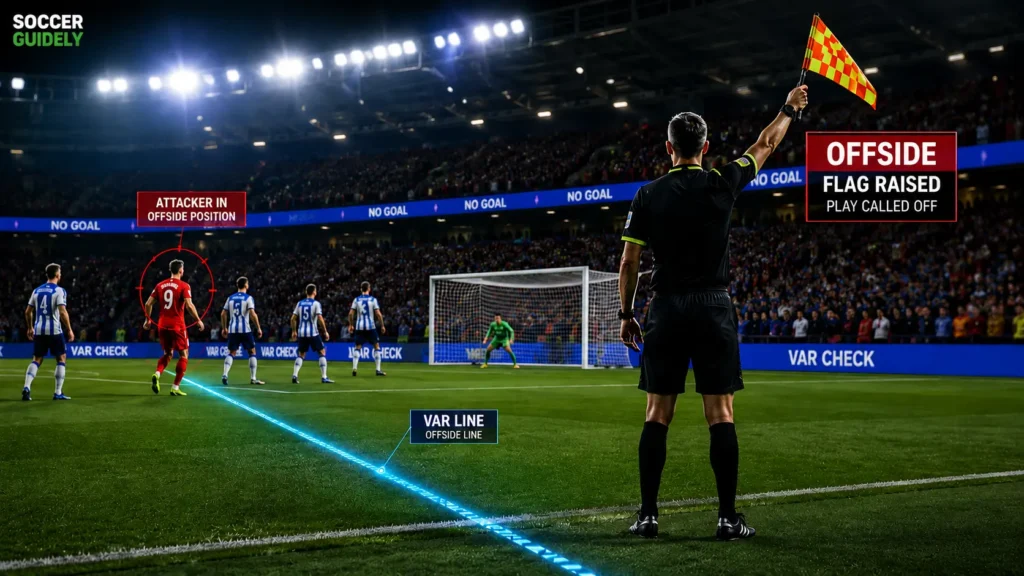
Active offside happens the moment a player in an offside position does something that affects the play. Touch the ball. Block a goalkeeper’s sightline. Pick up a rebound you should not have been near. Any of those three converts a legal passive situation into an illegal active one. Flag goes up. Play stops. Indirect free kick for the defending team.
Think of it like pass interference in the NFL. A receiver can run any route they want before the ball is thrown. The moment they make contact with a defender while the ball is in the air, flag comes out. The route was legal. The contact was not. In soccer, being in an offside position is the route. Actively interfering is the contact. Same idea. Different sport.
One thing worth knowing before we go further. When active offside is called, play stops and the defending team gets what is called an indirect free kick from the spot where the offside player got involved. Indirect means the ball has to touch at least one other player before it can go into the goal. You cannot just shoot directly from the spot and score. Think of it as a possession reset rather than a major punishment, more like losing a down in football than getting hit with a penalty kick.
Passive Offside, When Being in the Wrong Spot Means Nothing
Passive offside is when a player is in an offside position and does absolutely nothing. No touch. No interference. and no advantage gained. They could be standing five yards past the last defender. If they do nothing, no offense occurred. Nothing.
This is why you will sometimes see a player completely freeze during a developing attack. Not confused. Not injured. They are deliberately going passive, removing themselves from the play so the referee has zero grounds to call them for active offside. Smart move. Totally legal.
What Are the Three Ways a Player Can Be Actively Offside?
According to FIFA’s 2024 officiating guidelines, active involvement calls, specifically the interfering with an opponent category, account for the highest proportion of post goal VAR reviews where the original on field decision gets changed. More than basic offside position errors. More than handball reviews. This is the category that creates the most controversy, and it is exactly what we are about to break down.
Under Law 11, IFAB defines active involvement in exactly three situations. Every active offside call at every level of soccer falls into one of these three. Get these down and you basically understand the whole rule.
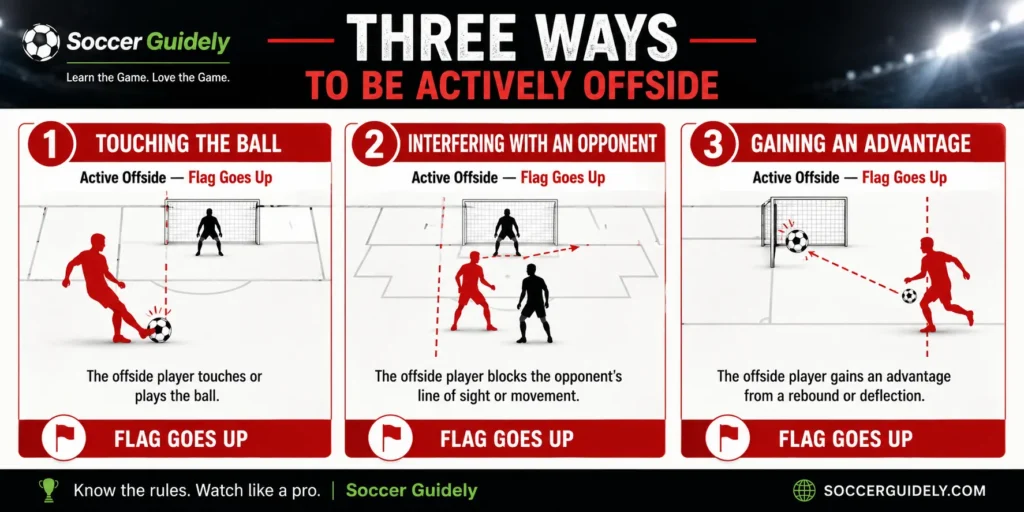
Way 1: Touching or Playing the Ball
Simple one first. A player in an offside position directly receives or touches a ball played by their teammate. Flag goes up. No debate. The player was illegally positioned and the ball came to them. Indirect free kick. Done.
This is the most common active offside call by a wide margin. The forward receives a through pass while past the last defender. VAR confirms the position at the moment the ball was played. Clear call. For a deep look at exactly when that moment of the pass gets judged, our offside timing guide covers the freeze frame rule in full detail.
Way 2: Interfering With an Opponent
Now it gets interesting. A player in an offside position can be called for active offside without ever touching the ball. Not one touch required.
The key is whether the offside player caused a defender or goalkeeper to change what they were doing. Making a run that pulls a defender out of position. Standing directly in front of a goalkeeper as a teammate shoots. Getting close enough to a defender that they have to track you instead of the actual play. Any of those movements, no contact, no ball touch, can be interfering with an opponent.
The most controversial version of this is goalkeeper screening. An offside player stands directly between a shooting teammate and the goalkeeper. The goalkeeper cannot track the ball cleanly. Shot goes in. Flag goes up. Goal disallowed. The offside player never touched the ball. But they took away the goalkeeper’s ability to make a clean save. Active involvement.
Referees argue about this one constantly. Fans argue about it more. Because the line between “I was just standing there” and “I was clearly in the way” is genuinely fuzzy sometimes.
Here is something coaches know that most fans do not. Interference has a distance component most fans never consider. Under IFAB’s interpretation guidance, a player in an offside position can be judged to be interfering with an opponent even from several yards away, if their positioning forces a defender to make a decision they would not otherwise have to make. A center back does not need to physically collide with an offside attacker to be interfered with. If that center back has to choose between stepping toward the offside attacker or staying with the actual ball carrier, and that hesitation creates even a half second delay, officials can rule that interference occurred.
What this means practically is that an offside attacker standing 8 to 10 yards from the play, doing nothing dramatic, just existing in a defender’s peripheral vision at the wrong moment, can still trigger an active offside call. The attacker does not need to lunge or block anything. They just need to occupy a defender’s decision making space at the critical instant. This is why some active offside calls look, to a casual fan, like absolutely nothing happened. Something did happen. It happened in the defender’s head.
Way 3: Gaining an Advantage From an Illegal Position
Third one surprises people the most because the offside player does not have to be the intended recipient of anything.
Teammate shoots. Ball hits the post. Offside player, already illegally positioned near goal, picks up the rebound. Offside called. Goal disallowed.
Why? Because they were in an illegal position when the ball was originally played. The rebound came to them specifically because they were already illegally placed near goal. Their illegal position gave them the rebound opportunity. That is gaining an advantage. Active offside. No exceptions.
The post rebound is the most common example but not the only one. If a teammate’s shot is saved by the goalkeeper and the rebound falls to an offside player, same call. If a ball deflects off an onside teammate and the path of that deflection brings it directly to an offside player who was already in the illegal spot, same call. The principle stays consistent every time. Your illegal position gave you access to a ball you would not otherwise have reached. That is the advantage. And that advantage gets called.
What Does Passive Offside Actually Look Like During a Match?
Picture this. A midfielder plays a through ball to a striker on the left side of the box. On the far right, a second striker is standing well past the last defender. Clearly offside. Anyone can see it.
But the second striker does not move. He does not run toward the ball, go near any defender, or get between the goalkeeper and the play. He just stands there, watching everything unfold.
Left side striker receives the ball onside. Takes a touch. Scores. No flag. Goal stands.
The second striker’s offside position had zero effect on anything. Their presence caused no reaction from any opponent. Zero involvement. Zero offense.
Why Smart Players Deliberately Go Passive
What most American fans do not realize is that freezing in an offside position is a deliberate tactical decision, not an accident or a brain lapse. When a forward recognizes they have strayed offside before a play fully develops, the smart move is to stop. Completely. Do nothing. Let it happen around them.
If they stay passive and an onside teammate scores, the goal stands. If they try to get involved and touch the ball or get in a defender’s way, the flag goes up. The passive freeze saves the goal. Active involvement kills it. Elite forwards understand this distinction instinctively.
How to Spot a Passive Offside Situation From the Stands
Here is a tip that will change how you watch matches. When an attack develops and you see a player in an obvious offside position, do not automatically expect the flag. Watch what they do. Are they running toward the ball? Moving toward a defender? Getting between the goalkeeper and the shooter?
If the answer to all of those is no, if they just stand there, watch for the goal to stand. You will start reading these situations before the officials even react.
What Is the Deliberate Defender Touch Rule and Why Does It Reset Everything?
This is the rule almost nobody explains clearly. And it causes arguments constantly.
If a player is in an offside position and a defender deliberately plays the ball, the entire offside situation resets. Completely gone. The player who was passively offside can now receive the ball with no flag.
The reason makes sense when you think about it. The defender made a free, deliberate choice to play that ball. Nobody forced them to. They chose to touch it. Because of that free choice, the attacker cannot be considered to have gained an unfair advantage from their illegal position. The defender’s own action created the new situation.
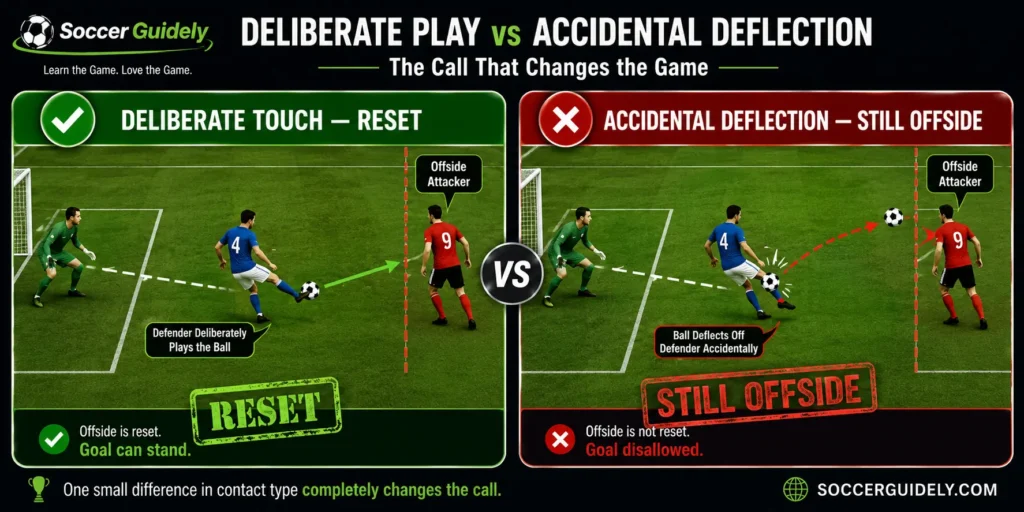
Deliberate Play vs Accidental Deflection, The Call That Changes the Game
The reset only applies to deliberate play. An accidental deflection, ball bounces off a defender’s shin without any intentional action, does not reset the offside situation. The original passive offside is still live. Offside player picks up that unintentional deflection? Flag goes up.
Deliberate defender touch? Offside reset. Play on.
Accidental deflection? Offside still active. Flag goes up.
Why This Rule Creates So Much Controversy at Every Level
Here is the problem with this rule. Deliberate versus accidental is a judgment call made in real time. Two officials watching the same moment can genuinely see it differently. Did the defender intend to play that ball or did it just clip them? Even with VAR going frame by frame, this specific distinction produces contested calls all the time.
According to UEFA’s analysis of VAR interventions across the 2022-23 Champions League season, the deliberate play vs accidental deflection determination was among the most reviewed and most disputed subcategories of offside VAR decisions. That says a lot about how genuinely difficult this call is, even for the most sophisticated officiating system ever deployed in club soccer.
Active vs Passive Offside, The Comparison Every Fan Needs
| Situation | Type | Flag Goes Up? | Goal Stands? |
|---|---|---|---|
| Offside player touches ball from teammate’s pass | Active | Yes | No |
| Offside player blocks goalkeeper’s view of shot | Active | Yes | No |
| Offside player picks up post rebound | Active | Yes | No |
| Offside player stands still and does nothing | Passive | No | Yes |
| Offside player freezes while onside teammate scores | Passive | No | Yes |
| Defender deliberately plays ball to offside player | Reset | No | Yes |
| Ball deflects accidentally off defender to offside player | Active | Yes | No |
| Offside player runs toward defender who tracks them | Active | Yes | No |
Active or Passive? Five Real Game Scenarios Every Fan Should Know
These are the exact moments you are going to see at the 2026 World Cup. Real situations. Real outcomes. The play unfolding the way it actually does on the field.
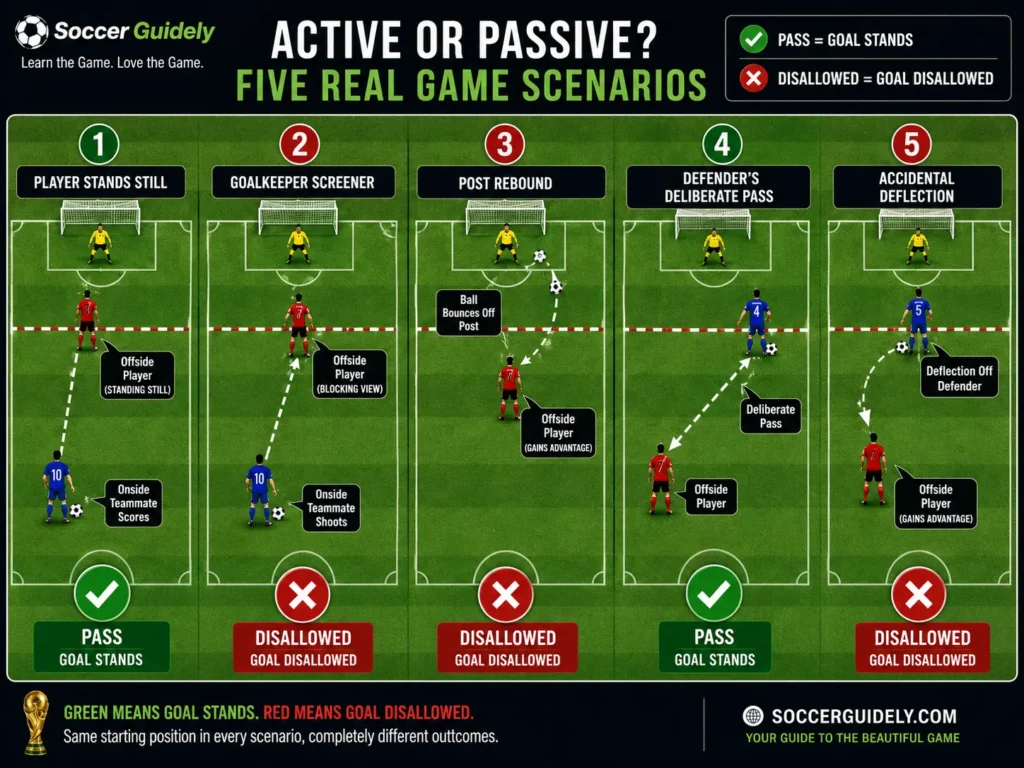
Scenario 1: The Player Who Just Stands There
A midfielder plays a through ball to a striker on the left side of the attacking zone. On the far right, a second striker is standing well past the last defender. Clearly offside. Everyone watching knows it.
The second striker does not move. Does not approach the ball. Does not get close to any defender. Just stands there watching.
Left side striker scores. No flag. Goal stands. The second striker was passive. Their offside position had zero connection to how the goal happened. No touch, no interference, and no advantage. Nothing to call.
Scenario 2: The Goalkeeper Screener
A teammate winds up for a long range shot. An offside player positions themselves directly in front of the goalkeeper, between the goalkeeper and the ball’s path. The goalkeeper has to move to get a sightline around the offside player. Shot goes in.
Flag goes up. Goal disallowed. Indirect free kick.
The offside player never touched the ball. But they physically impaired the goalkeeper’s ability to track and save the shot. Interfering with an opponent. Active offside. No goal.
Scenario 3: The Post Rebound
A striker shoots from a clearly onside position. Ball crashes off the post. A second striker, in an offside position when the shot was taken, is closest to the rebound and taps it home.
Flag goes up. Goal disallowed. The second striker was illegally positioned when the ball was originally played. The rebound came to them because they were already in that illegal spot near the goal. Gaining an advantage from an offside position. Active offside. Happens more than you think at the highest level.
Scenario 4: The Defender’s Deliberate Pass
A forward is passive in an offside position, standing past the last defender but completely uninvolved in the developing play. A defender, under zero pressure, decides to play the ball back to their goalkeeper. The pass is misplayed. Rolls directly toward the offside forward who scores.
No flag. Goal stands. The defender deliberately chose to play that ball. Nobody forced them. That free choice reset the offside situation completely. The forward receiving the misplayed pass is clean.
Scenario 5: The Accidental Deflection
A player in an offside position is standing near the goal. A teammate shoots from distance. The shot deflects accidentally off a defender’s shin, a genuine ricochet the defender had no control over, and rolls directly to the offside player who scores.
Flag goes up. Goal disallowed. The deflection was accidental. Not deliberate. Because it was not deliberate play, the offside was never reset. The player gained an advantage from being illegally positioned in exactly the right spot. Active offside.
How Does VAR Decide if Offside Is Active or Passive?
Before VAR, active vs passive calls were some of the most inconsistent in soccer officiating. Human eyes at full speed trying to determine whether a player was genuinely affecting play, or just standing there, produced wildly different results match to match.
VAR changed the process without removing the judgment. When a goal involves an offside player, VAR goes frame by frame through the sequence. Did the offside player make any movement that caused a defender to change course? Did the goalkeeper shift position in response? And did the ball reach the player because of their offside position?
What VAR Officials Are Actually Looking For
According to FIFA’s official VAR protocol documentation, the primary review questions for an active vs passive determination are whether the offside player directly interfered with an opponent’s ability to play the ball, and whether their position gave them a physical advantage in reaching or playing the ball. These are judgment based questions, not geometric calculations. VAR gives officials better evidence. It does not give them automatic answers.
For a complete breakdown of how VAR processes all types of offside decisions including active vs passive, our guide on VAR offside decisions covers the full review process step by step.
Why Active vs Passive Is Still a Judgment Call Even With Technology
This is where active vs passive fundamentally differs from basic offside position calls. Offside position is geometric, was the player past the line when the ball was played? SAOT technology measures that with centimeter level accuracy. Active vs passive is behavioral, did this player’s presence cause a reaction? Did they benefit from where they were standing? Those require human judgment even with perfect camera coverage.
With the 2026 World Cup arriving in US stadiums this summer, FIFA is deploying Semi-Automated Offside Technology across all 16 host venues. According to FIFA’s official Semi-Automated Offside Technology documentation, the system tracks every player’s limb positions 50 times per second. That gives VAR officials the most detailed movement picture ever available at a major tournament. But the final call on “was that interference” still belongs to the human official reviewing the footage.
What most American fans do not realize is that SAOT cannot tell the difference between deliberate and accidental, and that gap becomes one of the biggest stories of 2026. Semi-Automated Offside Technology is extraordinary at answering geometric questions. Was a player’s foot past the defender by two centimeters at the exact millisecond the ball was played? SAOT answers that with near perfect accuracy, every time, instantly.
But SAOT cannot answer the question of intent. Whether a defender’s touch on the ball was deliberate or accidental, whether an offside player’s positioning genuinely interfered with a goalkeeper’s sightline or was merely incidental. These are not geometry questions. They are judgment questions. And SAOT, for all its sensors and cameras, has no opinion on judgment.
What this means for the 2026 World Cup is genuinely fascinating. You are going to watch matches where SAOT instantly confirms a player’s exact position down to the centimeter, displayed on the stadium screen in seconds, and then watch the same review take an additional 30 to 60 seconds while human officials debate whether that position actually mattered. The technology will be faster than it has ever been at answering one question and exactly as slow as it has always been at answering the other. According to FIFA’s own technical framework for SAOT, the system is explicitly designed to assist with offside position determinations, while active versus passive judgment remains entirely within the video match official’s authority.
How Do Elite Teams Use Passive Offside as a Tactical Weapon?
What most American fans do not realize is that passive offside is not something that accidentally happens. At the elite level, it is deliberately engineered as a tactical tool. Teams spend real training ground time on this.
The Strategy Coaches Drill on the Training Ground
The basic pattern works like this. One striker deliberately positions themselves in an offside position before a play develops. They stay passive. Completely still. Now the defense has a problem. Do they track the offside player, which opens space for onside teammates, or ignore them and focus on the real threats?
If a defender commits to tracking the passive offside player, space opens for an onside teammate. If the defense ignores the passive offside player, that player waits for a reset moment, a back pass, a clearance, a goalkeeper distribution, and times a run to become legally onside at the right instant.
The tactical reason behind this goes even further. What most American fans do not realize is that elite attacking teams sometimes position TWO players in offside positions simultaneously, on purpose, in different parts of the pitch. Why two? Because a single offside attacker creates one decision point for the defense. Two offside attackers in different zones create two simultaneous decision points, and a back line can only manage so many at once.
If the defense correctly ignores both offside players and holds its line, the attacking team has accomplished nothing directly, but they have forced every defender to process two separate threats at once. If even one defender breaks to track either offside player, both passive attackers can become live threats on the next phase, since the moment the ball is reset or played backward, both players have a clean path to time a run onside. When you watch a 2026 World Cup match and see two attackers standing suspiciously far forward while their team builds up from the back, that is not sloppy positioning. That is two decision points being created on purpose. Understanding the offside trap connects directly to this, and our offside trap guide shows exactly how defensive teams respond.
What the Passive Offside Player Is Actually Doing for the Team
The passive offside player is taking up space in the defense’s mental bandwidth without doing anything that can be called. Every defender on the pitch knows they are there. Someone has to make the decision about whether to track them. That decision making process creates hesitation. Hesitation creates space. Space is where goals come from.
According to MLS match data from the 2023 season, active offside calls, where a player in an offside position directly touched the ball or interfered with an opponent, accounted for approximately 78% of all offside offenses recorded across the league. The remaining 22% were passive situations correctly left uncalled, meaning roughly one in five times a player is in an offside position, nothing happens at all. That “standing still guy” you keep seeing is more common than you think.
Why Defenders Are Trained to Ignore Passive Offside Players
Here is something coaches know that most fans do not. Smart defenders are trained NOT to track passive offside players. Tracking a passive offside forward is exactly what that forward wants. It pulls the defender out of position, creates space, and does the attacker’s job for them without the attacker doing anything illegal.
Elite defensive units are coached to hold their line, keep the offside player passive, and trust the assistant referee to watch them. The moment a defender breaks from the defensive line to track a passive offside player, they become the problem. Not the offside forward. The defender just created the exact gap the attacking team was hoping for.
This is why you will sometimes see a defender glance at a clearly offside attacker, then deliberately ignore them and stay in position. That is not a mistake. That is coaching.
What Offside Myths Do Most American Fans Still Believe?
These myths are in soccer conversations everywhere. Some get repeated by fans who have been watching for years without anyone correcting them.
Myth 1: “If a Player Is Offside They Should Always Be Flagged”
Most common myth by a long way. Being in an offside position is not a foul. Never has been. A player can spend an entire match in offside positions without a single call, as long as they stay passive. The position is not the offense. The active involvement is the offense.
Myth 2: “Any Distraction From an Offside Player Counts as Interference”
Not how it works. Casual presence is not interference. The offside player has to cause a specific, identifiable reaction from an opponent, blocking a clear sightline, pulling a defender away from where they would otherwise be, making a movement that forces the goalkeeper to adjust. Just being vaguely nearby does not trigger active offside. The interference has to be demonstrable, not theoretical.
Myth 3: “A Deflection Off a Defender Always Resets the Offside”
Only if the touch was deliberate. This myth comes from fans who know a defender’s touch can reset the offside situation but do not know the deliberate vs accidental distinction. An uncontrolled ricochet does not reset anything. Only a free, intentional choice by the defender to play the ball clears the offside situation. For every exception scenario in the offside rule, our offside exceptions guide covers them all in detail.
Myth 4: “VAR Makes the Active vs Passive Call Automatically”
VAR provides better information. It does not produce automatic active vs passive decisions. Unlike offside position, which SAOT measures geometrically, active vs passive is a behavioral judgment that a human referee still has to make. Better evidence. Same human judgment. Those two things coexist in the VAR era and they always will for this specific type of call. For every myth about the offside rule including the technology-related ones, our offside myths guide covers them all.
How Will Active vs Passive Offside Work at the 2026 World Cup?
With the 2026 World Cup arriving in US cities this summer, MetLife Stadium in New Jersey, AT&T Stadium in Dallas, SoFi Stadium in Los Angeles, and 13 more venues, millions of American fans are going to watch live soccer at the highest level for the first time. Active vs passive situations are going to be some of the most debated moments of the entire tournament.
Why American Fans Need to Understand This Before July 2026
When a goal gets scored at MetLife Stadium and a VAR review starts, the fans around you, from Brazil, Argentina, Germany, Mexico, they are going to know immediately whether the review is about offside position or active vs passive involvement. They grew up watching this applied in real time.
You now have the same knowledge. You understand the three ways active offside is called, what passive offside looks like and why it is legal, how the deliberate touch rule works, and what VAR is actually looking for. Walk into that stadium with this and the game looks completely different. For the full picture of how the offside rule fits together as a whole, the complete offside guide connects every piece in one place.
Frequently Asked Questions About Active vs Passive Offside
Q:1 What is the difference between active and passive offside in soccer?
A: Active offside means a player in an offside position touches the ball, interferes with an opponent, or gains an advantage from their illegal position. Passive offside means the player is in an offside position but has zero involvement in the play. Under Law 11 of the Laws of the Game, only active offside is penalized. Passive offside is completely legal and play continues normally.
Q:2 Can a goal stand if an offside player is on the field?
A: Yes. Under Law 11 of the Laws of the Game, a player’s mere presence in an offside position is not an offense. If the offside player is passive, meaning zero involvement in the play, a goal stands regardless of where they are standing. Only active involvement by the offside player triggers the call and disallows the goal.
Q:3 What does interfering with an opponent mean in soccer offside?
A: Interfering with an opponent means the offside player’s presence caused a defender or goalkeeper to change their behavior. Blocking their sightline to the ball, preventing them from moving to make a play, or making a movement that forces them to track you instead of the real threat. The offside player does not need to touch the ball for this to be called.
Q:4 Does a deflection off a defender reset the offside rule?
A: Only if the touch was deliberate. A free, intentional choice by a defender to play the ball resets the offside situation and the attacker can receive it legally. An accidental deflection or uncontrolled ricochet does not reset the offside. The original passive offside remains active and the flag goes up if the offside player receives the ball.
Q:5 How does VAR decide if offside is active or passive?
A: VAR reviews the frame by frame sequence after a goal involving an offside player. Officials look for whether the offside player made movements causing opponent reactions, whether their position gave them a direct physical advantage, and whether they touched the ball. Unlike offside position, a geometric calculation, active vs passive remains a judgment call that a human official makes using VAR evidence.
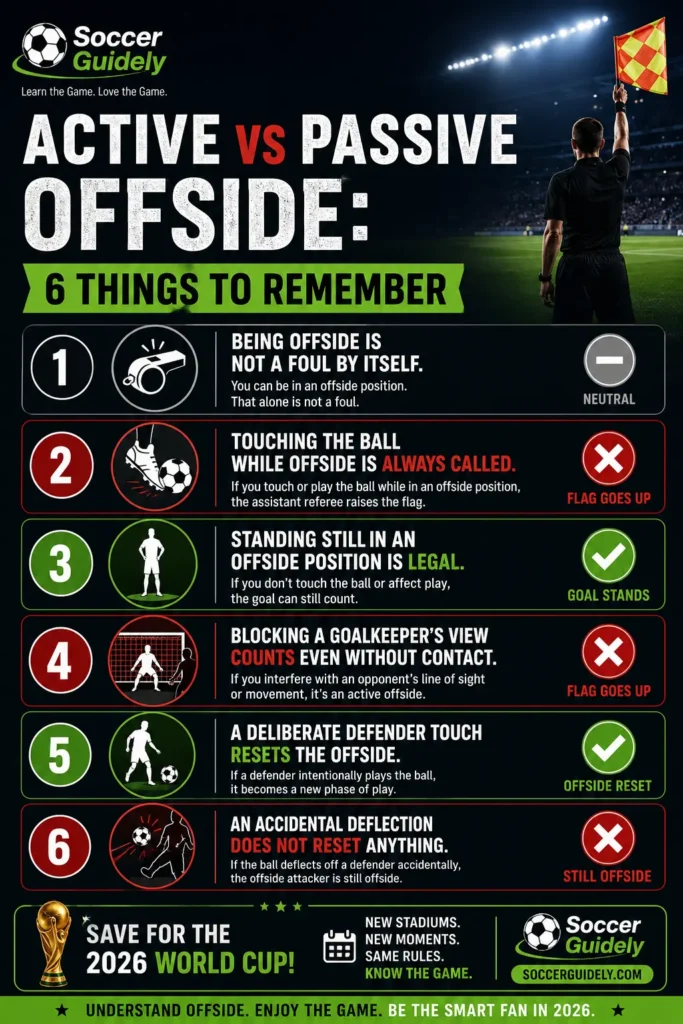
Want to Keep Learning?
Active vs passive is one layer of the offside rule, but it connects directly to two other concepts worth understanding before kickoff. The exact moment used to judge any of these calls comes down to offside timing, and the underlying position rule that makes all of this possible is covered in our offside position guide. For the full picture of the rule from start to finish, the complete offside guide ties everything together in one place.
Here is where to go next depending on what still has you thinking:
- What Is Offside in Soccer, The Complete Rule Guide
- Offside Position in Soccer, Full Breakdown
- Offside Timing, When Exactly Is the Call Made?
- Offside Exceptions, When the Rule Does Not Apply
- VAR Offside Decisions, How Technology Makes the Call
- The Offside Trap Explained
- History of the Offside Rule
- FIFA Law 11, Full Offside Law
- Offside Myths Busted
Have a question about something we did not cover? Drop it in the comments below. We update these guides regularly based on what American fans are actually asking, and your question might make it into the next version.
About This Article
Written by the SoccerGuidely Editorial Team, soccer analysts and MLS fans covering the sport for American audiences since 2019. All rule references verified against IFAB’s 2025-26 Laws of the Game. Statistics sourced from FIFA’s official VAR protocol documentation, FIFA’s 2024 officiating guidelines, UEFA Champions League VAR analysis 2022-23, and MLS 2023 competition data. Reviewed for accuracy before every publication.