
By the SoccerGuidely Editorial Team | Published: June 19, 2026 | Last Updated: June 19, 2026
Reviewed against FIFA Law 11 and IFAB 2026 official guidelines
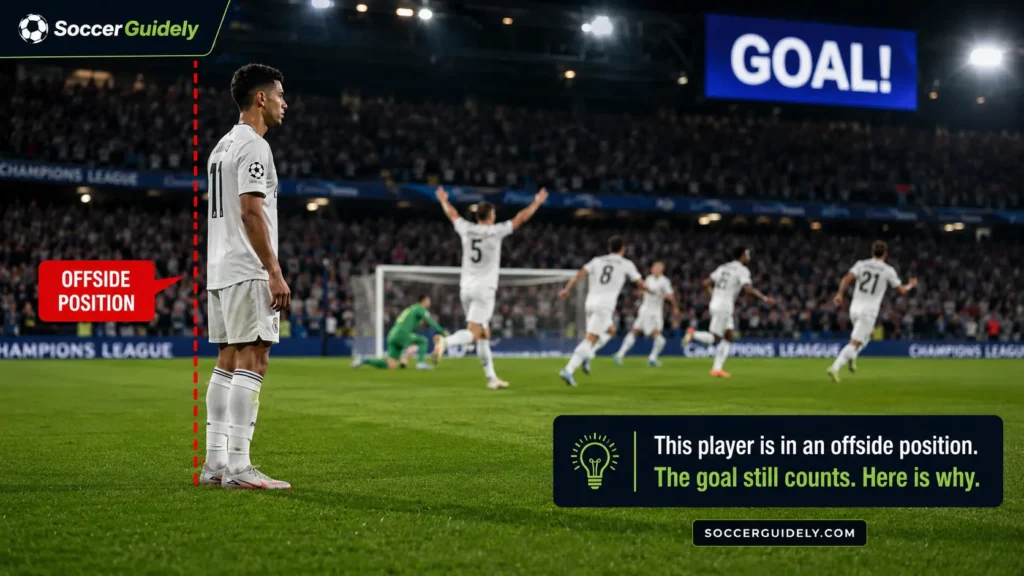
The goal goes in. SoFi Stadium loses its mind. Seventy thousand people on their feet.
Then the ref waves it off.
Half the crowd groans. Half just stares. Someone near you mutters “offside” like that actually explains anything. But here’s what nobody mentions in that moment: there are five specific situations where that flag should never go up in the first place. They’re called offside exceptions, and most casual fans don’t know all of them exist.
That feeling of watching something happen and not being able to tell if you should be mad about it is exactly what kills the experience for new fans.
You just watched a goal get disallowed. You have no idea if the call was right. And honestly? The 2026 World Cup has about a hundred more moments exactly like that one coming your way.
This guide fixes that.
One quick thing before we get into it this article is specifically about the exceptions to offside. If you want the full breakdown of what offside actually is first, hit our complete offside rule guide and come back. Won’t take long.
The Short Answer All 5 Offside Exceptions Right Here
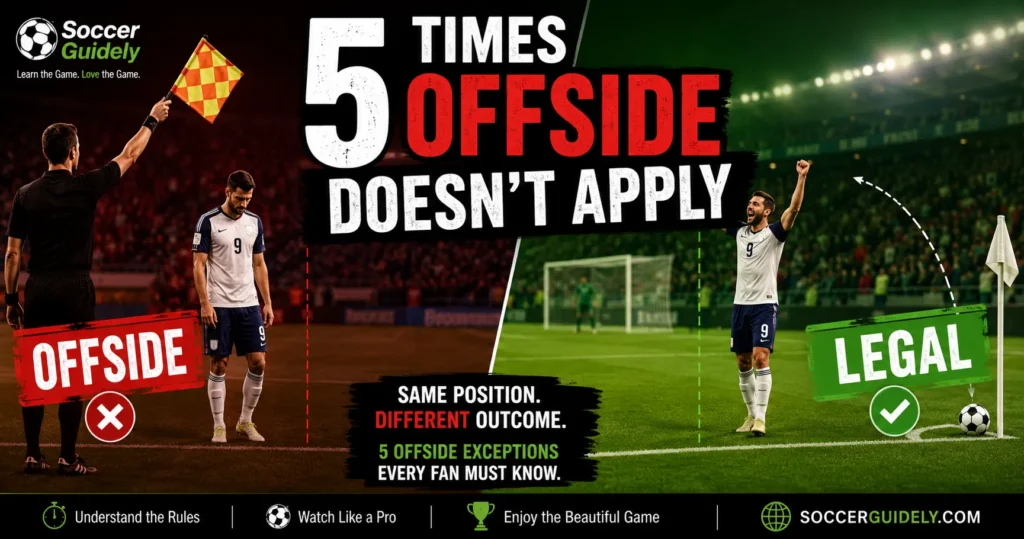
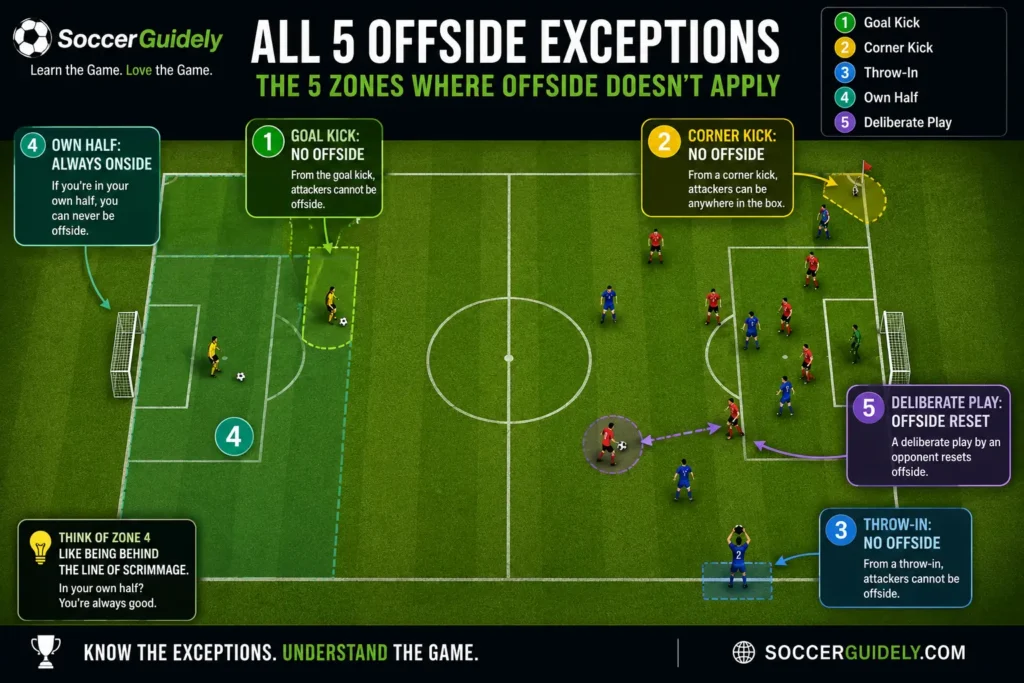
The offside rule does not apply in five specific situations in soccer: goal kicks, corner kicks, throw-ins, when a player is in their own half, and when a defender deliberately plays the ball to an attacker who was in an offside position. These are the official exceptions under FIFA’s Law 11. When offside is called, the defending team gets an indirect free kick meaning the ball must touch another player before a goal can be scored directly from the restart. Most new fans only learn the first three exceptions and that’s exactly why so many calls at watch parties still cause arguments. If you’re getting ready for World Cup 2026, knowing all five offside exceptions is the fastest way to stop second-guessing the referee every time a flag goes up.
What Even Is the Offside Rule?
You don’t need a law degree to follow this. You just need enough context for the exceptions to make sense. So here’s the shortest version that actually holds up.
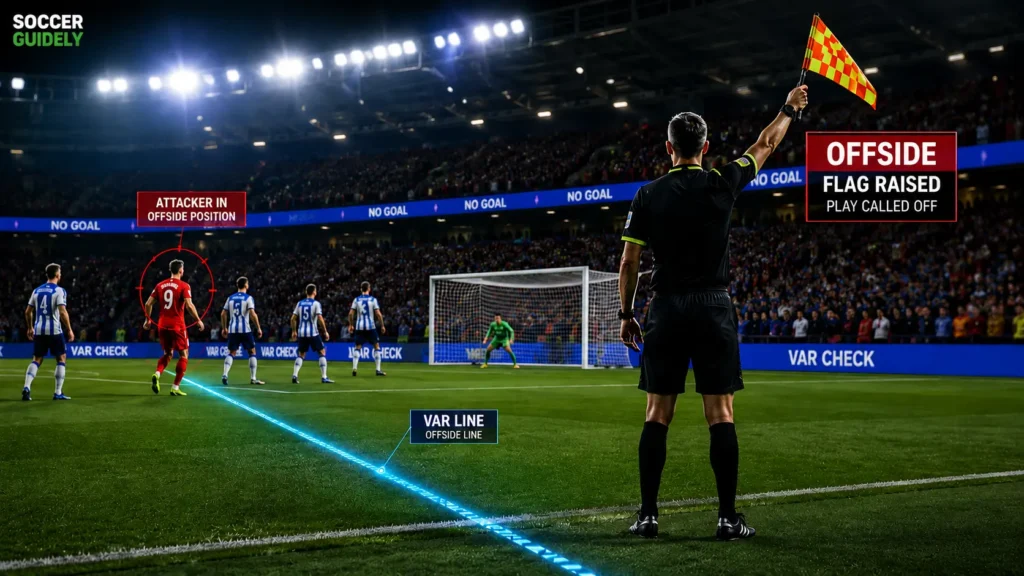
A player is offside when they’re in the opponent’s half and closer to the goal than both the ball and the second-to-last defender at the exact moment their teammate plays the ball. That’s it. But being in that position doesn’t automatically get you flagged. You also have to get involved in the play. Touch the ball, challenge for it, block a defender’s view that’s when the whistle comes.
Under Law 11 of the FIFA Laws of the Game written and maintained by IFAB, the International Football Association Board this is the core distinction that runs everything. Position alone isn’t the crime. It’s position plus involvement that gets you called.Why “Offside Position” and “Offside Offense” Are Not the Same Thing
Think of it like a false start in the NFL. Being near the line of scrimmage in the wrong spot isn’t a penalty by itself. Moving and causing a reaction that’s the flag. Same deal in soccer. You can stand offside all day. The moment you touch the ball while you’re in that position, you’re done.
What most American fans don’t realize is that these two things position and offense are completely separate triggers, and both have to happen at the same time. Tons of plays continue with a player technically standing in an offside position because they simply never got involved. No flag, no foul, game goes on. The rule has real, official, written exceptions too situations where it’s just completely suspended and knowing those exceptions is honestly more useful at a watch party than understanding the base rule. Because the base rule is simple. The exceptions are what cause all the arguments.
What Are the Offside Exceptions in Soccer? (All 5, Ranked by Confusion)
Before we dig in, here’s the full list. Every single one of these is official under Law 11.
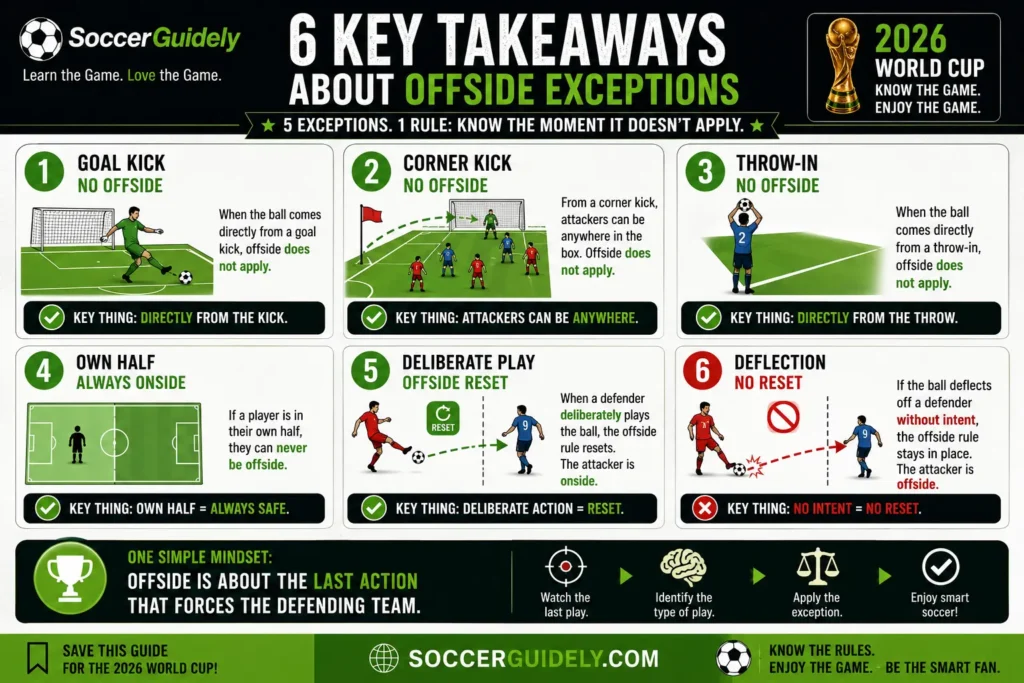
The 5 Official Offside Exceptions:
- Goal kicks offside suspended completely
- Corner kicks offside suspended completely
- Throw-ins offside suspended completely
- Player in their own half always onside, period
- Defender deliberately plays the ball offside phase reset
Most soccer explainers stop at three. The last two are where the real arguments happen especially number five, which is responsible for more VAR reviews, post-match meltdowns, and trending arguments than any other rule in the sport. All five deserve a real breakdown.
Exception 1: Goal Kicks Why the Ref Never Flags This One
When a goalkeeper takes a goal kick restarting play after the attacking team put the ball out over the end line offside is completely off. Gone. A striker can stand anywhere. Two feet from the opposing goalkeeper. Deeper in the opponent’s half than every single defender on the pitch. Doesn’t matter. The moment that kick is taken, no offside call can be made.
None.
What Changed in 2019 That Made This Exception Bigger
Here’s something most people don’t know this exception used to be smaller. Before 2019, a player in the opponent’s half could still be called offside during a goal kick sequence. FIFA expanded the rule specifically to open up the game, to let goalkeepers and defenders build out from the back without a flag killing the whole thing before it started. It worked. You see far more controlled build-up play now than you did ten years ago, and this rule change is a big reason why.
The “Direct Only” Rule That Trips Everyone Up
There’s a catch though. The exception only covers the direct reception of the goal kick. If the goalkeeper plays it to a midfielder, and that midfielder plays it forward to a striker in an offside position flagged. The exception is a one-play grace period. The second a teammate gets a touch, normal offside is back in effect. Miss that detail and you’ll be arguing with the TV when the call is actually right.
Exception 2: Corner Kicks The Reason Big Defenders Rush Into the Box
Same deal. When a team earns a corner and delivers it from the flag, offside is completely suspended. Any attacker can stand anywhere. Right on the goal line. In the six-yard box. Shoulder to shoulder with the goalkeeper. Completely legal.
This is why you’ll see something that looks genuinely weird to first-time viewers: a massive central defender a 6’4″ guy whose whole job is to stop goals sprinting forty yards up the field to crowd into the box when his team wins a late corner. He’s not confused about what position he plays. He knows offside doesn’t apply, and he’s turning himself into a goal threat because the rules let him.
Why Attacking Teams Load the Box on Every Corner
The entire world of corner kick tactics exists because of this exception. The target runners, the blockers, the near-post flick-ons, the late arrivals at the far post all of it is built on the fact that nobody is restricted by their position. Teams spend real training time on this. Without the exception, that whole tactical layer disappears.
Here’s something coaches know that most fans watching from the couch never pick up on the corner kick exception isn’t just a rule that allows free positioning. It’s a tactical weapon that elite teams deliberately engineer entire set-piece systems around, and it shows up at every major tournament including World Cup 2026.
When offside is suspended on a corner, the attacking team doesn’t just randomly flood the box. They run choreographed routes specific players assigned to specific zones, timed to arrive at exactly the moment the ball does. What the exception does is remove the spatial restriction entirely, meaning attackers can start their run from any point on the field and build full momentum before the ball arrives. The tactical term for this is a “late runner” set piece design a player positioned outside the box waits until the corner is struck, then accelerates in at full speed just as the ball arrives, arriving with a full head of steam while defenders are already tracking multiple runners. Think of it like an NFL wide receiver running a deep route before the snap is even called the timing and positioning are designed in advance, not improvised.
According to a 2023 analysis by Stats Bomb one of soccer’s leading data analytics firms set pieces account for approximately 30% of all goals scored in top European leagues, with corner kicks representing the single largest category within that group. That number is not an accident. It’s the direct result of teams investing serious coaching resources into exploiting the corner kick exception specifically.
The One Touch That Brings Offside Back Into Play
Same rule as goal kicks direct delivery only. If the corner goes to a teammate who then plays it into the box, the second pass is fully live under normal offside rules. One touch from a teammate and the flag is back in play. That’s the detail that catches people. Watch for it.
Exception 3: Throw-Ins The Exception That Surprises Even Longtime Fans
This one genuinely surprises people. Even fans who’ve been watching for years. When a player throws the ball in from the sideline, offside doesn’t apply. At all. You can be standing in an offside position anywhere on the field, receive a throw-in directly, and cannot be flagged.
Here’s what that looks like in a real match. Picture a winger standing two yards ahead of the last defender near the halfway line. Their teammate grabs the ball on the sideline and throws it in. The winger collects it in what would normally be a blatant offside position and the flag stays down. Completely legal. They turn, drive at goal, and the defense has to scramble back. That’s the exception doing exactly what it’s designed to do.
The reason for this comes down to game flow. Pure and simple. Applying offside to throw-ins would mean players sprinting back toward their own goal every time the ball went out of bounds just to hold a legal position before the throw is taken. The game would stop constantly. So the rule just cuts throw-ins out entirely. Think of it like a basketball inbounds reset the play pauses, everyone repositions, no penalty for where you’re standing when the clock stops.
Why Soccer Suspends Offside on Sideline Restarts
What most American fans don’t realize is that throw-ins are genuinely low-threat situations from a scoring standpoint. The throwing motion limits distance and direction. A player receiving a throw is rarely in an immediate position to score they still have to control the ball, turn, and beat defenders from a standing start. The original framers of the rule recognized this. The risk of someone gaming the offside rule from a throw-in is low enough that the exception has always made sense. It’s not an accident. It’s intentional design.
And here’s the part most fans never notice the throw-in exception isn’t just passive. Smart teams exploit it actively. When a team wins a throw-in in the attacking third, a well-coached winger will immediately sprint into a position that would be offside during open play. They’re not confused. They’re doing it on purpose. The throw-in gives them a free pass to start from a more advanced position than the defensive line would normally allow. The specific version you’ll see at World Cup 2026 is called a “quick throw” combination the thrower spots the runner moving past the defensive line, throws it fast before the defense reorganizes, and suddenly there’s a foot race. It’s soccer’s version of pushing pace off a defensive rebound before the other team gets set. The best teams in the world run this deliberately. Most fans think it just happened naturally.
When the Exception Ends and the Rule Kicks Back In
Same principle as always direct reception only. The throw goes to Player A, Player A immediately plays it to Player B who’s in an offside position — Player B is flagged. The exception only protects the first touch. After that, it’s live. Check out our offside timing guide if you want the full breakdown of exactly when that clock starts ticking.
Exception 4: Your Own Half Can You Ever Be Offside Behind Midfield?
No. You cannot. Ever.
This one is geometrically simple but causes endless watch party arguments because it’s basically invisible on TV. Here’s the rule: if any part of your body that can legally score head, torso, feet is behind the halfway line, in your own half, you are always onside. Doesn’t matter where the defenders are. Doesn’t matter what the score is or what minute of the game it is. Behind the line? Can’t be offside. Done.
The Geometry That Makes This One Simple
The whole point of offside is to stop forwards from camping near the opponent’s goal, waiting for a long ball. Cherry-picking, basically. Like a basketball player who just parks themselves under the opposing team’s basket the whole game, doing nothing, waiting for an outlet pass. That’s what offside prevents. But if you’re fifty yards away on your own side of the field? You’re not gaining any unfair advantage. There’s nothing to protect against. So the rule doesn’t apply there. Simple as that.
How Fast-Break Goals Exploit This Rule Legally
Here’s where it gets genuinely exciting and where American sports fans will immediately recognize the pattern.
A midfielder can receive a ball completely alone in their own half not a single defender between them and the goal and they are 100% legal. No offside. No flag. Full speed ahead. This is how some of the fastest, most devastating counter-attack goals in soccer history happen. A team pushes everyone forward chasing a goal, loses the ball, and suddenly the opponent has open field in front of them with nobody back. It’s almost exactly like a prevent defense in the NFL getting caught too far upfield on a fourth-quarter drive the other team exploits the space you left behind, and there’s nothing illegal about it. You just got burned by your own tactics.
Teams that specialize in counter-attacking soccer are specifically built around this exception. They defend deep, stay compact, and the moment they win the ball, they hit the gas knowing their forwards in their own half are completely free from the offside rule. No flag can stop a counter if it starts behind the halfway line. Our offside position guide maps out exactly how these runs develop across different zones of the field.
Exception 5: Deliberate Play The Most Controversial Exception in Soccer
Okay. This is the one.
This is the exception that generates the longest VAR reviews, the most furious sideline reactions, and the most heated post-match press conferences. If you understand this exception, you understand the most debated aspect of the modern game.
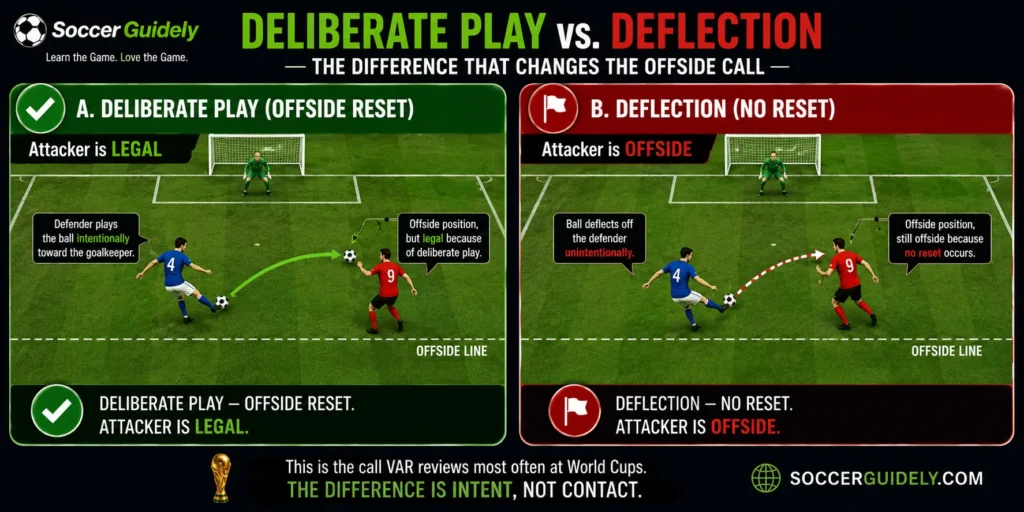
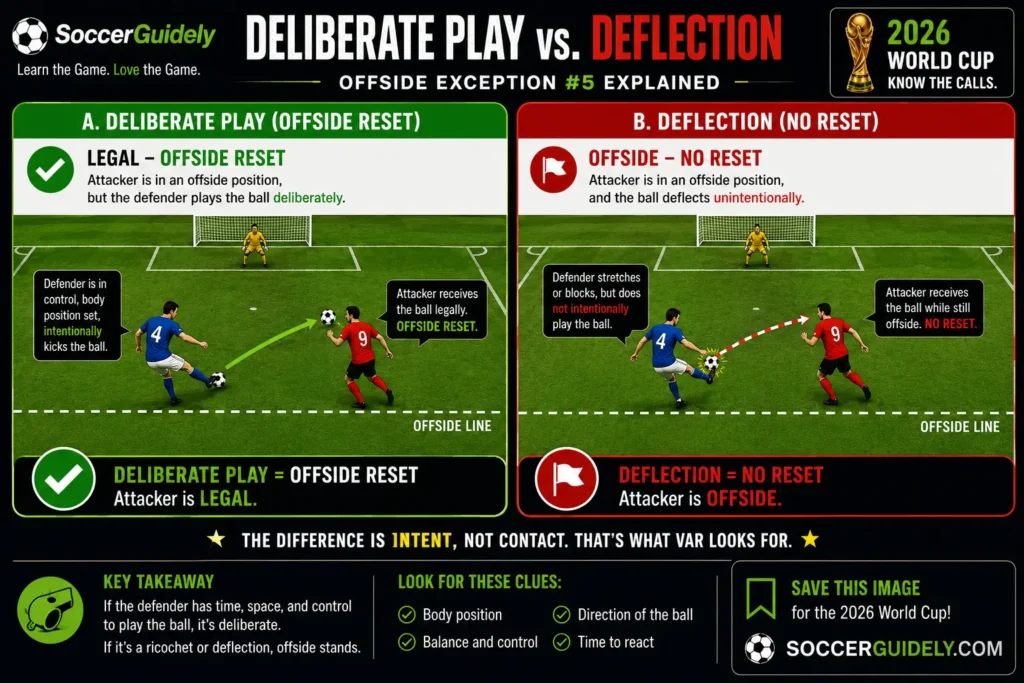
Under Law 11: if a defender deliberately plays the ball intentionally passes it, clears it, or attempts to control it and it reaches an attacker who was in an offside position, that attacker is not offside. The defender’s deliberate touch resets everything. The attacker didn’t gain an unfair advantage because the defender made a conscious decision that changed the play.
Simple concept. Nightmare to judge in real time.
What “Deliberate Play” Actually Means Under Law 11
“Deliberately” is doing a lot of work in that rule. IFAB is specific about what counts. According to the official FIFA/IFAB Laws of the Game, a player has “deliberately played” the ball when the ball came from distance and they had a clear view of it, they had time to coordinate their body movement, and they directed it intentionally rather than reacting instinctively. Those are indicators, not a strict checklist — but officials are looking for genuine control and intent. Not just contact. Control.
Deliberate Play vs. Deflection: Where the Line Gets Blurry
Here’s where even experienced referees struggle. There’s a real difference between a deliberate play and a deflection and that difference is the entire ballgame.
A deflection is when a ball clips off a defender without real intent or control. Their leg was in the way. The ball hit them. That does not reset offside. An attacker collecting a deflected ball while in an offside position is still flagged even if the contact was totally accidental.
A deliberate play is a real choice. A clearance attempt. A pass to the keeper. A genuine decision to play the ball, even a bad one. Under Law 11, an unsuccessful deliberate play still counts as a deliberate play so even if the defender completely mishits their clearance and it rolls straight to an offside forward, the offside is wiped if the attempt was genuine. Didn’t work out. Didn’t matter. Deliberate is deliberate.
The Griezmann Goal at the 2022 World Cup A Real-World Example
No example illustrates this better than Antoine Griezmann’s disallowed goal for France against Tunisia at the 2022 World Cup. Stoppage time. France trailing. Griezmann latches onto a ball in the box and buries it but he was in an offside position when it arrived. The question for VAR: did Tunisian defender Montassar Talbi deliberately head the ball, which would have reset the offside phase and made the goal legal?
VAR ruled that Talbi’s header wasn’t a deliberate play. He was stretching. Reacting. Not in control of the situation. Goal disallowed. France were absolutely furious. Half of soccer Twitter argued about it for days. And honestly reasonable people can disagree on that call. That’s the point. The line between “deliberate control” and “reactive stretch” is genuinely blurry, even on five angles of slow-motion replay. You will see this exact situation at World Cup 2026. Guaranteed.
For the full breakdown of how VAR handles these reviews, our VAR offside decisions guide walks through the entire process. And for the active vs. passive distinction that often runs alongside these calls, our active vs. passive offside guide clears that up too.
What About the Deliberate Save? Here’s the Wrinkle Nobody Talks About
One more layer. Almost nobody explains this one.
A deliberate save when a goalkeeper or defender stops a ball heading into or very close to the goal does not count as a deliberate play for offside purposes. Even if the keeper fully committed with both hands. An attacker in an offside position who collects that rebound is still flagged.
Why? Because if saves reset offside, defenders would just dive out of the way of shots deliberately to trap rebounding attackers in offside positions. The rule closes that loophole specifically. Deliberate play wipes offside. Deliberate saves do not. Small distinction. Comes up two or three times per World Cup. When it does, it’s almost always massive.
Can an Attacker Step Off the Field to Dodge Offside?
Here’s one more edge case worth knowing the kind that comes up maybe once every two World Cups but causes absolute chaos when it does.
If an attacking player deliberately steps off the field of play walks behind the end line or the sideline and then re-enters to receive a ball, they are treated as if they were standing on that boundary line for offside purposes. Under IFAB’s official guidance on Law 11, you cannot use “I was technically off the pitch” as a loophole to beat the offside flag. The rule accounts for it directly.
Think of it like a wide receiver deliberately stepping out of bounds before a play and then trying to come back in as an eligible receiver. The NFL has rules for that exact situation. Soccer does too. You can’t opt out of the field to dodge an offside flag.
Offside Exception Comparison: What’s Suspended and What Isn’t
| Situation | Offside Applies? | Direct Reception Only? | Notes |
|---|---|---|---|
| Goal Kick | ❌ No | ✅ Yes | Rule expanded in 2019 |
| Corner Kick | ❌ No | ✅ Yes | Full tactical freedom for attackers |
| Throw-In | ❌ No | ✅ Yes | Game flow low scoring threat |
| Own Half | ❌ No | Not Required – applies to full half | Entire half, not just near midfield |
| Deliberate Play | ❌ No | Not Required – resets the offside phase entirely | Intent and control required |
| Deflection | ✅ Yes | Not Required – offside stands regardless | No intent = no reset |
| Deliberate Save | ✅ Yes | Not Required – offside stands regardless | Explicitly excluded from exception |
| Free Kick | ✅ Yes | No – full offside rules apply from the kick | The one set piece where rule fully applies |
| Extra Time | ✅ Yes | No – all open play rules apply throughout | Full rules apply throughout |
| Penalty Shootout | No – open play rules do not apply | No – spot kicks only, no open play involved | Open play rules don’t apply |
What Offside Exceptions Do Americans Get Wrong Most Often?
American sports fans are sharp. But soccer has quirks that don’t translate cleanly from football, basketball, or hockey and a few myths about offside exceptions have spread wide enough that you’ll hear them said confidently at watch parties across the country. In Dallas living rooms. In New York sports bars, and LA watching groups that showed up for the vibes and stayed for the actual game.
Let’s end them here.
Myth: “You Can’t Be Offside on a Free Kick” – Actually, You Can
Probably the single most common misconception. Free kicks are actually the one major set piece where offside fully, completely applies. Goal kicks? Exempt. Corner kicks? Exempt. Throw-ins? Exempt. Free kicks? Nope fully enforced.
It feels like a restart, similar to the other set pieces. But a free kick gives the attacking team a dead ball from a favorable position, often close to goal. Letting attackers sprint into offside spots while the kick is being set up would be a nightmare. So the rule stays on. Always.
Myth: “Offside Doesn’t Apply in Extra Time” – Wrong
This one pops up every single knockout round, without fail. Extra time plays by exactly the same rules as regular time. Offside is enforced for every minute of both extra time periods. The only moment offside stops mattering is during a penalty shootout and that’s because you’re not playing open soccer anymore. But if the ball is in open play? Offside is active. That’s it.
Myth: “Two Touches Resets Offside” – This Rule Doesn’t Exist
There is no two-touch rule in the Laws of the Game. Someone invented this at a watch party and it’s been bouncing around ever since. The question is always about intent and control, not touch count. A defender can touch the ball ten times in a scramble and still not have made a “deliberate play” if they were just reacting blindly. Touch count is irrelevant. Always has been.
Myth: “The Goalkeeper Always Sets the Offside Line” – Not Exactly
Partially right, which is exactly what makes this one sticky. The offside line is drawn from the second-to-last defender not the goalkeeper specifically. Most of the time the keeper is the deepest player, so the line ends up near a field player and it all feels the same. But if the goalkeeper charges out past a defender sprinting off the line to close down a through ball the line is now drawn from whichever field player is second-deepest. Positional, not role-based. Always. The offside trap guide explains how defenders use this to their advantage if you want to see it in action.
How Will These Exceptions Play Out at World Cup 2026?
The 2026 World Cup is already running across the United States, Canada, and Mexico 48 teams, 104 matches, the biggest tournament in history. Matches are being played in American cities that know their sports crowds: Los Angeles, Dallas, New York. These fans are loud, opinionated, and are going to have a lot to say every time a flag goes up. More matches means more set pieces, more corner kicks and goal kicks where offside is suspended, and more of those grinding deliberate play vs. deflection calls that send everyone scrambling for their phones.
And these same rules apply whether you’re watching the men’s tournament or following the USWNT same Law 11, same five exceptions, same VAR process. All of it.
How the New Semi-Automated Offside Technology Changes Everything
FIFA has significantly upgraded its semi-automated offside technology for 2026. According to FIFA’s official 2026 World Cup technical specifications released ahead of the tournament, the system runs 12 dedicated tracking cameras per stadium, capturing every player’s body position at 50 frames per second and mapping 29 specific data points per player joints, limbs, extremities building a real-time 3D model of the entire pitch. The key upgrade: the system now sends instant audio alerts to match officials when a player is clearly offside by more than 10 centimeters, cutting out most of the long delays that drove fans crazy in Qatar.
According to FIFA’s official 2022 World Cup VAR report, technology reviewed and ruled out 8 goals for offside while also correctly overturning 2 incorrect offside flags 10 goals directly affected by offside technology across 64 matches. Scale that to 104 matches at 2026 and you’re looking at potentially 15 or more goal-level offside decisions across the full tournament. The freeze-frame is going to be a regular part of your viewing experience.
Why the Deliberate Play Exception Will Still Be a Human Call
Here’s the thing though all that technology cannot fix exception 5. Twelve cameras and 29 body-point maps tell you exactly where everyone is positioned down to the centimeter. They cannot tell you whether a defender meant to play the ball. That judgment is still entirely human.
And here’s what most fans haven’t processed yet: 2026 is creating a two-speed VAR review system. The fast calls routine position-based offside checks get resolved in seconds thanks to SAOT. Audio alert to the official, freeze frame confirmed, game continues or doesn’t. But the deliberate play calls? Those still take three or four minutes of human review. A four-minute deliberate play review in 2026 surrounded by ten-second offside checks on either side of it is going to feel like an eternity to a crowd in Dallas or Los Angeles that grew up on instant replay in football and basketball.
What’s even more interesting: because coaches know that deliberate play still requires human judgment, some defensive coaches at the highest level are now training their defenders to be more decisive in their clearance attempts not necessarily more accurate, but more deliberate in their body movement specifically so that if an offside forward collects a ball after their clearance, the official has clear evidence of intent. A committed, full-bodied clearance attempt reads as deliberate even if it goes straight to an opponent. A half-hearted, reactive poke reads as a deflection. Defenders are literally being coached on how their own movement affects the referee’s interpretation of this exception. That’s how deep this rabbit hole goes.
Our VAR offside decisions guide walks through exactly how that review process works if you want the full picture.
The Watch Party Cheat Sheet: How to Read Any Offside Situation Live
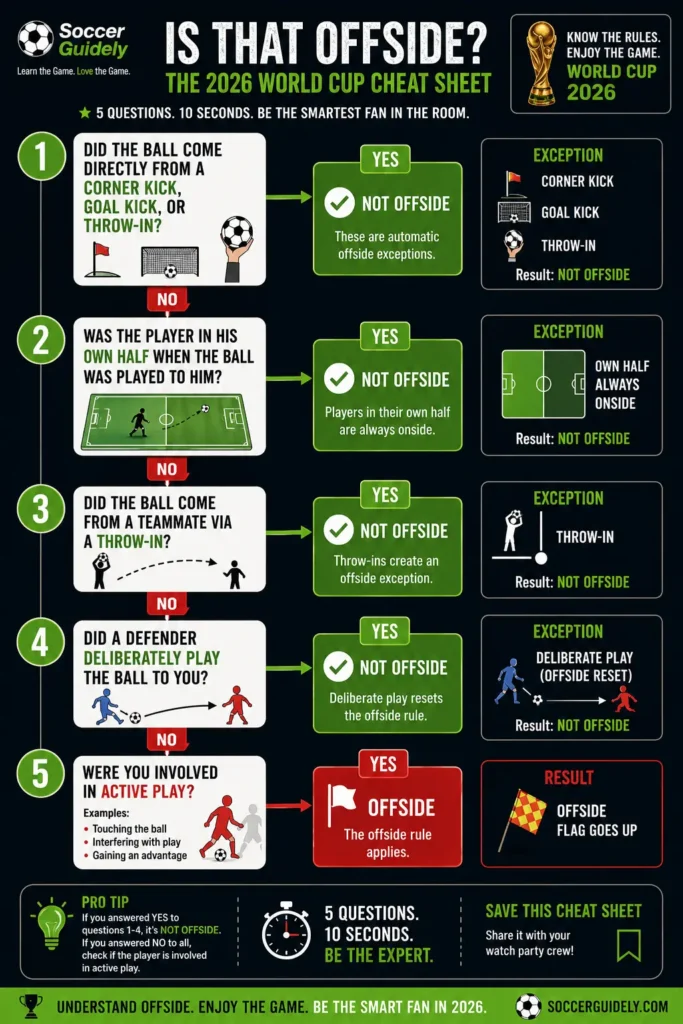
Back to SoFi. The goal goes in. Flag is up or the VAR light is on and everyone’s waiting. Here’s the mental checklist. Run it fast.
Did the ball come directly from a corner, goal kick, or throw-in? No offside possible if the flag went up, something else happened or there was a touch you missed. Was the attacker in their own half? Completely onside, full stop. Did a defender make a clear, genuine attempt to play the ball? Offside wiped unless it was a save. Did the ball clip off a defender without real control? Offside stands and VAR is about to confirm it over the next three minutes while everyone stares at the big screen.
That’s the whole game. Five exceptions, one checklist. Next time someone at your watch party confidently announces “offside!” you’ll actually know whether they’re right.
Frequently Asked Questions About Soccer’s Offside Exceptions
Q:1 Is There Offside on a Corner Kick?
A: No. Offside does not apply when a player receives the ball directly from a corner kick. A player can stand anywhere on the field including right next to the goalkeeper on the goal line and cannot be flagged offside. The exception ends the moment a teammate touches the ball before it reaches them.
Q:2 Can You Be Offside From a Throw-In in Soccer?
A: No. A player cannot be called offside if they receive the ball directly from a throw-in, regardless of where they are standing on the field. This is one of three set-piece exceptions alongside goal kicks and corner kicks where offside is completely suspended. Normal offside rules return after the first touch following the throw.
Q:3 What Happens If a Defender Deflects the Ball to an Offside Player?
A: It depends whether it was a deliberate play or a deflection. If the defender genuinely attempted to play the ball a clearance or pass offside is wiped even if the execution was poor. If the ball simply bounced off the defender without real control or intent, it is a deflection and offside stands. This is the most reviewed and most debated distinction in professional soccer.
Q:4 Can You Be Offside in Your Own Half of the Field?
A: No. A player whose legal scoring body parts head, torso, feet are behind the halfway line cannot be in an offside position. This applies regardless of where defenders are positioned or how far up the field the team has pushed. The offside rule only applies in the opponent’s half of the pitch.
Q:5 Does the Offside Rule Apply in Extra Time?
Yes. Offside applies for every minute of a soccer match regular time, stoppage time, and both periods of extra time. The rule is only irrelevant during a penalty shootout, where open-play rules are replaced by spot kicks. Any time the ball is in open play, offside is fully enforced.a
More on the Offside Rule
The offside rule has a lot of moving parts these are the pieces that connect directly to what you just read:
- What Is Offside in Soccer The Complete Rule Guide
- Offside Position in Soccer How the Line Actually Works
- How VAR Reviews Offside at the World Cup
- Active vs. Passive Offside Explained
- The Offside Trap How Defenders Use the Rule Tactically
- IFAB Law 11 The Full Official Text, Simplified
New to soccer and watching the 2026 World Cup? SoccerGuidely’s weekly newsletter breaks down the rules, the moments, and the storylines worth following written for American fans. Subscribe free here.
About This Article
This article was researched and written by the SoccerGuidely Editorial Team and reviewed for accuracy against IFAB’s Laws of the Game (Law 11, June 2026 edition) and FIFA’s official 2026 World Cup technical documentation. All offside rule references, VAR statistics, and set-piece data were fact-checked against primary sources before publication. Rule interpretations reflect official IFAB guidance current as of June 2026 and may be subject to future amendment by the International Football Association Board.
Sources: IFAB Laws of the Game Law 11 (June 2026) · FIFA 2026 World Cup Technical Specifications · FIFA 2022 World Cup VAR Report · StatsBomb Set Piece Analysis, 2023. All rule references reflect IFAB guidelines current as of June 2026 and are subject to amendment. For official rule language, visit theifab.com.
Reviewed by the SoccerGuidely Editorial Team.